

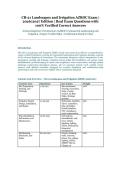
CR-21 Landscapes and Irrigation AZROC Exam |
2026/2027 Edition | Real Exam Questions with
100% Verified Correct Answers
Arizona Registrar of Contractors (AZROC) Commercial Landscaping and
Irrigation | Expert-Verified Q&A | Certification-Ready Format
Introduction
This CR-21 Landscapes and Irrigation AZROC actual exam 2026/2027 delivers a comprehensive,
expert-verified Evaluation covering all commercial landscaping and irrigation domains required
by the Arizona Registrar of Contractors. The assessment integrates critical competencies in site
preparation, grading and drainage, irrigation system design and installation, soil science, plant
establishment, and hardscaping to ensure code compliance, water conservation, and high-quality
landscape construction throughout Arizona. All 100 questions include 100% verified correct
answers with detailed rationales, designed for accurate Evaluation and certification-ready
performance under the 2026/2027 AZROC CR-21 examination blueprint.
Content Area Overview – CR-21 Landscapes and Irrigation AZROC 2026/2027
Content Area Questions Key Topics Weight
Site Preparation, 1-20 (20) Site assessment, 20%
Grading, and clearing, excavation,
Drainage slope, erosion
control, AZ Blue
Stake, drainage
systems
Irrigation System 21-55 (35) Hydraulics, backflow, 35%
Design, Installation, valves, controllers,
and Repair drip, sprinklers,
lateral/mainline,
UPC compliance,
water conservation
Plant Installation, 56-80 (25) Soil analysis, 25%
Soil Science, and amendments, turf,
Maintenance trees, shrubs,
planting, staking,
AZDA, fertilization,
integrated
management
Hardscaping, 81-100 (20) Pavers, retaining 20%
Structures, and walls, concrete,
Safety fences, low-voltage
lighting, OSHA,
AZROC Title 32
Chapter 10
,Examination Questions – 100 Verified Questions | CR-21 2026/2027
Domain: Site Preparation, Grading, and Drainage
20% – Questions 1-20
1. What is the first step in planning a CR-21 commercial hardscape and irrigation
project in Arizona?
A. Purchase materials immediately
B. Conduct a site assessment evaluating soil, slope, utilities, and drainage
C. Install the irrigation controller
D. Lay pavers to establish grade
Correct Answer: B
Rationale: A complete site assessment identifies soil conditions, slope, existing utilities, and
drainage patterns required by AZROC industry standards before design.
2. Under Arizona Blue Stake law, how many working days before excavation must a
CR-21 contractor call 811?
A. Same day
B. At least 2 full working days, excluding weekends and holidays
C. 7 calendar days
D. 30 days
Correct Answer: B
Rationale: Arizona 811 requires locate requests a minimum of two full working days prior to
excavation, excluding the day of call, weekends, and state holidays.
3. What color utility marking does Arizona Blue Stake use for electric power
distribution?
A. Safety Yellow
B. Safety Red
C. Safety Alert Orange
D. Safety Precaution Blue
Correct Answer: B
Rationale: APWA uniform color code: Red marks electric power lines, conduits, and lighting
cables.
4. What color marks telecommunications, cable TV, and fiber optics in Arizona?
A. Orange
B. Yellow
C. Green
D. Purple
Correct Answer: A
Rationale: Safety Alert Orange designates communication, alarm, signal lines, cables, and
conduit.
5. What is the minimum recommended slope to direct surface water away from
commercial building foundations in Arizona landscape grading?
A. 0%
B. 2% minimum for at least 10 feet
, C. 10%
D. 0.25%
Correct Answer: B
Rationale: Industry standards specify a minimum 2% slope (1/4 inch per foot) extending 10
feet from foundations to prevent water intrusion.
6. Which soil condition is most common in central Arizona and requires special
excavation methodology?
A. Loam
B. Caliche hardpan
C. Peat
D. Silt loam
Correct Answer: B
Rationale: Caliche, a cemented calcium carbonate layer, is prevalent in Arizona desert soils
and requires ripping or pneumatic excavation.
7. What is the ideal slope range for lateral drainage swales to prevent erosion while
ensuring flow?
A. 0% - 1%
B. 1% - 2%
C. 5% - 10%
D. 8% - 12%
Correct Answer: B
Rationale: A 1% to 2% slope provides positive drainage without erosive velocity, consistent
with AZROC drainage regulatory standards.
8. When a CR-21 contractor arrives on site and finds the substrate defective, what is
required?
A. Continue as scheduled
B. Walk off the job
C. Inspect, document, and notify the owner in writing before proceeding
D. Pour concrete to stabilize
Correct Answer: C
Rationale: AZROC workmanship standards require written notification of defective substrate
conditions prior to installation to preserve warranty and liability rights.
9. What is the maximum allowable slope for planting ground cover and shrubs
without specialized erosion control, per Arizona landscape standards?
A. 30%
B. 40%
C. 50%
D. 70%
Correct Answer: C
Rationale: Slopes up to 2:1 (50%) are generally the maximum for standard shrub and ground
cover installation without terracing or engineered stabilization.
10. Which tool provides the most accurate measurement for commercial site
grading and slope verification?
2026/2027 Edition | Real Exam Questions with
100% Verified Correct Answers
Arizona Registrar of Contractors (AZROC) Commercial Landscaping and
Irrigation | Expert-Verified Q&A | Certification-Ready Format
Introduction
This CR-21 Landscapes and Irrigation AZROC actual exam 2026/2027 delivers a comprehensive,
expert-verified Evaluation covering all commercial landscaping and irrigation domains required
by the Arizona Registrar of Contractors. The assessment integrates critical competencies in site
preparation, grading and drainage, irrigation system design and installation, soil science, plant
establishment, and hardscaping to ensure code compliance, water conservation, and high-quality
landscape construction throughout Arizona. All 100 questions include 100% verified correct
answers with detailed rationales, designed for accurate Evaluation and certification-ready
performance under the 2026/2027 AZROC CR-21 examination blueprint.
Content Area Overview – CR-21 Landscapes and Irrigation AZROC 2026/2027
Content Area Questions Key Topics Weight
Site Preparation, 1-20 (20) Site assessment, 20%
Grading, and clearing, excavation,
Drainage slope, erosion
control, AZ Blue
Stake, drainage
systems
Irrigation System 21-55 (35) Hydraulics, backflow, 35%
Design, Installation, valves, controllers,
and Repair drip, sprinklers,
lateral/mainline,
UPC compliance,
water conservation
Plant Installation, 56-80 (25) Soil analysis, 25%
Soil Science, and amendments, turf,
Maintenance trees, shrubs,
planting, staking,
AZDA, fertilization,
integrated
management
Hardscaping, 81-100 (20) Pavers, retaining 20%
Structures, and walls, concrete,
Safety fences, low-voltage
lighting, OSHA,
AZROC Title 32
Chapter 10
,Examination Questions – 100 Verified Questions | CR-21 2026/2027
Domain: Site Preparation, Grading, and Drainage
20% – Questions 1-20
1. What is the first step in planning a CR-21 commercial hardscape and irrigation
project in Arizona?
A. Purchase materials immediately
B. Conduct a site assessment evaluating soil, slope, utilities, and drainage
C. Install the irrigation controller
D. Lay pavers to establish grade
Correct Answer: B
Rationale: A complete site assessment identifies soil conditions, slope, existing utilities, and
drainage patterns required by AZROC industry standards before design.
2. Under Arizona Blue Stake law, how many working days before excavation must a
CR-21 contractor call 811?
A. Same day
B. At least 2 full working days, excluding weekends and holidays
C. 7 calendar days
D. 30 days
Correct Answer: B
Rationale: Arizona 811 requires locate requests a minimum of two full working days prior to
excavation, excluding the day of call, weekends, and state holidays.
3. What color utility marking does Arizona Blue Stake use for electric power
distribution?
A. Safety Yellow
B. Safety Red
C. Safety Alert Orange
D. Safety Precaution Blue
Correct Answer: B
Rationale: APWA uniform color code: Red marks electric power lines, conduits, and lighting
cables.
4. What color marks telecommunications, cable TV, and fiber optics in Arizona?
A. Orange
B. Yellow
C. Green
D. Purple
Correct Answer: A
Rationale: Safety Alert Orange designates communication, alarm, signal lines, cables, and
conduit.
5. What is the minimum recommended slope to direct surface water away from
commercial building foundations in Arizona landscape grading?
A. 0%
B. 2% minimum for at least 10 feet
, C. 10%
D. 0.25%
Correct Answer: B
Rationale: Industry standards specify a minimum 2% slope (1/4 inch per foot) extending 10
feet from foundations to prevent water intrusion.
6. Which soil condition is most common in central Arizona and requires special
excavation methodology?
A. Loam
B. Caliche hardpan
C. Peat
D. Silt loam
Correct Answer: B
Rationale: Caliche, a cemented calcium carbonate layer, is prevalent in Arizona desert soils
and requires ripping or pneumatic excavation.
7. What is the ideal slope range for lateral drainage swales to prevent erosion while
ensuring flow?
A. 0% - 1%
B. 1% - 2%
C. 5% - 10%
D. 8% - 12%
Correct Answer: B
Rationale: A 1% to 2% slope provides positive drainage without erosive velocity, consistent
with AZROC drainage regulatory standards.
8. When a CR-21 contractor arrives on site and finds the substrate defective, what is
required?
A. Continue as scheduled
B. Walk off the job
C. Inspect, document, and notify the owner in writing before proceeding
D. Pour concrete to stabilize
Correct Answer: C
Rationale: AZROC workmanship standards require written notification of defective substrate
conditions prior to installation to preserve warranty and liability rights.
9. What is the maximum allowable slope for planting ground cover and shrubs
without specialized erosion control, per Arizona landscape standards?
A. 30%
B. 40%
C. 50%
D. 70%
Correct Answer: C
Rationale: Slopes up to 2:1 (50%) are generally the maximum for standard shrub and ground
cover installation without terracing or engineered stabilization.
10. Which tool provides the most accurate measurement for commercial site
grading and slope verification?


