

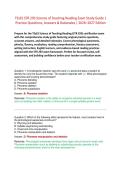
TExES STR 293 Science of Teaching Reading Exam Study Guide |
Practice Questions, Answers & Rationales | 2026–2027 Edition
Prepare for the TExES Science of Teaching Reading (STR 293) certification exam
with this comprehensive study guide featuring original practice questions,
accurate answers, and detailed rationales. Covers phonological awareness,
phonics, fluency, vocabulary, reading comprehension, literacy assessment,
writing instruction, English learners, and evidence-based reading practices
aligned with the STR 293 exam framework. Perfect for focused review, self-
assessment, and building confidence before your teacher certification exam.
Question 1: A kindergarten teacher says the word pig aloud and asks a student to
identify the very first sound they hear. The student responds with /p/. What phonological
awareness skill is being demonstrated?
A. Phoneme blending
B. Phoneme isolation
C. Phoneme deletion
D. Phoneme substitution
Answer: B. Phoneme isolation
Rationale: Phoneme isolation is the ability to recognize individual sounds in a word,
such as isolating the initial, medial, or final sound in a single-syllable spoken word.
Question 2: Which of the following skills represents the highest, most complex level of
the phonological awareness continuum?
A. Rhyming and alliteration
B. Syllable segmenting and blending
C. Onset and rime manipulation
D. Phoneme manipulation and deletion
Answer: D. Phoneme manipulation and deletion
Rationale: Phonological awareness develops from large units of sound to small units.
Phoneme manipulation (such as deleting or substituting sounds) operates at the
individual phoneme level, which is the most advanced tier.
,Question 3: A first-grade teacher presents a student with a card containing the letters s-
t-o-p and asks the student to read it. The student says, "/s/ /t/ /o/ /p/, stop!" This task
evaluates which specific literacy skill?
A. Phonemic awareness
B. Phonics decoding
C. Sight word memorization
D. Structural analysis
Answer: B. Phonics decoding
Rationale: Phonics involves the direct relationship between letters (graphemes) and
sounds (phonemes). Because the student is looking at written letters to sound out a
word, it is a phonics decoding task, not a purely auditory phonemic awareness task.
Question 4: A teacher displays a small mirror during a small-group reading intervention
and asks students to observe their lips and teeth when making the sounds /f/ and /v/.
This instruction directly targets:
A. Orthographic mapping
B. Articulatory features of phonemes
C. Print awareness concepts
D. Morphemic analysis boundaries
Rationale: Focusing on the physical positioning of the lips, teeth, and tongue targets the
articulatory features of phonemes, helping students physically distinguish between
voiced and unvoiced consonant pairings.
Question 5: A student reads the word cloud as clod and the word train as tran during
oral reading. These errors indicate a clear instructional need in which area of phonics?
A. Consonant blends
B. Closed syllables
C. Vowel digraphs and teams
D. Inflectional endings
Answer: C. Vowel digraphs and teams
Rationale: The student is misreading vowel teams ("ou" and "ai") by omitting the
secondary vowel sound and treating them as short vowels. This shows a need for
explicit instruction in reading vowel teams.
,Question 6: Which of the following instructional sequences aligns with a systematic and
explicit approach to teaching foundational reading skills?
A. Teaching irregular high-frequency words before introducing regular letter-sound
correspondences
B. Teaching simple consonant-vowel-consonant (CVC) words before introducing
complex consonant digraphs and blends
C. Introducing multi-syllabic informational texts before checking closed-syllables
D. Relying on context clues within picture books to guess unfamiliar vocabulary words
Answer: B. Teaching simple consonant-vowel-consonant (CVC) words before
introducing complex consonant digraphs and blends
Rationale: Systemic and explicit reading instruction follows a logical progression from
simple, predictable linguistic structures (like CVC words) to increasingly complex
patterns (like blends and digraphs).
Question 7: A first-grade student routinely relies on looking at the illustrations in a book
to guess unfamiliar words during oral reading. According to the Science of Reading, the
teacher should redirect the student to:
A. Skip the word entirely and continue reading the rest of the sentence
B. Grapheme-phoneme mapping to blend and decode the printed word from left to right
C. Use a dictionary to find the word's definition before reading further
D. Memorize the entire book using predictive language frames
Answer: B. Grapheme-phoneme mapping to blend and decode the printed word
from left to right
Rationale: The Science of Reading indicates that guessing words using pictures or
context (the three-cueing system) is an inefficient strategy. Strong readers decode
printed words by looking closely at the letters and mapping them to their corresponding
speech sounds.
Question 8: What is the primary purpose of using Elkonin sound boxes during small-
group foundational reading instruction?
A. To keep track of the total number of words inside a sentence
B. To visually assist students in segmenting a spoken word into its individual phonemes
C. To introduce alphabetical index skills to early childhood learners
D. To track a student's absolute oral reading rate in words-correct-per-minute
, Answer: B. To visually assist students in segmenting a spoken word into its
individual phonemes
Rationale: Elkonin boxes provide a visual and tactile framework for students to map
sounds. Students push a token into a box for every unique phoneme they hear in a
spoken word.
Question 9: A teacher wants to assess a kindergarten student's understanding of the
alphabetic principle. Which of the following assessment strategies is most appropriate?
A. Asking the student to point to the front cover and title of a picture book
B. Having the student say the sound that corresponds to a displayed written letter card
C. Reading a poem aloud and asking the student to identify rhyming word pairs
D. Counting the total number of sentences printed on a standard reading passage
Answer: B. Having the student say the sound that corresponds to a displayed
written letter card
Rationale: The alphabetic principle is the understanding that letters and letter patterns
represent the sounds of spoken language. Asking a student to produce the sound for a
written letter evaluates this specific relationship.
Question 10: Which of the following words contains an example of a consonant blend?
A. Chat
B. Ship
C. Frog
D. Sing
Answer: C. Frog
Rationale: A consonant blend consists of two or more adjacent consonants that each
retain their own distinct sound when spoken (e.g., the /f/ and /r/ in "frog"). Digraphs (like
"ch" and "sh") join together to make one completely new sound.
Question 11: A second-grade student reads aloud with 97% accuracy but maintains a
flat, monotone voice and ignores all punctuation marks. The student is demonstrating a
deficit in which component of reading fluency?
A. Accuracy
B. Automaticity
Practice Questions, Answers & Rationales | 2026–2027 Edition
Prepare for the TExES Science of Teaching Reading (STR 293) certification exam
with this comprehensive study guide featuring original practice questions,
accurate answers, and detailed rationales. Covers phonological awareness,
phonics, fluency, vocabulary, reading comprehension, literacy assessment,
writing instruction, English learners, and evidence-based reading practices
aligned with the STR 293 exam framework. Perfect for focused review, self-
assessment, and building confidence before your teacher certification exam.
Question 1: A kindergarten teacher says the word pig aloud and asks a student to
identify the very first sound they hear. The student responds with /p/. What phonological
awareness skill is being demonstrated?
A. Phoneme blending
B. Phoneme isolation
C. Phoneme deletion
D. Phoneme substitution
Answer: B. Phoneme isolation
Rationale: Phoneme isolation is the ability to recognize individual sounds in a word,
such as isolating the initial, medial, or final sound in a single-syllable spoken word.
Question 2: Which of the following skills represents the highest, most complex level of
the phonological awareness continuum?
A. Rhyming and alliteration
B. Syllable segmenting and blending
C. Onset and rime manipulation
D. Phoneme manipulation and deletion
Answer: D. Phoneme manipulation and deletion
Rationale: Phonological awareness develops from large units of sound to small units.
Phoneme manipulation (such as deleting or substituting sounds) operates at the
individual phoneme level, which is the most advanced tier.
,Question 3: A first-grade teacher presents a student with a card containing the letters s-
t-o-p and asks the student to read it. The student says, "/s/ /t/ /o/ /p/, stop!" This task
evaluates which specific literacy skill?
A. Phonemic awareness
B. Phonics decoding
C. Sight word memorization
D. Structural analysis
Answer: B. Phonics decoding
Rationale: Phonics involves the direct relationship between letters (graphemes) and
sounds (phonemes). Because the student is looking at written letters to sound out a
word, it is a phonics decoding task, not a purely auditory phonemic awareness task.
Question 4: A teacher displays a small mirror during a small-group reading intervention
and asks students to observe their lips and teeth when making the sounds /f/ and /v/.
This instruction directly targets:
A. Orthographic mapping
B. Articulatory features of phonemes
C. Print awareness concepts
D. Morphemic analysis boundaries
Rationale: Focusing on the physical positioning of the lips, teeth, and tongue targets the
articulatory features of phonemes, helping students physically distinguish between
voiced and unvoiced consonant pairings.
Question 5: A student reads the word cloud as clod and the word train as tran during
oral reading. These errors indicate a clear instructional need in which area of phonics?
A. Consonant blends
B. Closed syllables
C. Vowel digraphs and teams
D. Inflectional endings
Answer: C. Vowel digraphs and teams
Rationale: The student is misreading vowel teams ("ou" and "ai") by omitting the
secondary vowel sound and treating them as short vowels. This shows a need for
explicit instruction in reading vowel teams.
,Question 6: Which of the following instructional sequences aligns with a systematic and
explicit approach to teaching foundational reading skills?
A. Teaching irregular high-frequency words before introducing regular letter-sound
correspondences
B. Teaching simple consonant-vowel-consonant (CVC) words before introducing
complex consonant digraphs and blends
C. Introducing multi-syllabic informational texts before checking closed-syllables
D. Relying on context clues within picture books to guess unfamiliar vocabulary words
Answer: B. Teaching simple consonant-vowel-consonant (CVC) words before
introducing complex consonant digraphs and blends
Rationale: Systemic and explicit reading instruction follows a logical progression from
simple, predictable linguistic structures (like CVC words) to increasingly complex
patterns (like blends and digraphs).
Question 7: A first-grade student routinely relies on looking at the illustrations in a book
to guess unfamiliar words during oral reading. According to the Science of Reading, the
teacher should redirect the student to:
A. Skip the word entirely and continue reading the rest of the sentence
B. Grapheme-phoneme mapping to blend and decode the printed word from left to right
C. Use a dictionary to find the word's definition before reading further
D. Memorize the entire book using predictive language frames
Answer: B. Grapheme-phoneme mapping to blend and decode the printed word
from left to right
Rationale: The Science of Reading indicates that guessing words using pictures or
context (the three-cueing system) is an inefficient strategy. Strong readers decode
printed words by looking closely at the letters and mapping them to their corresponding
speech sounds.
Question 8: What is the primary purpose of using Elkonin sound boxes during small-
group foundational reading instruction?
A. To keep track of the total number of words inside a sentence
B. To visually assist students in segmenting a spoken word into its individual phonemes
C. To introduce alphabetical index skills to early childhood learners
D. To track a student's absolute oral reading rate in words-correct-per-minute
, Answer: B. To visually assist students in segmenting a spoken word into its
individual phonemes
Rationale: Elkonin boxes provide a visual and tactile framework for students to map
sounds. Students push a token into a box for every unique phoneme they hear in a
spoken word.
Question 9: A teacher wants to assess a kindergarten student's understanding of the
alphabetic principle. Which of the following assessment strategies is most appropriate?
A. Asking the student to point to the front cover and title of a picture book
B. Having the student say the sound that corresponds to a displayed written letter card
C. Reading a poem aloud and asking the student to identify rhyming word pairs
D. Counting the total number of sentences printed on a standard reading passage
Answer: B. Having the student say the sound that corresponds to a displayed
written letter card
Rationale: The alphabetic principle is the understanding that letters and letter patterns
represent the sounds of spoken language. Asking a student to produce the sound for a
written letter evaluates this specific relationship.
Question 10: Which of the following words contains an example of a consonant blend?
A. Chat
B. Ship
C. Frog
D. Sing
Answer: C. Frog
Rationale: A consonant blend consists of two or more adjacent consonants that each
retain their own distinct sound when spoken (e.g., the /f/ and /r/ in "frog"). Digraphs (like
"ch" and "sh") join together to make one completely new sound.
Question 11: A second-grade student reads aloud with 97% accuracy but maintains a
flat, monotone voice and ignores all punctuation marks. The student is demonstrating a
deficit in which component of reading fluency?
A. Accuracy
B. Automaticity


