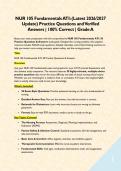
NUR 105 Fundamentals ATI: (Latest 2026/2027
Update) Practice Questions and Verified
Answers | 100% Correct | Grade A
Boost your exam preparation with this comprehensive NUR 105 Fundamentals ATI: 50
Practice Questions & Answers study guide. Designed for nursing students, this targeted
resource includes NCLEX-style questions, detailed rationales, and critical thinking scenarios to
help you master core nursing concepts, patient safety, and the nursing process.
Title:
NUR 105 Fundamentals ATI: 50 Practice Questions & Answers
Overview
Ace your NUR 105 Fundamentals exam and prepare for your ATI Proctored Assessment with
this ultimate study companion. This resource features 50 highly-relevant, multiple-choice
practice questions that mirror the exact difficulty and style of actual nursing school exams.
Whether you are reviewing for a midterm, final, or cumulative ATI exam, this targeted Q&A
bank is exactly what you need to test your knowledge.
What’s Included?
• 50 Exam-Style Questions: Practice questions focusing on the core fundamentals of
nursing.
• Detailed Answer Key: Not just the answers, but why the answer is correct.
• Rationale for Distractors: Learn why incorrect choices are wrong to eliminate
guesswork.
• Format: Easy-to-read PDF document, ready to print or study on the go.
Key Topics Covered
• The Nursing Process: Assessment, Diagnosis, Planning, Implementation, and
Evaluation (ADPIE).
• Patient Safety & Infection Control: Standard precautions, fall risk management, and
safe environments.
• Basic Care & Comfort: ADLs, hygiene, nutrition, and mobility support.
• Therapeutic Communication: Effective nurse-to-patient interactions.
• Fundamental Skills: Vital signs, medication administration math, and oxygenation
assessments.
1
,Why Choose This Resource?
• Boost Your Confidence: Familiarize yourself with the tricky wording, SATA (Select
All That Apply) formats, and NGN (Next Generation) style scenarios.
• Save Time: Stop stressing over creating your own flashcards. Focus entirely on
practicing and retaining critical clinical judgment.
• Immediate Results: Perfect for last-minute cramming or structured, week-by-week
exam prep.
Quiz_________________?
A client who reports shortness of breath requests her nurse's help in changing positions. After
repositioning the client, which of the following actions should the nurse take next?
a. Encourage the client to take deep breaths.
b. Observe the rate, depth, and character of the client's respirations.
c. Prepare to administer oxygen.
d. Give the client a back rub to help her relax. -
Answer
Observe the rate, depth, and character of the client's respirations.
The nurse should apply the nursing process priority-setting framework when caring for this
client. The nurse can use the nursing process to plan client care and prioritize nursing actions.
Each step of the nursing process builds on the previous step, beginning with assessment or data
collection. Before the nurse can formulate a plan of action, implement a nursing intervention, or
notify a provider of a change in the client's status, the nurse must first collect adequate data
from the client. Assessing or collecting additional data will provide the nurse with knowledge to
make an appropriate decision; therefore, the first action the nurse should take is to assess the
client's respiratory status.
Quiz_________________?
A nurse is caring for a client who, while sitting in a chair, starts to experience a seizure. Which
of the following actions should the nurse take?
2
, a. Place a padded tongue blade in the client's mouth.
b. Lower the client to the floor and place a pad under the client's head.
c. Seek the help of a coworker and lift the client back into bed.
d. Use an oropharyngeal airway to keep upper airway passages open. -
Answer
Lower the client to the floor and place a pad under the client's head.
To reduce the risk of injury to the client, the nurse should lower the client to the floor and
place a pillow or other soft object under the client's head.
Quiz_________________?
A home health nurse is planning to provide health promotion activities for a group of clients in
the community. Which of the following activities is an example of the nurse promoting primary
prevention?
a. Teaching clients to perform self-examinations of breasts and testicles
b. Educating clients about the recommended immunization schedule for adults
c. Teaching clients who have type 1 diabetes mellitus about care of the feet
d. Recommending that clients over the age of 50 have a fecal occult blood test annually -
Answer
Educating clients about the recommended immunization schedule for adults
Primary prevention includes health education about disease prevention.
Quiz_________________?
3
Update) Practice Questions and Verified
Answers | 100% Correct | Grade A
Boost your exam preparation with this comprehensive NUR 105 Fundamentals ATI: 50
Practice Questions & Answers study guide. Designed for nursing students, this targeted
resource includes NCLEX-style questions, detailed rationales, and critical thinking scenarios to
help you master core nursing concepts, patient safety, and the nursing process.
Title:
NUR 105 Fundamentals ATI: 50 Practice Questions & Answers
Overview
Ace your NUR 105 Fundamentals exam and prepare for your ATI Proctored Assessment with
this ultimate study companion. This resource features 50 highly-relevant, multiple-choice
practice questions that mirror the exact difficulty and style of actual nursing school exams.
Whether you are reviewing for a midterm, final, or cumulative ATI exam, this targeted Q&A
bank is exactly what you need to test your knowledge.
What’s Included?
• 50 Exam-Style Questions: Practice questions focusing on the core fundamentals of
nursing.
• Detailed Answer Key: Not just the answers, but why the answer is correct.
• Rationale for Distractors: Learn why incorrect choices are wrong to eliminate
guesswork.
• Format: Easy-to-read PDF document, ready to print or study on the go.
Key Topics Covered
• The Nursing Process: Assessment, Diagnosis, Planning, Implementation, and
Evaluation (ADPIE).
• Patient Safety & Infection Control: Standard precautions, fall risk management, and
safe environments.
• Basic Care & Comfort: ADLs, hygiene, nutrition, and mobility support.
• Therapeutic Communication: Effective nurse-to-patient interactions.
• Fundamental Skills: Vital signs, medication administration math, and oxygenation
assessments.
1
,Why Choose This Resource?
• Boost Your Confidence: Familiarize yourself with the tricky wording, SATA (Select
All That Apply) formats, and NGN (Next Generation) style scenarios.
• Save Time: Stop stressing over creating your own flashcards. Focus entirely on
practicing and retaining critical clinical judgment.
• Immediate Results: Perfect for last-minute cramming or structured, week-by-week
exam prep.
Quiz_________________?
A client who reports shortness of breath requests her nurse's help in changing positions. After
repositioning the client, which of the following actions should the nurse take next?
a. Encourage the client to take deep breaths.
b. Observe the rate, depth, and character of the client's respirations.
c. Prepare to administer oxygen.
d. Give the client a back rub to help her relax. -
Answer
Observe the rate, depth, and character of the client's respirations.
The nurse should apply the nursing process priority-setting framework when caring for this
client. The nurse can use the nursing process to plan client care and prioritize nursing actions.
Each step of the nursing process builds on the previous step, beginning with assessment or data
collection. Before the nurse can formulate a plan of action, implement a nursing intervention, or
notify a provider of a change in the client's status, the nurse must first collect adequate data
from the client. Assessing or collecting additional data will provide the nurse with knowledge to
make an appropriate decision; therefore, the first action the nurse should take is to assess the
client's respiratory status.
Quiz_________________?
A nurse is caring for a client who, while sitting in a chair, starts to experience a seizure. Which
of the following actions should the nurse take?
2
, a. Place a padded tongue blade in the client's mouth.
b. Lower the client to the floor and place a pad under the client's head.
c. Seek the help of a coworker and lift the client back into bed.
d. Use an oropharyngeal airway to keep upper airway passages open. -
Answer
Lower the client to the floor and place a pad under the client's head.
To reduce the risk of injury to the client, the nurse should lower the client to the floor and
place a pillow or other soft object under the client's head.
Quiz_________________?
A home health nurse is planning to provide health promotion activities for a group of clients in
the community. Which of the following activities is an example of the nurse promoting primary
prevention?
a. Teaching clients to perform self-examinations of breasts and testicles
b. Educating clients about the recommended immunization schedule for adults
c. Teaching clients who have type 1 diabetes mellitus about care of the feet
d. Recommending that clients over the age of 50 have a fecal occult blood test annually -
Answer
Educating clients about the recommended immunization schedule for adults
Primary prevention includes health education about disease prevention.
Quiz_________________?
3