

exsc 2090 short answer Exam Questions and
Answers with Verified Solutions | Latest
Updated 2026
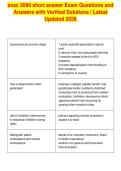
neuromuscular junction steps 1 action potential generated in spinal
cord
2 calcium influx into presynaptic terminal
3 vessicle release to bind to ACh
receptors
4 muscle depolarization from binding of
ACh receptors
5 contraction of muscle
how is deep tendon reflex kneecap is tapped, patellar tendon and
generated quadriceps tendon suddenly stretched.
involuntary kick is produced from sudden
contraction, inhibitory interneurons block
opposing stretch from occurring by
causing other muscle to relax
role of inhibitory interneurons prevent opposing muscle contraction
in reciprocal inhibition during causes it to relax
reflex
distinguish lateral lateral is for voluntary movement, direct
corticospinal and ventral of distal musculature
corticospinal ventral is for posture and locomotion
from brainstem
, noncorticospinal pathways rubrospinal for limb movements
and functions tectospinal for capture and avoid
reticulospinal for startle escape
vestibulospinal for posture and balance
forward modeling and forward modeling is predicting a
implementation by the movement and acting accordingly, an
cerebellum example is catching a ball because you
predict where the person will throw it in
order to properly catch it
motor cortex population a type of neural coding where there are
coding many different neurons that all are
programmed to go specific ways, when a
certain way needs to be gone, that
specific population of neurons
surrounding the area is initiated in order
to produce the movement. the different
neurons all have a direction preference
and come together to produce a joystick
movement
hierarchical organization of prime motor
the prefrontal cortex in motor premotor
control from posterior to prefrontal
anterior frontopolar cortex
mirror neurons and their support things like handshake, play a role
function in immitation and communication and fire
during action and observation, of the
prefrontal cortex
Answers with Verified Solutions | Latest
Updated 2026
neuromuscular junction steps 1 action potential generated in spinal
cord
2 calcium influx into presynaptic terminal
3 vessicle release to bind to ACh
receptors
4 muscle depolarization from binding of
ACh receptors
5 contraction of muscle
how is deep tendon reflex kneecap is tapped, patellar tendon and
generated quadriceps tendon suddenly stretched.
involuntary kick is produced from sudden
contraction, inhibitory interneurons block
opposing stretch from occurring by
causing other muscle to relax
role of inhibitory interneurons prevent opposing muscle contraction
in reciprocal inhibition during causes it to relax
reflex
distinguish lateral lateral is for voluntary movement, direct
corticospinal and ventral of distal musculature
corticospinal ventral is for posture and locomotion
from brainstem
, noncorticospinal pathways rubrospinal for limb movements
and functions tectospinal for capture and avoid
reticulospinal for startle escape
vestibulospinal for posture and balance
forward modeling and forward modeling is predicting a
implementation by the movement and acting accordingly, an
cerebellum example is catching a ball because you
predict where the person will throw it in
order to properly catch it
motor cortex population a type of neural coding where there are
coding many different neurons that all are
programmed to go specific ways, when a
certain way needs to be gone, that
specific population of neurons
surrounding the area is initiated in order
to produce the movement. the different
neurons all have a direction preference
and come together to produce a joystick
movement
hierarchical organization of prime motor
the prefrontal cortex in motor premotor
control from posterior to prefrontal
anterior frontopolar cortex
mirror neurons and their support things like handshake, play a role
function in immitation and communication and fire
during action and observation, of the
prefrontal cortex


