

exsc 213: exam 2: injury to lower limb lecture
Questions and Answers with Verified
Solutions | Latest Updated 2026
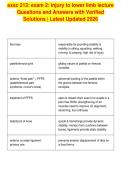
the knee responsible for providing stability &
mobility in sitting, squatting, walking,
running, & jumping; high risk of injury
patellofemoral joint gliding nature of patella on femoral
condyles
anterior "knee pain" = PFPS abnormal tracking of the patella within
(patellofemoral pain the groove between the femoral
syndrome; runner's knee) condyles
treatment of PFPS open & closed chain exsc's for quads in a
pain-free ROM, strengthening of all
muscles need to improve LE alignment,
stretching, foot orthoses
stabilizers of knee quads & hamstrings provide dynamic
stability; menisci form cushions between
bones; ligaments provide static stability
anterior cruciate ligament: prevents anterior displacement of tibia on
primary role a fixed femur
Questions and Answers with Verified
Solutions | Latest Updated 2026
the knee responsible for providing stability &
mobility in sitting, squatting, walking,
running, & jumping; high risk of injury
patellofemoral joint gliding nature of patella on femoral
condyles
anterior "knee pain" = PFPS abnormal tracking of the patella within
(patellofemoral pain the groove between the femoral
syndrome; runner's knee) condyles
treatment of PFPS open & closed chain exsc's for quads in a
pain-free ROM, strengthening of all
muscles need to improve LE alignment,
stretching, foot orthoses
stabilizers of knee quads & hamstrings provide dynamic
stability; menisci form cushions between
bones; ligaments provide static stability
anterior cruciate ligament: prevents anterior displacement of tibia on
primary role a fixed femur


