

Written by students who passed Immediately available after payment Read online or as PDF Wrong document? Swap it for free 4.6 TrustPilot
logo-home
Document preview thumbnail
Preview 1 out of 4 pages
Exam (elaborations)

Phlebotomy NHA Patient Preparation Questions and Answers

Document preview thumbnail
Preview 1 out of 4 pages

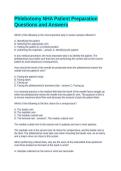
Phlebotomy NHA Patient Preparation Questions and Answers Which of the following is the most important step in routine sample collection? A. Identifying the patient B. Selecting the appropriate vein C. Putting the patient in a reclined position D. Gathering the materials A. Identifying the patient In any medical procedure, the most important step is to identify the patient. The phlebotomist must make sure that they are performing the correct skill on the correct patient to avoid disastrous consequences. How should the bevel of the needle be positioned when the phlebotomist inserts the needle into the patient's vein? A. Facing the patient's body B. Facing down C. Facing up D. Facing the phlebotomist's dominant side C. Facing up It is universal practice in the medical field that the bevel of the needle faces straight up when the phlebotomist inserts the needle into the patient's vein. The purpose of this is to ensure maximum blood flow and decrease the amount of pain the patient feels. Which of the following is the first choice for a venipuncture? A. The basilic vein B. The cephalic vein C. The median cubical vein D. The femoral vein C. The median cubical vein The median cubital vein is the easiest vein to palpate and see in most patients. The cephalic vein is the second vein of choice for venipuncture, and the basilic vein is the third. The phlebotomist must take care when choosing the basilic vein, as an artery and a major nerve run close to this vessel. When performing a blood draw, why are the veins of the antecubital fossa preferred over those located on the back of the hand or wrist? A. Samples collected on the hand or wrist are inaccurate B. There are no useable veins in the hand or wrist C. The veins of the forearm and wrist are at greater risk for contamination D. The veins in the antecubital fossa are easiest to locate and penetrate D. The veins of the upper arm and antecubital fossa tend to be larger and further away from nerves, bones, and tendons. While a major nerve does run down the medial aspect of the antecubital fossa, there are several other appropriate veins a phlebotomist may use to avoid causing the patient pain. Furthermore, because of their larger diameter, drawing blood is much easier. When performing venipuncture in the hand or wrist, a phlebotomist must be very cognizant of the increased risk of causing tissue damage and/or severe pain to the patient. When working with infants and children, how can a phlebotomist greatly reduce the risk of damaging bones, arteries, and nerves when collecting specimens via capillary puncture? A. Use a spring-loaded puncture device set for a specific depth B. Perform venipuncture C. Use a non-retractable blade lancet D. Use a manual lancet A. Use a spring-loaded puncture device set for a specific depth Spring-loaded puncture devices contain needles or blades that puncture the skin to a preset depth. Using this type of device provides protection for underlying structures when working with the anatomy of pediatric patients. In addition, present spring-loaded devices improve phlebotomist safety and patient satisfaction. Manual lancets should not be used on youngsters or babies due to the difficulty in controlling puncture depth. As a result, there is a greater risk of harm from deep punctures. Non-retractable blade lancets should not be used due to the risk of accidental injury to the healthcare worker and patient. Venipuncture is acceptable, but not preferred for obtaining blood from infants and very young children, since infants have a small blood volume, and removing too much blood could lead to anemia. Who submits the order for venipuncture? A. The phlebotomist B. The nurse C. The physician or mid-level provider D. The patient C. The physician or mid-level provider In a healthcare setting, the physician or a mid-level provider (such as a Nurse Practitioner or Physicians Assistant) submits an order for venipuncture. This order will include which tests will be submitted to the laboratory. Multiple tests can be run on a single tube, so it is vital for the phlebotomist to ensure that they get enough sample and in the correct sample containers. The main purpose of properly greeting the patient is to: A. Make the procedure go faster B. Choose the correct phlebotomy equipment for the patient C. Gain the patient's trust and decrease the patient's anxiety D. Ensure accurate billing details C. Gain the patient's trust and decrease the patient's anxiety Gaining the patient's trust is the most important part of developing a good relationship with the patient and is a responsibility shared by the whole patient care team. Often, the phlebotomist will be one of the first clinical staff the patient meets and, therefore, has one of the best opportunities to make a good first impression. Establishing eye contact, providing a clear introduction, and maintaining confident body language are key to starting a good patient relationship and decreasing the patient's anxiety. Which of the following definitions correctly identifies the lateral aspect of the body? A. Toward the side of the body B. The back surface of the body C. The front surface of the body D. Toward the middle of the body A. Toward the side of the body In the anatomical position, the body is viewed from the front with the palms facing forward. If one were to imagine a line down the middle of the body, portions of the body close to that line are considered medial, while portions of the body further from that line are considered lateral. For example, in an anatomical position, the thumb is more lateral than the pinky finger. Similarly, the inside of the thigh is considered the medial aspect while the outside of the thigh is considered the lateral aspect. The understanding of medial and lateral becomes particularly useful for the phlebotomist when describing capillary puncture sites. If the patient is unconscious with no advance directives and the physician believes that venipuncture is in the best interest of the patient's health, what kind of consent is applied? A. Accepting consent B. Implied consent C. None - a violation of ethics has occurred D. Informed consent B. Implied consent Consent can at times seem like a complex subject. However, all questions regarding consent can be answered by referring to the patient's rights. Implied consent stems from a situation in which the patient cannot give consent, such as when the patient is unconscious. In this case, if it is reasonable to assume that the patient would give consent to the treatment if they were conscious, implied consent is assumed. Informed consent stems from the patient's right to be informed of their treatment and the patient's right to consent to or refuse treatment. By informing the patient of the venipuncture procedure and the patient consenting to that procedure, the phlebotomist has received informed consent.

Content preview

Phlebotomy NHA Patient Preparation
Questions and Answers
Which of the following is the most important step in routine sample collection?

A. Identifying the patient
B. Selecting the appropriate vein
C. Putting the patient in a reclined position
D. Gathering the materials – answer A. Identifying the patient

In any medical procedure, the most important step is to identify the patient. The
phlebotomist must make sure that they are performing the correct skill on the correct
patient to avoid disastrous consequences.

How should the bevel of the needle be positioned when the phlebotomist inserts the
needle into the patient's vein?

A. Facing the patient's body
B. Facing down
C. Facing up
D. Facing the phlebotomist's dominant side – answer C. Facing up

It is universal practice in the medical field that the bevel of the needle faces straight up
when the phlebotomist inserts the needle into the patient's vein. The purpose of this is
to ensure maximum blood flow and decrease the amount of pain the patient feels.

Which of the following is the first choice for a venipuncture?

A. The basilic vein
B. The cephalic vein
C. The median cubical vein
D. The femoral vein - answerC. The median cubical vein

The median cubital vein is the easiest vein to palpate and see in most patients.

The cephalic vein is the second vein of choice for venipuncture, and the basilic vein is
the third. The phlebotomist must take care when choosing the basilic vein, as an artery
and a major nerve run close to this vessel.

When performing a blood draw, why are the veins of the antecubital fossa preferred
over those located on the back of the hand or wrist?

A. Samples collected on the hand or wrist are inaccurate

Document information

Uploaded on
July 2, 2026
Number of pages
4
Written in
2025/2026
Type
Exam (elaborations)
Contains
Questions & answers
$16.49

Wrong document? Swap it for free Within 14 days of purchase and before downloading, you can choose a different document. You can simply spend the amount again.
Written by students who passed
Immediately available after payment
Read online or as PDF

Seller avatar
Reputation scores are based on the amount of documents a seller has sold for a fee and the reviews they have received for those documents. There are three levels: Bronze, Silver and Gold. The better the reputation, the more your can rely on the quality of the sellers work.
Pogba119
3.9
(14)
Sold
59
Followers
2
Items
5443
Last sold
1 month ago


Why students choose Stuvia

Created by fellow students, verified by reviews

Quality you can trust: written by students who passed their exams and reviewed by others who've used these revision notes.

Didn't get what you expected? Choose another document

No problem! You can straightaway pick a different document that better suits what you're after.

Pay as you like, start learning straight away

No subscription, no commitments. Pay the way you're used to via credit card and download your PDF document instantly.

Student with book image

“Bought, downloaded, and smashed it. It really can be that simple.”

Alisha Student

Working on your references?

Create accurate citations in APA, MLA and Harvard with our free citation generator.

Working on your references?

Frequently asked questions
