
Week 6
Chapter 18 - Breast & Regional Lymphatic System
Structure & Function
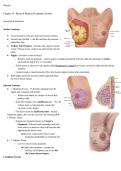
Surface Anatomy
● Located anterior to the pec major and serratus anterior
● Extend from 2nd Rib → 6th Rib and from the sternum →
midaxillary line
● Axillary Tail of Spence - located in the superior lateral
corner of breast tissue - projects up and laterally into the
axilla
● Nipple - just below centre of breast
○ Rough, round and protrudes - surface appears wrinkled and intend with tiny milk duct openings ● Areola -
surrounds the nipple in a 1-2 cm radius
○ Inside areola is sebaceous (oil) glands called Montgomery’s glands that secrete a protective lipid material during
lactation
○ Around areola is smooth muscles fibres that lead to nipple erection when stimulated
● Both nipple and areola are more darkly pigmented than
the rest of breast surface
Internal Anatomy
● 1. Glandular Tissue - 15-20 lobes radiating from the
nipple and composed with lobules
○ Within each lobule are clusters of alveoli that
produce milk
○ Each lobe empties into a lactiferous duct - 15 to 20
of these form a collecting duct system that
converges at the nipples
○ The ducts forms the lactiferous sinus - located
behind the nipple, these are the reservoirs for storing milk ●
2. Fibrous Tissue:
○ Suspensory ligaments known as Cooper’s
Ligaments - Fibrous bands extending vertically
from surface to attach on chest wall muscles thus
supporting the breast tissue
■ Becomes contracted in breast cancer -
producing pits/dimples in overlying skin
● 3. Adipose Tissue
○ Can be viewed in four quadrants:
■ Upper outer quadrant - contains the
Axillary tail of Spence and is also the
site of most breast tumors
Lymphatic System
, ● Most of the lymph drains into the ipsilateral
axillary node
● Lymph - protein rich fluid
● 4 groups of axillary nodes:
○ 1. Central Axillary Nodes - high up in the
middle of axilla, over ribs and serratus
anterior
■ Will receive lymph from other 3
groups of nodes
○ 2. Pectoral (Anterior) - along lateral edgeof
pec major, inside the anterior axillary fold
○ 3. Subscapular (Posterior) - along the
lateral edge of scapula, deep in the
posterior axillary fold
○ 4. Lateral - among humerus inside the upper
arm
● From the central axillary node, lymph will flow up to the infraclavicular and supraclavicular nodes
Developmental Considerations
● Embryo
○ Milk lines/ventral epidermal ridges present - will curve from axilla to groin
bilaterally
■ Breast will develop along the ridge over the thorax - rest of the ridge usually
atrophies
■ Sometimes, a supernumerary (extra) nipple persist somewhere on the milk
line
○ No alveoli developed
○ Only structure is the lactiferous ducts within the nipple
● Adolescent
○ Estrogen stimulates breast change:
■ 1. Breast enlarge due to extensive fat deposition
● Uneven breast growth is normal
■ 2. Duct system grows and branches
■ 3. Masses of cells develop at duct endings potential
alveoli
○ Tanner Staging - the 5 stages of classical breast
development
■ Full development from Stage 2 → 5 takes ~ 3 years,
but the range is 1.5 - 6 years
■ During this time, public hair will appear, with
axillary hair 2 years after public hair
■ Thelarche - the beginning of breast development
occurs before Menarche - beginning of
menstruation by ~ 2 years
● Menarche - occurs during breast development stage 3/4, usually
after the peak of adolescent growth spurt (~12 years old)
, Stage 1 Stage 4
(Preadolescent) - Areola and nipple form a secondary
- only small mound over breast
elevated nipple
present
Stage 2 (Breast Stage 5 (Mature Breast)
Bud Stage) - Only nipple protrudes
- small mound of - Areola is flush with breast
breast and nipple contour - In some women, areola
develops widening may continue as secondary mound
of areola
Stage 3
- breast and areola
enlarge - nipple is
flush with breast
surface
○ Breasts of nonpregnant women change with hormones during the menstrual cycle
○ Nodules tend to from starting from the mid cycle up to menstruation
○ 3-4 days before menstruation, the breast feel full, heavy, and tight
○ Day 4-7 of the menstrual cycle has the breast at its smallest volume
● Pregnant Women
○ Breast changes starting on the 2nd month - usually the early sign of pregnancy:
■ 1. Expansion of ductal system and supporting fatty tissue
■ 2. Development of the true secretory alveoli
■ 3. Breasts enlarge and feel more nodular
■ 4. Nipples become larger, darker, and more erectile
■ 5. Areola become larger and darker as pregnancy progresses
● Colour will fade after lactation but will never return to original
■ 6. Tubercles more prominent and venous pattern over skin surface ○
4th month:
■ Colostrum - thick yellow fluid milk-precursor that is contains the same levels of protein and lactose, but no
fat - contains antibodies that protect newborn against infection
● Body will produce this
■ Milk production begins 1-3 days postpartum ●
Older Women - After menopause
○ Ovarian secretion of estrogen and progesterone decreases - leading to breast glandular tissue atrophy ■
Will become replaced with fibrous connective tissue
○ Fat envelope also atrophies beginning in the middle years and marked by the 8th/9th decade
■ Will decrease breast size and elasticity, leading to breast drooping or sag ○
Inner structures become more prominent due to reduced size
■ Lumps that were not detected are now easier to detect
■ Lactiferous ducts more palpable ●
Male Breast
○ Areola is well-developed and nipple is relatively small
○ Adolescence - common for breast tissue to temporarily enlarge, known as gynecomastia
■ Usually unilateral and transient
■ May reappear in adult men - could be due to testosterone deficiency
Social Determinants of Health Considerations
, ● Breast cancer is the most common form of cancer in women
● Indigenous and South Asian women more likely to underuse cancer-screening methods
Risk Factors for Breast Cancer
Unmodifible Risk Factors Modifiable Risk Factors Possible Risk Factors
- Female sex, between 50-69 years - Physical Inactivity
- Nulliparity - not having children
- Personal and Family hx of breast - Adult weight gain
- Having first child after 30 years
cancer - Smoking & second-hand smoke exposure
- Hormonal contraceptive use
- Dense breasts - High birth weight
- Hormone replacement therapy
- BRCA gene mutation - Night shift work
- Alcohol intake of > 1 drink daily
- Ashkenazi Jewish Ancestry - Certain benign breast conditions
- Obesity
- Specific rare genetic conditions -
- High SES - potentially due to the an
Early menarche (before 11) or late
older age of childbirth, having fewer
menopause (55 or older)
children, or greater likelihood of receiving
- Exposure to ionizing radiation
postmenopausal hormone replacement
- Atypical hyperplasia
therapy
- Tall adult height
Subjective Data
Health Hx Questions
Breast
Mastalgia - Breast pain - occurs with trauma, inflammation,
1. Pain infection, and benign breast disease
● Where is the pain? Localized or global?
● Is the painful spot sore to touch, burning or pulling sensation?
Cyclical pain common with normal breasts, oral contraceptives,
● Is pain cyclical? Any relation to menstrual period? and benign breast disease
Determine if the pain has a cause
● Is pain brought on by strenuous activity, especially involving
one arm?
○ Change in activity, manipulation during sex, part of an
underwire bra?
2. Lump Explore carefully for lumps - A lump present for many years and
● When did you first notice it? Has it changed since? exhibit no changes may not be serious but should still be
● Does lump have any relation to menstrual period? investigated
● Have you ever noticed any change in overlying skin: redness,
warmth, dimpling, swelling? New lumps or recent changes with a lump should be approached
with suspicion
3. Discharge Galactorrhea - milky-white secretion from one or both breasts in
● When did you first notice this? a man, or women that is not pregnant or breastfeeding
● What colour and consistency is the discharge? -Some medication can lead to clear nipple discharge
● Does it have an odour? -Any discharge with a lump or bloody/blood-tinged discharge
should be investigated
4. Rash Paget’s Disease - beings with a small crust on nipple apex, and
● When did you first notice? spread to areola
● Where did it start? - Nipple, Areola, Skin? -Eczema usually begins on areola or surrounding skin then to
nipple unless due to breastfeeding


