
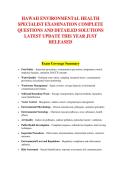
HAWAII ENVIRONMENTAL HEALTH
SPECIALIST EXAMINATION COMPLETE
QUESTIONS AND DETAILED SOLUTIONS
LATEST UPDATE THIS YEAR JUST
RELEASED
Exam Coverage Summary
Food Safety – Inspection procedures, contamination prevention, temperature control,
employee hygiene, sanitation, HACCP concepts.
Water Quality – Drinking water safety, sampling, treatment basics, contamination
prevention, recreational water monitoring.
Wastewater Management – Septic systems, sewage disposal, environmental
contamination prevention.
Solid and Hazardous Waste – Storage, transportation, disposal methods, hazardous
waste identification.
Vector Control – Mosquitoes, rodents, insects, integrated pest management.
Environmental Microbiology – Disease transmission, pathogens, sanitation principles.
Environmental Toxicology – Chemical exposure pathways, toxic substances, health
effects.
Air Quality – Indoor air pollutants, outdoor pollution, particulate matter, ventilation.
Public Health Investigation – Complaint response, outbreak investigation, interviewing
techniques.
Inspection Procedures – Observation, documentation, enforcement actions, corrective
measures.
Environmental Laws and Regulations – Regulatory compliance and enforcement
authority.
Risk Assessment – Hazard identification, exposure assessment, risk communication.
, Emergency Response – Environmental incidents, hazardous spills, disaster sanitation.
Occupational Health – Worker protection, PPE, hazard communication.
Housing and Institutional Sanitation – Schools, hotels, correctional facilities,
healthcare facilities.
Swimming Pools and Recreational Waters – Water chemistry, filtration, operator
responsibilities.
Noise and Radiation – Public health impacts and monitoring principles.
Data Collection and Sampling – Chain of custody, sample preservation, laboratory
coordination.
Communication Skills – Public education, report writing, conflict resolution.
Professional Ethics – Confidentiality, impartiality, evidence-based decision making.
1.
During a routine restaurant inspection, an inspector discovers
cooked chicken maintained at 118°F for over three hours
before service. What is the most appropriate immediate
regulatory action?
A. Permit continued service if reheated later
B. Require immediate disposal because time-temperature
abuse has occurred
C. Cool the chicken at room temperature
D. Allow service if customers are informed
Answer: B
Rationale: Time-temperature abuse promotes rapid bacterial
growth; unsafe food should be discarded.
,2.
An environmental health specialist receives complaints
regarding unusually colored drinking water affecting multiple
homes served by the same distribution system. Which
investigation step should occur first?
A. Issue fines immediately
B. Collect representative water samples and determine
whether contamination exists
C. Replace the entire distribution system
D. Advise residents to ignore the discoloration
Answer: B
Rationale: Sampling confirms contamination before corrective
actions are implemented.
3.
Which environmental condition most directly increases the
probability of mosquito breeding following several days of
heavy rainfall?
A. Dry compacted soil
B. Standing stagnant water remaining for several days
C. Windy open fields
D. Rocky slopes with rapid drainage
, Answer: B
Rationale: Mosquitoes require standing water for egg
development.
4.
During a swimming pool inspection, the disinfectant residual
measures well below recommended operating levels while
numerous swimmers are present. What should the inspector
require?
A. Continue operations without changes
B. Increase disinfectant concentration and restrict swimming
until safe levels are restored
C. Lower the water level
D. Add food coloring
Answer: B
Rationale: Adequate disinfectant prevents recreational water
illness.
5.
Which sampling practice best preserves the integrity of
environmental evidence submitted for laboratory analysis?
A. Allow anyone to transport samples
SPECIALIST EXAMINATION COMPLETE
QUESTIONS AND DETAILED SOLUTIONS
LATEST UPDATE THIS YEAR JUST
RELEASED
Exam Coverage Summary
Food Safety – Inspection procedures, contamination prevention, temperature control,
employee hygiene, sanitation, HACCP concepts.
Water Quality – Drinking water safety, sampling, treatment basics, contamination
prevention, recreational water monitoring.
Wastewater Management – Septic systems, sewage disposal, environmental
contamination prevention.
Solid and Hazardous Waste – Storage, transportation, disposal methods, hazardous
waste identification.
Vector Control – Mosquitoes, rodents, insects, integrated pest management.
Environmental Microbiology – Disease transmission, pathogens, sanitation principles.
Environmental Toxicology – Chemical exposure pathways, toxic substances, health
effects.
Air Quality – Indoor air pollutants, outdoor pollution, particulate matter, ventilation.
Public Health Investigation – Complaint response, outbreak investigation, interviewing
techniques.
Inspection Procedures – Observation, documentation, enforcement actions, corrective
measures.
Environmental Laws and Regulations – Regulatory compliance and enforcement
authority.
Risk Assessment – Hazard identification, exposure assessment, risk communication.
, Emergency Response – Environmental incidents, hazardous spills, disaster sanitation.
Occupational Health – Worker protection, PPE, hazard communication.
Housing and Institutional Sanitation – Schools, hotels, correctional facilities,
healthcare facilities.
Swimming Pools and Recreational Waters – Water chemistry, filtration, operator
responsibilities.
Noise and Radiation – Public health impacts and monitoring principles.
Data Collection and Sampling – Chain of custody, sample preservation, laboratory
coordination.
Communication Skills – Public education, report writing, conflict resolution.
Professional Ethics – Confidentiality, impartiality, evidence-based decision making.
1.
During a routine restaurant inspection, an inspector discovers
cooked chicken maintained at 118°F for over three hours
before service. What is the most appropriate immediate
regulatory action?
A. Permit continued service if reheated later
B. Require immediate disposal because time-temperature
abuse has occurred
C. Cool the chicken at room temperature
D. Allow service if customers are informed
Answer: B
Rationale: Time-temperature abuse promotes rapid bacterial
growth; unsafe food should be discarded.
,2.
An environmental health specialist receives complaints
regarding unusually colored drinking water affecting multiple
homes served by the same distribution system. Which
investigation step should occur first?
A. Issue fines immediately
B. Collect representative water samples and determine
whether contamination exists
C. Replace the entire distribution system
D. Advise residents to ignore the discoloration
Answer: B
Rationale: Sampling confirms contamination before corrective
actions are implemented.
3.
Which environmental condition most directly increases the
probability of mosquito breeding following several days of
heavy rainfall?
A. Dry compacted soil
B. Standing stagnant water remaining for several days
C. Windy open fields
D. Rocky slopes with rapid drainage
, Answer: B
Rationale: Mosquitoes require standing water for egg
development.
4.
During a swimming pool inspection, the disinfectant residual
measures well below recommended operating levels while
numerous swimmers are present. What should the inspector
require?
A. Continue operations without changes
B. Increase disinfectant concentration and restrict swimming
until safe levels are restored
C. Lower the water level
D. Add food coloring
Answer: B
Rationale: Adequate disinfectant prevents recreational water
illness.
5.
Which sampling practice best preserves the integrity of
environmental evidence submitted for laboratory analysis?
A. Allow anyone to transport samples


