

FIM - Theory
Financial Institutions and Markets
Part 1: Introduction
Chapter 1: Why study Financial Markets and Institutions?
Why study Financial Markets
• Financial Markets are crucial in our economy
o Channel funds from savers to investors
o Market activity affects: personal wealth, business firms and economy
• Well-functioning markets are key factors in producing high economic growth
Debt Markets & Interests Rates
• Debt markets allow governments, corporations and individuals to borrow
• Borrowers issue a security, called a bond, offering interest and principal over
time
• The interest rate is the cost of borrowing
• Many types of market interest rates; mortgage rates, car loan rates, CC
rates…
• The level of these rates is important (Mortgage rates 1983 = 13%, today =
±4.75%)
• Understanding its history is beneficial
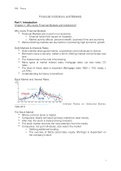
Bond Market and Interest Rates
Interest Rates on Selected Bonds,
1950-2013
The Stock Market
• Where common stock is traded
• Companies initially sell stock (primary market) to raise money
• After that, the stock is traded among investors
• The stock market receives the most attention from the media
• Companies, not just individuals, also watch the market
o Seeking additional funding
o The success of SEOs (secondary equity offerings) is dependent on
the company’s stock
1
,FIM - Theory
Stock Prices as measured by DJIA, 1950-2013
The Foreign Exchange Market
• Where international currencies trade and exchange rates are set
• Most people know little about this market, it has daily volume nearing $3
trillion
• These fluctuations matter ! US consumers have less buying power in
Europe, due to a weakening dollar relative to the euro
Exchange Rate of US Dollar, 1970-2013
Why study Financial Institutions
• Financial Institutions are the corporations, organisations and networks that
operate the so-called marketplaces
o Structure of the Financial System – helps funds move from savers to
investors
o Financial Crises – why did they happen? E.g.: Great Recession
2007-2009
o Central Banks and the Conduit of Monetary Policy – role of the fed in
the management of interest rates and the money supply
o International Finance System – capital flows between countries impact
domestic economies (IMF)
o Banks and other financial institutions – role of mutual funds, pension
funds…
o Financial innovation – impact of technology improvements on financial
product delivery
o Managing risk in financial Institutions – focus on risk management
Applied Managerial Perspective
• Financial institutions are the largest employers in the US and often pay high
salaries
• Knowing how financial institutions are managed may help you better deal
with them
How to study FIMs
• Basic Analytic Framework
2
,FIM - Theory
o Simplified models are constructed, explained and then manipulated to
illustrate various phenomena
o Practicing Manager cases are used to tie theoretical and empirical
aspects
• Others features
o Case studies
o Applications and numerical examples
o Special interest boxes
o Hundreds of analytical end-of-chapter problems
o Predicting the future problems
Chapter Summary
• Why study Financial Markets – introduction of the 3 primary markets
• Why study Financial Institutions – the key changes affecting the markets
• Applied managerial perspective – how managers use the info in daily
operations
• How we study FIM – analytical framework, features and web exercises
3
, FIM - Theory
Chapter 2: Overview of the Financial Systems
Function of Financial Markets
• Channels funds from person or business without investment opportunities
(lender – savers) to one who has them (borrowers – spenders)
• Improves economic efficiency
Financial Markets Funds Transferees
• Lender – Savers
o Households
o Business firms
o Government
o Foreigners
• Borrowers – Spenders
o Business firms
o Government
o Households
o Foreigners
Segments of Financial Markets
• Direct Finance – borrowers borrow directly from lenders in financial markets
by selling financial instruments which are claims on the borrower’s future
income or assets
• Indirect Finance – borrowers borrow indirectly from lenders via financial
intermediaries (established to source loanable funds and loan opportunities)
by issuing financial instruments which are claims on the borrower’s future
income or assets
Importance of Financial Markets
• Financial markets are critical for producing an efficient allocation of capital,
allowing funds to move from people who lack production investment
opportunities to people who have them
4
Financial Institutions and Markets
Part 1: Introduction
Chapter 1: Why study Financial Markets and Institutions?
Why study Financial Markets
• Financial Markets are crucial in our economy
o Channel funds from savers to investors
o Market activity affects: personal wealth, business firms and economy
• Well-functioning markets are key factors in producing high economic growth
Debt Markets & Interests Rates
• Debt markets allow governments, corporations and individuals to borrow
• Borrowers issue a security, called a bond, offering interest and principal over
time
• The interest rate is the cost of borrowing
• Many types of market interest rates; mortgage rates, car loan rates, CC
rates…
• The level of these rates is important (Mortgage rates 1983 = 13%, today =
±4.75%)
• Understanding its history is beneficial
Bond Market and Interest Rates
Interest Rates on Selected Bonds,
1950-2013
The Stock Market
• Where common stock is traded
• Companies initially sell stock (primary market) to raise money
• After that, the stock is traded among investors
• The stock market receives the most attention from the media
• Companies, not just individuals, also watch the market
o Seeking additional funding
o The success of SEOs (secondary equity offerings) is dependent on
the company’s stock
1
,FIM - Theory
Stock Prices as measured by DJIA, 1950-2013
The Foreign Exchange Market
• Where international currencies trade and exchange rates are set
• Most people know little about this market, it has daily volume nearing $3
trillion
• These fluctuations matter ! US consumers have less buying power in
Europe, due to a weakening dollar relative to the euro
Exchange Rate of US Dollar, 1970-2013
Why study Financial Institutions
• Financial Institutions are the corporations, organisations and networks that
operate the so-called marketplaces
o Structure of the Financial System – helps funds move from savers to
investors
o Financial Crises – why did they happen? E.g.: Great Recession
2007-2009
o Central Banks and the Conduit of Monetary Policy – role of the fed in
the management of interest rates and the money supply
o International Finance System – capital flows between countries impact
domestic economies (IMF)
o Banks and other financial institutions – role of mutual funds, pension
funds…
o Financial innovation – impact of technology improvements on financial
product delivery
o Managing risk in financial Institutions – focus on risk management
Applied Managerial Perspective
• Financial institutions are the largest employers in the US and often pay high
salaries
• Knowing how financial institutions are managed may help you better deal
with them
How to study FIMs
• Basic Analytic Framework
2
,FIM - Theory
o Simplified models are constructed, explained and then manipulated to
illustrate various phenomena
o Practicing Manager cases are used to tie theoretical and empirical
aspects
• Others features
o Case studies
o Applications and numerical examples
o Special interest boxes
o Hundreds of analytical end-of-chapter problems
o Predicting the future problems
Chapter Summary
• Why study Financial Markets – introduction of the 3 primary markets
• Why study Financial Institutions – the key changes affecting the markets
• Applied managerial perspective – how managers use the info in daily
operations
• How we study FIM – analytical framework, features and web exercises
3
, FIM - Theory
Chapter 2: Overview of the Financial Systems
Function of Financial Markets
• Channels funds from person or business without investment opportunities
(lender – savers) to one who has them (borrowers – spenders)
• Improves economic efficiency
Financial Markets Funds Transferees
• Lender – Savers
o Households
o Business firms
o Government
o Foreigners
• Borrowers – Spenders
o Business firms
o Government
o Households
o Foreigners
Segments of Financial Markets
• Direct Finance – borrowers borrow directly from lenders in financial markets
by selling financial instruments which are claims on the borrower’s future
income or assets
• Indirect Finance – borrowers borrow indirectly from lenders via financial
intermediaries (established to source loanable funds and loan opportunities)
by issuing financial instruments which are claims on the borrower’s future
income or assets
Importance of Financial Markets
• Financial markets are critical for producing an efficient allocation of capital,
allowing funds to move from people who lack production investment
opportunities to people who have them
4


