

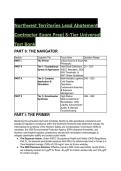
Northwest Territories Lead Abatement
Contractor Exam Prep| S-Tier Universal
Test Bank
PART 0: THE NAVIGATOR
Section Cognitive Tier Focus Area Question Range
PART I The Primer Critical Axioms & Exam N/A
Philosophy
PART II Tier 1: Foundational Hard-Deck Definitions, Q1 – Q15
Syntax & Application WSCC Mandates, 2026
EPA Thresholds, &
NWT Waste Guidelines
PART II Tier 2: Complex Multi-Variable Logistics, Q16 – Q35
Application & Cold Weather
Simulation Operations,
Containment Breaches,
& Exposure
Management
PART II Tier 3: Grandmaster High-Stakes Q36 – Q60
Synthesis Multi-Jurisdictional
Remediation, OHS
Liability, Subcontractor
Audits, & Ultimate
Troubleshooting
PART I: THE PRIMER
Mastering this exhaustive test bank translates directly to elite operational competence and
bulletproof regulatory compliance within the Northwest Territories lead abatement industry. By
internalizing the synthesis of the Workers' Safety and Compensation Commission (WSCC)
mandates, the 2026 Environmental Protection Agency (EPA) clearance thresholds, and
Northern cold-weather logistics, practitioners elevate their remediation methodologies to
mitigate catastrophic liability and protect public health.
● The Exposure Axiom: Under WSCC Occupational Health and Safety (OHS) Regulations
Part 21, the absolute permissible exposure limit (PEL) for airborne lead dust or fumes is a
Time-Weighted Average (TWA) of 0.05 mg/m³ over an 8-hour workday.
● The 2026 Clearance Doctrine: Effective January 2026, Dust-Lead Action Levels (DLAL)
are ruthlessly lowered to 5 µg/ft² for floors, 40 µg/ft² for interior window sills, and 100 µg/ft²
for window troughs.
, ● The NWT Waste Threshold: Under the NWT Environmental Protection Act, waste is
classified as hazardous if its lead concentration exceeds 5.0 mg/L when subjected to the
Toxicity Characteristic Leaching Procedure (TCLP, Method 1311).
● The Notification Mandate: The WSCC requires a formal Lead Project Notification to be
submitted exactly five business days prior to commencement, inclusive of mandatory
exposure control plans, emergency procedures, and documented worker certifications.
PART II: THE ELITE TEST BANK
Tier 1: Foundational Syntax & Application
Q1: A commercial lead abatement contractor is finalizing the operational exposure control plan
for a Yellowknife facility. According to the WSCC Working with Lead Code of Practice, what is
the maximum permissible Time-Weighted Average (TWA) for airborne lead exposure over a
standard 8-hour shift? A) 0.50 mg/m³ B) 5.0 mg/m³ C) 0.05 mg/m³ D) 0.02 mg/m³
● The Answer: C (0.05 mg/m³)
● Distractor Analysis:
○ A is incorrect: This value is a miscalculation tenfold higher than the legal limit,
representing a catastrophic exposure hazard.
○ B is incorrect: This figure represents the Toxicity Characteristic Leaching Procedure
(TCLP) threshold for hazardous waste disposal (5.0 mg/L) , not the airborne
exposure limit.
○ D is incorrect: While some jurisdictions evaluate action levels at lower thresholds,
the absolute legal limit established by the WSCC in the Northwest Territories is 0.05
mg/m³.
The Mentor's Analysis: The fundamental baseline of all occupational health planning hinges
on the exact exposure limits designated by the governing body. In the Northwest Territories, the
WSCC strictly enforces the 0.05 mg/m³ limit to prevent acute neurological and physiological
degradation. By utilizing Objective Air Monitoring Data, the contractor bypasses the common
trap of relying on outdated jurisdictional averages. Professional/Academic Intuition: The 0.05
mg/m³ TWA is the hard deck; exceeding this without supplemental respiratory protection is a
direct violation of WSCC OHS Regulations Part 21.
Q2: Following the abatement of a pre-1960 residential property in Inuvik, the contractor
conducts clearance dust sampling. Based on the stringent 2026 federal EPA standards adopted
for best practices, which result mandates a mandatory recleaning of the specific surface? A) 3
µg/ft² on a carpeted floor B) 35 µg/ft² on an interior window sill C) 80 µg/ft² in a window trough
D) 6 µg/ft² on a hardwood floor
● The Answer: D (6 µg/ft² on a hardwood floor)
● Distractor Analysis:
○ A is incorrect: The 2026 Dust-Lead Action Level (DLAL) for floors is 5 µg/ft². A
result of 3 µg/ft² passes clearance.
○ B is incorrect: The updated DLAL for interior window sills is 40 µg/ft². A result of 35
µg/ft² is compliant.
○ C is incorrect: The revised DLAL for window troughs is 100 µg/ft². A result of 80
µg/ft² is acceptable under the 2026 standards.
The Mentor's Analysis: The transition to the 2026 Dust-Lead Action Levels represents a
paradigm shift in post-abatement validation. When facing Clearance Testing, the immediate
, priority is verifying compliance against the most current thresholds (5/40/100). By utilizing
NLLAP-recognized laboratory analytics, the assessor bypasses the novice error of applying
legacy 2001 clearance limits (10/100/400). Professional/Academic Intuition: Clearance is
absolute; a floor sample of 6 µg/ft² fails against the 5 µg/ft² standard, requiring immediate
damp-wiping, HEPA vacuuming, and retesting.
Q3: A remediation firm is preparing to transport abatement debris from a site in Hay River to an
approved landfill. The debris must be tested to determine if it meets the criteria for hazardous
waste under the NWT Environmental Protection Act. Which analytical parameter establishes the
material as hazardous waste? A) Total lead concentration exceeding 600 parts per million
(ppm). B) Surface wipe sampling indicating greater than 100 µg/ft². C) A Toxicity Characteristic
Leaching Procedure (TCLP) result exceeding 5.0 mg/L. D) An airborne particulate concentration
exceeding 30 µg/m³.
● The Answer: C (A Toxicity Characteristic Leaching Procedure (TCLP) result exceeding
5.0 mg/L.)
● Distractor Analysis:
○ A is incorrect: While 600 ppm defines lead-containing paint for consumer goods and
hazard identification , it does not legally define leachable hazardous waste for
landfill disposal.
○ B is incorrect: Surface wipe sampling determines environmental clearance, not
waste toxicity.
○ D is incorrect: Airborne concentration dictates worker respiratory protection (Action
Level is 30 µg/m³), not solid waste classification.
The Mentor's Analysis: Environmental contamination is governed by the potential of a
substance to leach into groundwater. When facing Waste Disposal Protocols, the immediate
priority is securing Method 1311 TCLP testing. By utilizing Accredited Laboratory Leaching
Analysis, the contractor bypasses the common trap of conflating total lead content with
leachable hazard status. Professional/Academic Intuition: Paint on a wall is an exposure
hazard; paint in the ground is an environmental hazard dictated exclusively by its TCLP
leachate potential.
Q4: A lead abatement supervisor must submit a Lead Project Notification to the WSCC prior to
initiating a high-risk structural demolition in Fort Simpson. What is the minimum required
timeframe for submitting this specific notification? A) 30 calendar days prior to the start of the
project. B) 5 business days prior to the start of the project. C) 48 hours after the establishment
of the containment perimeter. D) 10 working days prior to the commencement of abatement.
● The Answer: B (5 business days prior to the start of the project.)
● Distractor Analysis:
○ A is incorrect: While general "High Hazard Work" might trigger a 30-day notice
under overarching WSCC policy , the specific Lead Project Notification Form
explicitly dictates a 5-business-day review window.
○ C is incorrect: Notifications must be proactive, not reactive. Establishing
containment is part of the abatement process.
○ D is incorrect: This is a legacy or multi-jurisdictional standard, not the NWT WSCC
mandate.
The Mentor's Analysis: Regulatory notification allows governing bodies to allocate inspection
resources and verify public safety controls. When facing Project Initiation, the immediate priority
is the formal submission of the Lead Project Notification. By utilizing Five Business Days Lead
Time, the contractor bypasses the trap of project suspension due to administrative
non-compliance. Professional/Academic Intuition: Documentation precedes mobilization; no
Contractor Exam Prep| S-Tier Universal
Test Bank
PART 0: THE NAVIGATOR
Section Cognitive Tier Focus Area Question Range
PART I The Primer Critical Axioms & Exam N/A
Philosophy
PART II Tier 1: Foundational Hard-Deck Definitions, Q1 – Q15
Syntax & Application WSCC Mandates, 2026
EPA Thresholds, &
NWT Waste Guidelines
PART II Tier 2: Complex Multi-Variable Logistics, Q16 – Q35
Application & Cold Weather
Simulation Operations,
Containment Breaches,
& Exposure
Management
PART II Tier 3: Grandmaster High-Stakes Q36 – Q60
Synthesis Multi-Jurisdictional
Remediation, OHS
Liability, Subcontractor
Audits, & Ultimate
Troubleshooting
PART I: THE PRIMER
Mastering this exhaustive test bank translates directly to elite operational competence and
bulletproof regulatory compliance within the Northwest Territories lead abatement industry. By
internalizing the synthesis of the Workers' Safety and Compensation Commission (WSCC)
mandates, the 2026 Environmental Protection Agency (EPA) clearance thresholds, and
Northern cold-weather logistics, practitioners elevate their remediation methodologies to
mitigate catastrophic liability and protect public health.
● The Exposure Axiom: Under WSCC Occupational Health and Safety (OHS) Regulations
Part 21, the absolute permissible exposure limit (PEL) for airborne lead dust or fumes is a
Time-Weighted Average (TWA) of 0.05 mg/m³ over an 8-hour workday.
● The 2026 Clearance Doctrine: Effective January 2026, Dust-Lead Action Levels (DLAL)
are ruthlessly lowered to 5 µg/ft² for floors, 40 µg/ft² for interior window sills, and 100 µg/ft²
for window troughs.
, ● The NWT Waste Threshold: Under the NWT Environmental Protection Act, waste is
classified as hazardous if its lead concentration exceeds 5.0 mg/L when subjected to the
Toxicity Characteristic Leaching Procedure (TCLP, Method 1311).
● The Notification Mandate: The WSCC requires a formal Lead Project Notification to be
submitted exactly five business days prior to commencement, inclusive of mandatory
exposure control plans, emergency procedures, and documented worker certifications.
PART II: THE ELITE TEST BANK
Tier 1: Foundational Syntax & Application
Q1: A commercial lead abatement contractor is finalizing the operational exposure control plan
for a Yellowknife facility. According to the WSCC Working with Lead Code of Practice, what is
the maximum permissible Time-Weighted Average (TWA) for airborne lead exposure over a
standard 8-hour shift? A) 0.50 mg/m³ B) 5.0 mg/m³ C) 0.05 mg/m³ D) 0.02 mg/m³
● The Answer: C (0.05 mg/m³)
● Distractor Analysis:
○ A is incorrect: This value is a miscalculation tenfold higher than the legal limit,
representing a catastrophic exposure hazard.
○ B is incorrect: This figure represents the Toxicity Characteristic Leaching Procedure
(TCLP) threshold for hazardous waste disposal (5.0 mg/L) , not the airborne
exposure limit.
○ D is incorrect: While some jurisdictions evaluate action levels at lower thresholds,
the absolute legal limit established by the WSCC in the Northwest Territories is 0.05
mg/m³.
The Mentor's Analysis: The fundamental baseline of all occupational health planning hinges
on the exact exposure limits designated by the governing body. In the Northwest Territories, the
WSCC strictly enforces the 0.05 mg/m³ limit to prevent acute neurological and physiological
degradation. By utilizing Objective Air Monitoring Data, the contractor bypasses the common
trap of relying on outdated jurisdictional averages. Professional/Academic Intuition: The 0.05
mg/m³ TWA is the hard deck; exceeding this without supplemental respiratory protection is a
direct violation of WSCC OHS Regulations Part 21.
Q2: Following the abatement of a pre-1960 residential property in Inuvik, the contractor
conducts clearance dust sampling. Based on the stringent 2026 federal EPA standards adopted
for best practices, which result mandates a mandatory recleaning of the specific surface? A) 3
µg/ft² on a carpeted floor B) 35 µg/ft² on an interior window sill C) 80 µg/ft² in a window trough
D) 6 µg/ft² on a hardwood floor
● The Answer: D (6 µg/ft² on a hardwood floor)
● Distractor Analysis:
○ A is incorrect: The 2026 Dust-Lead Action Level (DLAL) for floors is 5 µg/ft². A
result of 3 µg/ft² passes clearance.
○ B is incorrect: The updated DLAL for interior window sills is 40 µg/ft². A result of 35
µg/ft² is compliant.
○ C is incorrect: The revised DLAL for window troughs is 100 µg/ft². A result of 80
µg/ft² is acceptable under the 2026 standards.
The Mentor's Analysis: The transition to the 2026 Dust-Lead Action Levels represents a
paradigm shift in post-abatement validation. When facing Clearance Testing, the immediate
, priority is verifying compliance against the most current thresholds (5/40/100). By utilizing
NLLAP-recognized laboratory analytics, the assessor bypasses the novice error of applying
legacy 2001 clearance limits (10/100/400). Professional/Academic Intuition: Clearance is
absolute; a floor sample of 6 µg/ft² fails against the 5 µg/ft² standard, requiring immediate
damp-wiping, HEPA vacuuming, and retesting.
Q3: A remediation firm is preparing to transport abatement debris from a site in Hay River to an
approved landfill. The debris must be tested to determine if it meets the criteria for hazardous
waste under the NWT Environmental Protection Act. Which analytical parameter establishes the
material as hazardous waste? A) Total lead concentration exceeding 600 parts per million
(ppm). B) Surface wipe sampling indicating greater than 100 µg/ft². C) A Toxicity Characteristic
Leaching Procedure (TCLP) result exceeding 5.0 mg/L. D) An airborne particulate concentration
exceeding 30 µg/m³.
● The Answer: C (A Toxicity Characteristic Leaching Procedure (TCLP) result exceeding
5.0 mg/L.)
● Distractor Analysis:
○ A is incorrect: While 600 ppm defines lead-containing paint for consumer goods and
hazard identification , it does not legally define leachable hazardous waste for
landfill disposal.
○ B is incorrect: Surface wipe sampling determines environmental clearance, not
waste toxicity.
○ D is incorrect: Airborne concentration dictates worker respiratory protection (Action
Level is 30 µg/m³), not solid waste classification.
The Mentor's Analysis: Environmental contamination is governed by the potential of a
substance to leach into groundwater. When facing Waste Disposal Protocols, the immediate
priority is securing Method 1311 TCLP testing. By utilizing Accredited Laboratory Leaching
Analysis, the contractor bypasses the common trap of conflating total lead content with
leachable hazard status. Professional/Academic Intuition: Paint on a wall is an exposure
hazard; paint in the ground is an environmental hazard dictated exclusively by its TCLP
leachate potential.
Q4: A lead abatement supervisor must submit a Lead Project Notification to the WSCC prior to
initiating a high-risk structural demolition in Fort Simpson. What is the minimum required
timeframe for submitting this specific notification? A) 30 calendar days prior to the start of the
project. B) 5 business days prior to the start of the project. C) 48 hours after the establishment
of the containment perimeter. D) 10 working days prior to the commencement of abatement.
● The Answer: B (5 business days prior to the start of the project.)
● Distractor Analysis:
○ A is incorrect: While general "High Hazard Work" might trigger a 30-day notice
under overarching WSCC policy , the specific Lead Project Notification Form
explicitly dictates a 5-business-day review window.
○ C is incorrect: Notifications must be proactive, not reactive. Establishing
containment is part of the abatement process.
○ D is incorrect: This is a legacy or multi-jurisdictional standard, not the NWT WSCC
mandate.
The Mentor's Analysis: Regulatory notification allows governing bodies to allocate inspection
resources and verify public safety controls. When facing Project Initiation, the immediate priority
is the formal submission of the Lead Project Notification. By utilizing Five Business Days Lead
Time, the contractor bypasses the trap of project suspension due to administrative
non-compliance. Professional/Academic Intuition: Documentation precedes mobilization; no


