
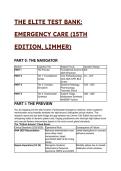
THE ELITE TEST BANK:
EMERGENCY CARE (15TH
EDITION, LIMMER)
PART 0: THE NAVIGATOR
Section Cognitive Tier Subject Focus Question Range
PART I The Preview Foundational Axioms & N/A
2026 Directives
PART II Tier 1: Foundational Core Pathophysiology, Q1 – Q15
Syntax AHA 2025 CPR, BLS
Syntax
PART II Tier 2: Complex Systems Pathology, Q16 – Q35
Simulation Pharmacology,
Traumatic Shock
PART II Tier 3: Grandmaster Austere Triage, Q36 – Q60
Synthesis Multisystem Synthesis,
NAEMSP Vectors
PART I: THE PREVIEW
You are stepping into the elite echelon of prehospital emergency medicine, where academic
memorization must instantly translate into split-second, field-grade clinical intuition. This
research report and test bank bridge the gap between the Limmer 15th Edition text and the
unforgiving reality of dynamic patient care, forging practitioners who intercept high-stakes errors
and execute flawless interventions based on the most current global standards.
The "Critical Axioms" Cheat Sheet:
Clinical Standard (2025/2026) Operational Rule Consequence of Failure
AHA 2025 Resuscitation Naloxone administration must Lethal interruptions in coronary
never delay chest perfusion pressure.
compressions; target
post-ROSC MAP of 65 mmHg
strictly.
Sepsis Imperative (Ch 24) Recognize Systemic Mortality spikes due to missed
Inflammatory Response distributive shock windows.
Syndrome (SIRS) and qSOFA
,Clinical Standard (2025/2026) Operational Rule Consequence of Failure
early to initiate rapid alerts.
Hemorrhagic Trauma Triad TXA within 1–3 hours for shock Coagulopathy and fatal
; deploy pelvic binders for exsanguination.
unstable fractures over arbitrary
fluid dumping.
Airway/Ventilation Rule Utilize Video Laryngoscopy Iatrogenic hypoxia from failed
(VL) and Supraglottic Airways advanced airway attempts.
(SGA) as primary rescue
interventions.
Documentation Imperative The use of Artificial Intelligence Severe legal liability and
(AI) to write Patient Care medical record invalidation.
Report narratives is strictly
prohibited.
PART II: THE ELITE TEST BANK
Q1: You are treating an adult patient in cardiac arrest. According to the updated 2025 AHA
Guidelines, a bystander reports they suspect an opioid overdose. Which action regarding
Naloxone administration is the MOST APPROPRIATE? A) Administer 2 mg of IN Naloxone prior
to initiating chest compressions to reverse the respiratory depression. B) Delay defibrillation for
up to 2 minutes to allow an IV push of Naloxone to circulate. C) Administer Naloxone
concurrently with resuscitation efforts, ensuring it does not delay high-quality chest
compressions. D) Withhold Naloxone entirely, as it is strictly contraindicated once cardiac arrest
has occurred.
● The Answer: C (Administer Naloxone concurrently with resuscitation efforts, ensuring it
does not delay high-quality chest compressions.)
● Distractor Analysis:
○ A is incorrect: The 2025 AHA guidelines mandate that compressions are the
supreme priority; administering an antidote must never delay mechanical
circulation.
○ B is incorrect: Defibrillation of a shockable rhythm takes absolute precedence over
pharmacological interventions.
○ D is incorrect: Naloxone is indicated in suspected opioid-induced arrest, provided it
does not disrupt the core CPR algorithm.
The Mentor's Analysis: Opioids cause respiratory arrest, which progresses to cardiac arrest.
Once the heart stops, the priority shifts from the opioid receptors to mechanical tissue perfusion.
When facing an opioid-induced code, the immediate priority is high-quality compressions. By
utilizing concurrent administration, you bypass the common trap of prioritizing an antidote over
basic life support. Professional/Academic Intuition: Compress first, reverse second. Dead
tissue cannot respond to an antidote.
Q2: A patient achieves Return of Spontaneous Circulation (ROSC) following a 15-minute
ventricular fibrillation arrest. Based on the 2025 AHA Guidelines for post-cardiac arrest care,
what is the MOST ACCURATE hemodynamic target? A) A Mean Arterial Pressure (MAP) of 65
mmHg. B) A systolic blood pressure strictly above 120 mmHg. C) A target end-tidal CO2
(EtCO2) of 20 mmHg to prevent cerebral edema. D) Immediate prophylactic administration of
Epinephrine to maintain vascular tone.
● The Answer: A (A Mean Arterial Pressure (MAP) of 65 mmHg.)
, ● Distractor Analysis:
○ B is incorrect: Legacy guidelines targeted an SBP of 90, but current standards
focus specifically on a MAP of 65 mmHg to ensure adequate organ perfusion.
○ C is incorrect: Normal EtCO2 post-ROSC should be 35–45 mmHg; 20 mmHg
indicates lethal hyperventilation.
○ D is incorrect: Epinephrine is titrated only for refractory hypotension, not as a
universal prophylactic measure post-ROSC.
The Mentor's Analysis: Post-resuscitation hemodynamics are incredibly fragile. When facing a
post-ROSC patient, the immediate priority is protecting the ischemic brain and heart. By utilizing
a specific MAP of 65 mmHg , you bypass the common trap of relying on systolic pressures that
fail to account for diastolic coronary perfusion. Professional/Academic Intuition: Systolic
measures the pump; MAP measures the perfusion. Target 65.
Q3: A full-term neonate is delivered precipitously in the field. The infant is vigorous, crying
loudly, and has good muscle tone. According to the 2025 AHA Neonatal Resuscitation
Guidelines, what is the FIRST priority regarding the umbilical cord? A) Clamp and cut the cord
immediately to prevent polycythemia. B) Delay cord clamping for at least 60 seconds while
drying and stimulating the infant on the mother's abdomen. C) Milk the cord aggressively toward
the infant for 30 seconds before clamping. D) Clamp the cord only after the placenta has been
fully delivered.
● The Answer: B (Delay cord clamping for at least 60 seconds while drying and stimulating
the infant on the mother's abdomen.)
● Distractor Analysis:
○ A is incorrect: Immediate clamping is an outdated practice for vigorous infants and
deprives the neonate of critical blood volume and iron stores.
○ C is incorrect: Cord milking guidelines have been updated to reflect risks, and it is
not universally recommended for term, vigorous infants.
○ D is incorrect: Waiting for placental delivery (often 10–30 minutes) is unnecessary
and delays potential transport.
The Mentor's Analysis: The transition from fetal to neonatal circulation requires adequate
blood volume. When facing a healthy field delivery, the immediate priority is temperature
management and volume preservation. By utilizing delayed cord clamping (≥60s) , you bypass
the common trap of mechanically inducing neonatal hypovolemia. Professional/Academic
Intuition: If the infant is vigorous, the cord stays intact for 60 seconds. Mother and baby share
the transition.
Q4: A responsive 4-year-old child is choking on a small toy. They are coughing weakly and
exhibit inspiratory stridor. Based on the 2025 AHA Guidelines for Foreign Body Airway
Obstruction (FBAO), what is the MOST APPROPRIATE sequence of actions? A) Perform blind
finger sweeps to dislodge the object. B) Administer 5 back blows followed by 5 abdominal
thrusts. C) Perform continuous abdominal thrusts until the object is expelled. D) Place the child
supine and begin chest compressions immediately.
● The Answer: B (Administer 5 back blows followed by 5 abdominal thrusts.)
● Distractor Analysis:
○ A is incorrect: Blind sweeps are strictly forbidden as they push the object deeper
into the glottic opening.
○ C is incorrect: While previously standard for children, the 2025 guidelines
reintroduced the combination of back blows and abdominal thrusts for responsive
adults and children.
○ D is incorrect: Chest compressions are reserved for patients who become
EMERGENCY CARE (15TH
EDITION, LIMMER)
PART 0: THE NAVIGATOR
Section Cognitive Tier Subject Focus Question Range
PART I The Preview Foundational Axioms & N/A
2026 Directives
PART II Tier 1: Foundational Core Pathophysiology, Q1 – Q15
Syntax AHA 2025 CPR, BLS
Syntax
PART II Tier 2: Complex Systems Pathology, Q16 – Q35
Simulation Pharmacology,
Traumatic Shock
PART II Tier 3: Grandmaster Austere Triage, Q36 – Q60
Synthesis Multisystem Synthesis,
NAEMSP Vectors
PART I: THE PREVIEW
You are stepping into the elite echelon of prehospital emergency medicine, where academic
memorization must instantly translate into split-second, field-grade clinical intuition. This
research report and test bank bridge the gap between the Limmer 15th Edition text and the
unforgiving reality of dynamic patient care, forging practitioners who intercept high-stakes errors
and execute flawless interventions based on the most current global standards.
The "Critical Axioms" Cheat Sheet:
Clinical Standard (2025/2026) Operational Rule Consequence of Failure
AHA 2025 Resuscitation Naloxone administration must Lethal interruptions in coronary
never delay chest perfusion pressure.
compressions; target
post-ROSC MAP of 65 mmHg
strictly.
Sepsis Imperative (Ch 24) Recognize Systemic Mortality spikes due to missed
Inflammatory Response distributive shock windows.
Syndrome (SIRS) and qSOFA
,Clinical Standard (2025/2026) Operational Rule Consequence of Failure
early to initiate rapid alerts.
Hemorrhagic Trauma Triad TXA within 1–3 hours for shock Coagulopathy and fatal
; deploy pelvic binders for exsanguination.
unstable fractures over arbitrary
fluid dumping.
Airway/Ventilation Rule Utilize Video Laryngoscopy Iatrogenic hypoxia from failed
(VL) and Supraglottic Airways advanced airway attempts.
(SGA) as primary rescue
interventions.
Documentation Imperative The use of Artificial Intelligence Severe legal liability and
(AI) to write Patient Care medical record invalidation.
Report narratives is strictly
prohibited.
PART II: THE ELITE TEST BANK
Q1: You are treating an adult patient in cardiac arrest. According to the updated 2025 AHA
Guidelines, a bystander reports they suspect an opioid overdose. Which action regarding
Naloxone administration is the MOST APPROPRIATE? A) Administer 2 mg of IN Naloxone prior
to initiating chest compressions to reverse the respiratory depression. B) Delay defibrillation for
up to 2 minutes to allow an IV push of Naloxone to circulate. C) Administer Naloxone
concurrently with resuscitation efforts, ensuring it does not delay high-quality chest
compressions. D) Withhold Naloxone entirely, as it is strictly contraindicated once cardiac arrest
has occurred.
● The Answer: C (Administer Naloxone concurrently with resuscitation efforts, ensuring it
does not delay high-quality chest compressions.)
● Distractor Analysis:
○ A is incorrect: The 2025 AHA guidelines mandate that compressions are the
supreme priority; administering an antidote must never delay mechanical
circulation.
○ B is incorrect: Defibrillation of a shockable rhythm takes absolute precedence over
pharmacological interventions.
○ D is incorrect: Naloxone is indicated in suspected opioid-induced arrest, provided it
does not disrupt the core CPR algorithm.
The Mentor's Analysis: Opioids cause respiratory arrest, which progresses to cardiac arrest.
Once the heart stops, the priority shifts from the opioid receptors to mechanical tissue perfusion.
When facing an opioid-induced code, the immediate priority is high-quality compressions. By
utilizing concurrent administration, you bypass the common trap of prioritizing an antidote over
basic life support. Professional/Academic Intuition: Compress first, reverse second. Dead
tissue cannot respond to an antidote.
Q2: A patient achieves Return of Spontaneous Circulation (ROSC) following a 15-minute
ventricular fibrillation arrest. Based on the 2025 AHA Guidelines for post-cardiac arrest care,
what is the MOST ACCURATE hemodynamic target? A) A Mean Arterial Pressure (MAP) of 65
mmHg. B) A systolic blood pressure strictly above 120 mmHg. C) A target end-tidal CO2
(EtCO2) of 20 mmHg to prevent cerebral edema. D) Immediate prophylactic administration of
Epinephrine to maintain vascular tone.
● The Answer: A (A Mean Arterial Pressure (MAP) of 65 mmHg.)
, ● Distractor Analysis:
○ B is incorrect: Legacy guidelines targeted an SBP of 90, but current standards
focus specifically on a MAP of 65 mmHg to ensure adequate organ perfusion.
○ C is incorrect: Normal EtCO2 post-ROSC should be 35–45 mmHg; 20 mmHg
indicates lethal hyperventilation.
○ D is incorrect: Epinephrine is titrated only for refractory hypotension, not as a
universal prophylactic measure post-ROSC.
The Mentor's Analysis: Post-resuscitation hemodynamics are incredibly fragile. When facing a
post-ROSC patient, the immediate priority is protecting the ischemic brain and heart. By utilizing
a specific MAP of 65 mmHg , you bypass the common trap of relying on systolic pressures that
fail to account for diastolic coronary perfusion. Professional/Academic Intuition: Systolic
measures the pump; MAP measures the perfusion. Target 65.
Q3: A full-term neonate is delivered precipitously in the field. The infant is vigorous, crying
loudly, and has good muscle tone. According to the 2025 AHA Neonatal Resuscitation
Guidelines, what is the FIRST priority regarding the umbilical cord? A) Clamp and cut the cord
immediately to prevent polycythemia. B) Delay cord clamping for at least 60 seconds while
drying and stimulating the infant on the mother's abdomen. C) Milk the cord aggressively toward
the infant for 30 seconds before clamping. D) Clamp the cord only after the placenta has been
fully delivered.
● The Answer: B (Delay cord clamping for at least 60 seconds while drying and stimulating
the infant on the mother's abdomen.)
● Distractor Analysis:
○ A is incorrect: Immediate clamping is an outdated practice for vigorous infants and
deprives the neonate of critical blood volume and iron stores.
○ C is incorrect: Cord milking guidelines have been updated to reflect risks, and it is
not universally recommended for term, vigorous infants.
○ D is incorrect: Waiting for placental delivery (often 10–30 minutes) is unnecessary
and delays potential transport.
The Mentor's Analysis: The transition from fetal to neonatal circulation requires adequate
blood volume. When facing a healthy field delivery, the immediate priority is temperature
management and volume preservation. By utilizing delayed cord clamping (≥60s) , you bypass
the common trap of mechanically inducing neonatal hypovolemia. Professional/Academic
Intuition: If the infant is vigorous, the cord stays intact for 60 seconds. Mother and baby share
the transition.
Q4: A responsive 4-year-old child is choking on a small toy. They are coughing weakly and
exhibit inspiratory stridor. Based on the 2025 AHA Guidelines for Foreign Body Airway
Obstruction (FBAO), what is the MOST APPROPRIATE sequence of actions? A) Perform blind
finger sweeps to dislodge the object. B) Administer 5 back blows followed by 5 abdominal
thrusts. C) Perform continuous abdominal thrusts until the object is expelled. D) Place the child
supine and begin chest compressions immediately.
● The Answer: B (Administer 5 back blows followed by 5 abdominal thrusts.)
● Distractor Analysis:
○ A is incorrect: Blind sweeps are strictly forbidden as they push the object deeper
into the glottic opening.
○ C is incorrect: While previously standard for children, the 2025 guidelines
reintroduced the combination of back blows and abdominal thrusts for responsive
adults and children.
○ D is incorrect: Chest compressions are reserved for patients who become


