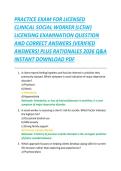
Licensed Professional Clinical Counselor
(LPCC) Certification Exam Questions and
Correct Answers (Verified Answers) Plus
Rationales 2026 Q&A | Instant
Download Pdf
1. What is the primary purpose of informed consent in counseling?
A. To diagnose a client
B. To explain the counseling process and client rights
C. To guarantee treatment success
D. To collect insurance information
Answer: B
Rationale: Informed consent ensures clients understand the counseling process,
potential risks and benefits, confidentiality, and their rights before treatment
begins.
2. Confidentiality in counseling means:
A. Sharing client information with anyone who asks
B. Protecting client information except when disclosure is legally or ethically
required
C. Never documenting sessions
D. Discussing clients with friends
Answer: B
Rationale: Counselors must protect client privacy while recognizing legal and
ethical exceptions.
,3. Which document outlines ethical standards for professional counselors?
A. DSM-5-TR
B. ACA Code of Ethics
C. HIPAA Privacy Rule
D. ICD-10-CM
Answer: B
Rationale: The American Counseling Association (ACA) Code of Ethics provides
professional ethical guidelines for counselors.
4. The primary purpose of a clinical assessment is to:
A. Bill insurance
B. Gather information about the client
C. Replace counseling sessions
D. Predict the future
Answer: B
Rationale: Assessment collects information needed for diagnosis, treatment
planning, and monitoring progress.
5. A mental status examination primarily evaluates a client's:
A. Blood pressure
B. Current psychological functioning
C. Family income
D. Physical strength
Answer: B
Rationale: The mental status exam assesses appearance, mood, cognition,
perception, and thought processes.
, 6. Which manual is most commonly used for diagnosing mental disorders in the
United States?
A. ICD-11
B. DSM-5-TR
C. APA Publication Manual
D. Merck Manual
Answer: B
Rationale: The DSM-5-TR is the standard diagnostic reference used by mental
health professionals in the U.S.
7. A diagnosis should be based primarily on:
A. Personal opinion
B. Established diagnostic criteria
C. Family expectations
D. Client income
Answer: B
Rationale: Diagnoses should be based on recognized diagnostic criteria and
clinical assessment.
8. Which counseling theory emphasizes self-actualization?
A. Behavioral Therapy
B. Person-Centered Therapy
C. Psychoanalysis
D. Reality Therapy
Answer: B
Rationale: Person-Centered Therapy, developed by Carl Rogers, emphasizes self-
actualization and unconditional positive regard.
(LPCC) Certification Exam Questions and
Correct Answers (Verified Answers) Plus
Rationales 2026 Q&A | Instant
Download Pdf
1. What is the primary purpose of informed consent in counseling?
A. To diagnose a client
B. To explain the counseling process and client rights
C. To guarantee treatment success
D. To collect insurance information
Answer: B
Rationale: Informed consent ensures clients understand the counseling process,
potential risks and benefits, confidentiality, and their rights before treatment
begins.
2. Confidentiality in counseling means:
A. Sharing client information with anyone who asks
B. Protecting client information except when disclosure is legally or ethically
required
C. Never documenting sessions
D. Discussing clients with friends
Answer: B
Rationale: Counselors must protect client privacy while recognizing legal and
ethical exceptions.
,3. Which document outlines ethical standards for professional counselors?
A. DSM-5-TR
B. ACA Code of Ethics
C. HIPAA Privacy Rule
D. ICD-10-CM
Answer: B
Rationale: The American Counseling Association (ACA) Code of Ethics provides
professional ethical guidelines for counselors.
4. The primary purpose of a clinical assessment is to:
A. Bill insurance
B. Gather information about the client
C. Replace counseling sessions
D. Predict the future
Answer: B
Rationale: Assessment collects information needed for diagnosis, treatment
planning, and monitoring progress.
5. A mental status examination primarily evaluates a client's:
A. Blood pressure
B. Current psychological functioning
C. Family income
D. Physical strength
Answer: B
Rationale: The mental status exam assesses appearance, mood, cognition,
perception, and thought processes.
, 6. Which manual is most commonly used for diagnosing mental disorders in the
United States?
A. ICD-11
B. DSM-5-TR
C. APA Publication Manual
D. Merck Manual
Answer: B
Rationale: The DSM-5-TR is the standard diagnostic reference used by mental
health professionals in the U.S.
7. A diagnosis should be based primarily on:
A. Personal opinion
B. Established diagnostic criteria
C. Family expectations
D. Client income
Answer: B
Rationale: Diagnoses should be based on recognized diagnostic criteria and
clinical assessment.
8. Which counseling theory emphasizes self-actualization?
A. Behavioral Therapy
B. Person-Centered Therapy
C. Psychoanalysis
D. Reality Therapy
Answer: B
Rationale: Person-Centered Therapy, developed by Carl Rogers, emphasizes self-
actualization and unconditional positive regard.