

Written by students who passed Immediately available after payment Read online or as PDF Wrong document? Swap it for free 4.6 TrustPilot
logo-home
Exam (elaborations)

NUR 2356 / NUR2356 Multidimensional Care I (MDC 1) Exam 1 (Latest 2026/2027 Update) | Rasmussen | Complete Study Guide | Verified Questions & Answers | 100% Correct Solutions | Grade A

Rating
-
Sold
-
Pages
96
Grade
A+
Uploaded on
01-07-2026
Written in
2025/2026

NUR 2356 / NUR2356 Multidimensional Care I (MDC 1) Exam 1 (Latest 2026/2027 Update) | Rasmussen | Complete Study Guide | Verified Questions & Answers | 100% Correct Solutions | Grade A What does Maslow believe about the hierarchy of needs? a person could not meet the needs of love and belonging and self-esteem without meeting basic physiological needs . herbal supplements & their usage Ginko Biloba: Depression, memory Ginseng: depression Kava: Depression, anxiety Echinacea: common cold Chamomile: calming and soothing properties. Goldenseal: Stimulates immune system and bile secretion Melatonin: sleep Kava Herbal Antianxiety Agent and Depression Name the pain scales 1-10 FACES FLACC CRIES FLACC pain scale F:face L:legs A:activity C:cry C:consolability Things to know about pain assessment PQRST If treatment works It's subjective Ginko Biloba Depression and memory (dementia) Ginseng fatigue and depression Echinacea common cold Goldenseal Stimulates immune system and bile secretion Chamomile calming and soothing properties. Melatonin sleep When dealing with maslow hierarchy of needs, what is done first? ABCs!! Maslow Hierarchy of needs Self-Actulaization, Esteem, Safety & Security, Love & Belonging, & physiological SelfActualization Met when the person reaches maximum potential and acts in an unselfish manner. Examples of self actualization (e.g., extent to which goals are achieved, role performance, Personal growth, reaching one's highest potential) Catholic End-of-Life indviduals may be brought to hospitalized patients by a priest, deacon, or designated lay Eucharis- tic minister A Roman Catholic who is seriously ill might wish to receive the sacrament of anointing the sick. (last rites) Last Rites Anointing of the Sick (Catholic) Mormons follow a strict health code, known as the Word of Wisdom Word of Wisdom (Mormon Culture) advises healthful living and pro- hibits the use of tea, coffee, alcohol, and tobacco Mormons believe in life before and after death; thus, death repre- sents the passage into another life phrase (Mormon) Nurses may remove garments before surgery, but it must at all times be considered intensely private and be treated with respect Mormons wear garments at all times except for hygiene, elimination, or being intimate in marriage Nursing Interventions to achieve self actualization Provide art supplies Esteem Met when a person feels a sense of accomplishment and are recognized by others for that achievement. Esteem tier consists of? (Maslow Hierarchy of needs) 1. Feeling of accomplishment 2. Body image 3. Pride in achievements 4. Admiration from others Self-Actualization tier consists of? (Maslow Hierarchy of needs) 1. Achieving one's full potential 2. Extent to which goals are achieved 3. Role performance Nursing Interventions to achieve esteem Facilitating visits from loved ones Safety and security freedom from physical harm and feelings of fear and anxiety. Safety and security tier consists of? (Maslow Hierarchy of needs) 1. Protection from physical harm 2. Adequate shelter 3. Freedom from fear and anxiety 4. Safe from falls 5. Treatment 6. Side effects 7. The need for psychological security Physiological tier consists of (Maslow Hierarchy of needs) -Air-Food - Nutrition -Water - Temperature regulation - Elimination -Rest - Sleep effects -Sex - Physical Activity - mobility assessment - Blood flow (perfusion) is necessary to meet other basic needs Nursing Interventions to achieve safety and security Prevent falls & Communicating concerns Love and belonging needs are met when the person seeks personal relationships with others. Love/Belonging tier consists of? (Maslow Hierarchy of needs) 1. Intimate relationship 2. Friends 3. Social supports Nursing Interventions to achieve love & belonging Referring a patient to a support group Physiological needs are essential for maintenance of life Examples of physiological needs (e.g., oxygen, water, food, air, water, shelter, sleep and rest, elimination, activity, temperature regulation) Nursing Interventions to achieve physiological needs 1. Helping patient to eat dinner 2.Changing a patients oxygen tank 3.Ensure patient is getting enough rest Basic physiological needs (needs that are essential for the maintenance of life) Air, Food (Nutrition), water, temp regulation, elimination, rest (sleep effects), sex, physical activity (mobility assessment), blood flow (perfusion) is necessary to meet other basic needs One of the most critical nursing interventions the nurse has is the ability to monitor and interpret the client's? vital signs. Interventions for elevated/decreased vitals continue to monitor patient recheck vitals Regulation or thermoregulation is determined using the client's temperature. Normal Temp 96.4 to 99.5 degrees Fahrenheit Different methods temperature can be taken Orally, Axillary Rectally Temporal Artery Tympanic Hypothermia: temperature below the normal range that may be related to exposure to a cold environment -Temp lower than 95 Hypothermia Preventions ii. Cover the pt with blankets iii. Use heating devices iv. Increase room temp v. Infuse warm solutions vi. Remove wet clothing Hyperthermia temperature above the normal range that may be related to exercise or exposure to an abnormally hot environment -Temp is greather than 104 degrees What is perfusion? Adequate arterial blood flow to the peripheral tissue. What does peripheral and central perfusion relate to? Peripheral=peripheral tissue Central=major organs Definition of pulse? rhythmic expansion of an artery produced when a bolus of oxygenated blood is forced into it by contraction of the heart. Bradycardia pulse rate less than 60 bpm Tachycardia pulse rate beats higher than 100/min Influences for pulses? o Exercise o Age o Gender o Anxiety o Pain Documentation for pulse? o Rhythm - even tempo o Strength (0-4+, absent, weak or thready, normal, strong, bounding) o Regular rhythm: 30 seconds x 2- or 15-seconds x 4o Irregular rhythm (regular/irregular); full minute; apical. o •Amplitude is what is measured o •Rate, rhythm (regular or irregular), and quality (strong, weak or bounding) Quality of pulse strong, weak or bounding Strength of pulse 0 = absent 1+ = thready or weak 2+ = normal 3+ = strong 4+ = bounding Rhythm of pulse regular or irregular Peripheral pulses (Normal, bradycardia, tachycardia) - Normal= 60-100 beats per minute o Bradycardia = beats below 60/min o Tachycardia= beats higher than 100/min rhythm of respiration even, regular Depth of respiration deep, moderate, shallow Inspiration drawing air into the lungs (diaphragm contracts lungs expand); Breathing in expiration expulsion of air from the lungs (diaphragm relaxes lungs recoil); breathing out systolic blood pressure ventricles contract, 90-120, maximum pressure on the arteries Pain assessment before and after treatment Scale of 0-10(0 being no pain 10 being the worst pain you have ever felt) Assessment of pain history · P: Provocation and Palliati o no What causes it? o What makes it better? o What makes it worse? · Q: Quality and Quantity o How does it feel, look, or sound? o How much of it is there? · R: Region and Radiationo Where is it? o Does it spread? · S: Severity and Scale o Does it interfere with activities? o How does it rate on a severity scale of 1-10? · T: Timing and Type of Onseto When did it begin? o How often does it occur? o Is it sudden or gradual? What is communication? Two-way process of sending & receiving messages Diastolic Blood Pressure (DBP) ventricles relax, 60-80, minimum pressure on the arteries Hyperthermia Preventions ii. Wear lightweight, loose-fitting clothing. iii. Avoid excessive sun exposure. iv. Stay indoors with fans or air conditioning when outside v. temperatures are elevated. vi. Limit consumption of alcohol and caffeine. vii. Apply sunscreen of at least 30 SPF. viii. If overheated, take a cool water shower or bath. Pulse Pulse allows the nurse to assess the how adequate the heart is pumping the blood to the body Normal Pulse Values 60 to 100 beats per minute Pulse points carotid radial femoral popliteal posterior tibial dorsalis pedis arteries Rate of pulse number of times the heart beats per minute; varies person to person rhythm of pulse regular or irregular quality of pulse strong, weak or bounding Normal BP values 120/80 cuff size the length needs to be 80% of the arm circumference width of the cuff should be 40% of the arm circumference What can occur if you have the wrong cuff size? false reading Hypotension related to dehydration from inadequate fluid intake, from diarrhea, elevated temp fits well with this unit. Hypotension Nursing interventions · Vital signs Initially increase HR and BP · Discuss other signs and symptoms associated with fluid loss · Identify high-risk populations · I & O, daily weights as examples Normal Resp Values 12-20 breaths per minute Resp Rate, Rhythm, and depth Normal, deep, or shallow Determine clients Respiratory effort (nasal flaring; use of accessory muscles, and body positioning) Pulse Ox measures the oxygen level in the blood Hypoxia is a low oxygen level in the blood, which leads to symptoms that may affect the client's basic care and comfort needs. Interventions to treat hypoxia i. Monitor for manifestations of respiratory depression, such as decreased respiratory rate and decreased level of consciousness. Notify the provider if findings are present. Respiratory distress interventions iii. Position the client for maximum ventilation (Fowler's or semi-Fowler's position). iv. Complete a focused respiratory assessment. v. Promote deep breathing, and use supplemental oxygen as prescribed. vi. Stay with the client, and provide emotional support to decrease anxiety. vii. Promote airway clearance by encouraging coughing and oral/oropharyngeal suctioning if necessary. stridor, wheezing, crackles, pleural rubs or crepitus, as these are associated with respiratory distress. Stridor harsh, high pitched, crowing like sound Stridor is generally caused by an obstruction or narrowing of the upper airway resulting from infections, blockages, foreign bodies, or tracheal anomalies. Wheezing high or low pitched whistling sound wheezing is generally caused by a combination of bronchoconstriction, mucus plugging and edema of the bronchioles Crackles sharp sounds heard on inspiration Dry crackles the sound one might hear when rubbing several hairs together close to the ear are associated with small airway collapse and lung disease. Moist crackles sound wet on auscultation and are related to the accumulation of alveolar fluid. Pleural rubs sounds of inflamed pleural surfaces rubbing over each other, they are loud, low pitched and localized Grunting is a short, deep, guttural sound heard during expiration. Grunting is caused when the child exhales against a partially closed glottis in an attempt to keep the bronchioles open and prevent closure of the alveoli. Grunting can be associated with pulmonary edema, pneumonia or atelectasis, a partially expanded lung. Crepitus is a crinkly, crackling or grating sound or feeling in the subcutaneous tissue. It can be an indication that free air has entered the tissue. Review signs and symptoms of hypoxia Hypoxia is a low oxygen level in the blood, which leads to symptoms that may affect the client's basic care and comfort needs. Hypoxia S/S Dyspnea Elevated blood pressure Increase respirations Increased pulse Pallor/pale skin Cyanosis/blue-tinged lips or oral cavity Anxiety Restlessness Confusion Drowsiness Hypoxia Interventions · Oxygen therapy (O2 delivery methods, amount of O2 delivered per device, safety education) · Incentive spirometry · Turn, Cough and Deep Breath · Pursed lip breathing · Collecting a sputum specimen as examples who is the most reliable source of pain? Patient Non verbal cues for pain Grimacing, guarding, and holding or touching the affected area Verbal cues for pain describing quality -sharp, dull, aching, mild, constant Pharmacological Interventions i. Analgesics are the mainstay for relieving pain. ii.NSAIDs iii.Opioids 1.PCA 2.IM 3.Transdermal 4.Epidural Non pharmacological interventions i. Mind-body practices (yoga,chiropractic manipulation) ii. Cognitive approaches (meditation, distraction) iii. Natural products (herbs, oils) iv. Exercise v. Relaxation techniques vi. Cutaneous Stimulation vii. Warm and colf therapies How to do pain assessment PQRST - Pain rating scales 0-10 - reassess pain after interventions given to reduce pain (eg. Analgesia) have had time to work - Assessment of pain history Types of pain Acute Cutaneous Visceral Phantom Somatic Radiating Referred Neuropathic Chronic Fall safety Lighting Visualize patient Orient to enviornment 2 bed rails Fire safety Oxygen RACE PASS Smoke detectors Code Red Priority safety for different age groups Middle age drugs Adolescent suicide Elderly falls Infant Suffocation Sentinel Event an unexpected occurrence involving death or serious physical or psychological injury, or the risk thereof within hospital Examples of Sentinel Events Suicide Death during/after labor Wrong place surgery Surgical error Infant abduction in hospital Medication errors Safe patient transfer techniques Use mechanical lift Nonslip shoes/socks Don't twist back Don't pull on neck Priority hygiene practices Dry skin folds Moisturized skin promote venous retour Oral hygiene principles Encourage pt assist HOB (Head of bed) elevated Unconscious-suction NPO-Oral care q2hrs Perineal Care Principles Wipe front to back Clean rag and water Away urethral meatus Cutaneous pain Arises from burning your skin like on a hot iron or from touching a hot pan on the stove. Visceral pain Caused from deep internal disorders such as menstrual cramps, labor pains, or gastrointestinal infections. Deep Somatic pain Originates from the ligaments, tendons, nerves, blood vessels and bones. Examples would be fractures or sprains. Radiating pain Starts at an origin but extends to other locations. Example: pain from a sore throat might extend to ears and head. Referred pain Occurs in an area distant from the site of origin. Example: pain from a heart attack might be felt in the left arm or jaw. Phantom pain Pain that is perceived from an area that has been surgically or traumatically removed. Example: pain from an amputated limb. Neuropathic pain Results from an injury of one or more nerves where messages regarding pain are transmitted without a pain stimulus occurring. Acute pain Short duration, rapid onset, and associated with some kind of injury. Chronic pain Last 6 months or longer and interferes with activities of daily living. Therapeutic communication Client-centered communication directed to achieve the patients' goal. (Avoid asking "why") Five qualities of therapeutic relationship Empathy Respect Genuineness Concreteness Confrontation Empathy A desire to understand and be sensitive to the feelings and situation of another person. Put yourself in the client's place, mentally and emotionally. Respect Allow the client to make choices. Be flexible when meeting the needs of each client. Genuineness Respond honestly. If the answer is not known to you, do not guess. Tell the client you need assistance prior to answering the question. Concreteness Provide your answers in specific understandable terms. Confrontation Request the client express his or her thoughts clearly so you can understand the meaning of the communication. Therapeutic Responses & Techniques - Active Listening - Cultural competence - Don't interrupt - Veracity - Fidelity - Establishing Trust - Being Assertive - Restating, Clarifying, and Validating Messages - Interpreting Body Language and Sharing Observations - Exploring Issues - Using Silence - Summarizing the Conversation Why incident reports? Lessen future risks Medication errors Needle sticks Falls Non therapeutic responses & Techniques -Asking Too Many Questions - Asking Why - Fire-Hosing Information - Changing the Subject Inappropriately - Failing to Probe - Offering Advice - Providing False Reassurance - Stereotyping - Using Patronizing Language Opened questions a. specify a topic to be explored, but phrase it broadly to encourage the patient to elaborate Closed ending questions a. those that can be answered with a "yes," "no," or other short, factual answer. Barriers of communication will discourage the client from sharing information openly with the nurse. Barriers of communication a. Asking too many questions b. Offering advice c. Changing the subject d. Expressing approval or disapproval e. Providing false reassurance f. Stereotyping g. Using patronizing language Communication with visual, hearing, speech and cognitive patients a. Be positive and patient b. Provide forms of nonverbal communication c. Use gestures d. Use short sentences when communicating e. Be concrete and specific f. Call client by name g. Minimize environmental noise h. Face the client when speaking Communication with hearing impaired patients o Inquire about possible hearing aid devices o Talk slowly, and enunciate o Avoid slang words or complex jargon Communication with visual impaired patients -Guide dogs -Braille -Auditory communication -Assisted devices such as walking sticks Communication with speech impaired patients o Nonverbal communication is key (hand gestures, picture board) o Family assistance o Provide comfortable environment that allows pt to practice speaking o Possible refer to speech pathologist Communication for cognitive impaired patients o Do not use in-room intercom to speak to pt o Reduce environmental distractions o Approach patient directly o Don't rush the client Nursing actions/interventions for communication o Be positive and patient o Call client by their preferred nameo Minimize environmental noise o Provide forms of nonverbal communication o Use gestures o Be concrete and specific o Keep eye contact (hearing impaired patients will read your lips) What is socialization? learning how to become a member of a society or a group. What is acculturation? an individual assumes the characteristics of a culture they just immigrated too What is assimilation? a new member will learn and eventually take essential values, beliefs, and behaviors of the dominant culture gradually. What are stereotypes? considers everyone are the same (ex. Cultural practices, health treatments, illnesses) under their racial or ethnic group What are the phases of therapeutic relationships? Pre-interaction Orientation Working phase Termination phase Pre interaction phase gathering info about client before meeting client Orientation phase begins when you meet the client and introduce yourself and role in the relationship ● Build rapport and trust Working phase the bulk of the therapeutic communication; the active part of the relationship ● Nurse communicates caring, the patient expresses thoughts and feelings, and mutual respect is maintained Termination phase conclusion of the relationship ● Ex: end of shift; client is discharged Personal space is boundary lines that determine how close another person can come Intimate Distance is the area immediately surround- ing people that they define as their "private space." Personal Distance 18 inches to 4 feet. Social Distance 4 to 12 feet. It is used in more formal interaction or when communicating with a group of individuals at the same time. Public Distance 12 feet. This distance requires loud and clear enunciation for communication. An interpreter is specially trained to provide the meaning behind the words Serve as a cultural broker by conveying the client's responses to questions and by providing general information about the client's culture. Recognize empathy by a. Adapt to different styles, tone, vocabulary and behavior b. Place yourself in the patients situation c. Understand the needs (be sensitive) Is silence a communication barrier? No, Remaining attentive and waiting for the client to compose the next statement in the conversation enhances therapeutic communication. What does the acronym stand for (SBAR)? Situation, Background, Assessment, Recommendation-Readback What types of situations are appropriate for use of SBAR? i. Interdisciplinary communication ii. Critical situations iii. Rapid response needed iv. Nurse- physician communication v. Team communication and collaboration Socialization learning how to become a member of a society or a group. Acculturation An individual assumes the characteristics of a culture they just immigrated too. Assimilation A new member learn and take essential values, beliefs and behaviors of the dominant culture gradually. Stereotype Considering everyone are the same under their racial or ethnic group. i. Assuming everyone from that culture practices health or treats illnesses the same way. Example pf stereotype All Asians are naturally intelligent. All Africans are naturally athletes or runners. Archetype Something recurrent that makes beliefs that everyone has under the same racial or ethical group Ex. of Arcgetype All Irish population will have reddish tone hair color. All Mexican will have brown eyes. All Europeans will have light color skin. Social effect in meeting basic care & comfort needs o Close social organization (Man is dominant and female is housemaker) o Social organization related to birth, death, illness, grieving & mourning (Delaying treatment with home remedies)o Kinship and social ties (VIP care compared to homeless) Health effects in meeting basic care & comfort needs o Scientific (hospitals, clinics, medications)o Magico-Religious: alternative or indigenous (supernatural forces of healing, rituals) o Holistic: need for harmony and balance of the body with nature (yoga, meditation) Folk medicine effects in meeting basic care & comfort needs o Beliefs and practices an individual performs when ill than conventional medicine (eating soup, resting, folk healer, teas, circumcision) o Passed down by generations to generations Environmental effect in care i. person's beliefs that they could change the outcomes of an illness without seeking help. Biological effect in care i. Genetic and physical aspects that determine situations ii. Ex. African American Females have a higher risk for breast cancer, Pacific Islanders and Native Hawaiians have a higher rate of uncontrolled diabetes and hypertension Health belief system Individual perception of health 3 Major Health Beliefs 1. Scientific 2. Magico-Religious 3. Holistic Holistic belief need for harmony and balance of the body with nature (yoga, meditation, etc.) Magico Religious belief - "alternative or indigenous" (supernatural forces of healing, rituals) Scientific belief Hospitals, clinics, medications, etc. Folk Medicine ii. Beliefs and practices an individual performs when ill than conventional medicine. iii. Passed down by generations to generations Examples of folk medicine a. Eating soup and resting when getting a cold b. Placing ointments c. Having a folk healer (North America, a professional healthcare provider is considered a folk healer) d. Circumcision after male birth e. Washing the death before burial f. Drinking teas Complementary and alternative therapy (CAM) inclusion of different approaches to achieve health Examples of Complementary and alternative therapy (CAM) 1. Pet Therapy 2. Massages 3. Biofeedback 4. Exercise & Fitness 5. Nutritional Supplements 6. Health-Focused TV 7. Music Therapy 8. Acupuncture 9. Acupressure 10. Disease Management 11. Aromatherapy Cultures that refuse blood? Jehovah witness Jehovah witness refuse Transplants & blood transfusions Do NOT self donate blood Prioritization and Maslow's Hiearchy ABCs 1ST!! Phsyiological Safety & Security (In that order) Prioritization of abnormal vital signs ABCs then physiologic Airway Breathing Circulation/Cardiac Techniques to promote/help therapeutic nurse patient relationships Respect Individualized care Assertiveness Define empathy in 1-3 words Caring Self in patients place Compassion Understanding Listening Communicatio with patients with aphasia Practice patience Speak clearly Closed ended questions What would be the proper follow up for cultures that refuse blood? ● Never force ● Educate the patient on why you would give blood ● Document why the reason the patient refused ● Try to find alternatives Cultures that refuse medications? Christian Scientists What would be the proper follow up for cultures that refuse medication? - Documentation why they refused - Never Force - Explain/Educate to the patient why you are giving them the medication - Try to find alternatives What are the risk factors for people with narcolepsy? a. Driving, working, or operating machinery Promote and prevent skin injuries turn patient every 2 hours, keep clean and dry Promote & prevent shearing injuries? use lift and not drawsheet What does bathing promote? a. Hygiene and circulation Different types of bathing Assist Bath Partial Bath Bed Bath Towel Bath Bag bath Basin & Water bath Shower Assist Bath Nurse helps the patient with areas that may be difficult to reach Partial Bath Cleanse only the areas that may cause odor or discomfort Bed Bath For patients who must remain in bed but who are able to bathe themselves. - You will assist by placing the bath supplies on the bedside stand or overbed table. Towel Bath Type of bed bath in which you place a large towel and a bath blanket in a plastic bag, saturate them with a warmed, commercially prepared mixture, and use them to bathe the patient. - No need to towel-dry the patient due to solution drying quickly Bag Bath: Modification of the towel bath, in which you use 8 to 10 washcloths instead of a towel and bath blanket. Basin and Water Bath Type of bed bath, you use a disposable basin with water; washcloths; lotion; and a pH-balanced, no-rinse soap or a chlorhexidine and water solution. Shower Most ambulatory patients prefer a shower. It is a time- saver and refreshing as well as cleansing. Order of bed bath ● Use prepackaged bathing products. ● Check the temperature of the packaged bath wipes after microwaving. ● Avoid chilling or tiring the patient. ● Bathe the patient following the principles of "head to toe" and "clean to dirty." ● For extremities, cleanse from distal to proximal. ● Use a new wipe for cleansing the perineum and whenever the wipe becomes soiled. ● Perform hand hygiene when moving from a contaminated body part to cleanse a clean body part. Priority assessments (think ABC's, who would you see first) a. A: Airway b. B: Breathing c. C: Cardiac Know delegation to other staff, like Nurse Assistants No assessments, double check if they find a critical finding Skin integrity (how to prevent pressure ulcers) a. Turn every 2 hours b. keep area dry Skin integrity (How to prevent shearing and friction) a. Use a lift- don't use drawsheet Restraints should i. Never interfere with treatment ii. Restrict movement as little as is necessary iii. Fit properly and be as discreet as possible iv. Be easy to remove or change v. Be avoided as much as possible vi. Not be used without doctor's order use least restrictive first Have pt close to nurses station What is the universal choking sign? a. Grasping the neck between the thumb and index finger b. clutching the neck with both hands What are the interventions of choking? a. Inspect toys for small, removable parts. b. Do not attach pacifiers, rattles, or other infant toys to ribbons or strings. c. Do not use sweatshirts or jackets with neck tie strings. d. Position mobiles well above the crib, out of the infant's reach. e. Keep window blind cords out of the child's reach. f. Store plastic bags away from young children in a secure place. g. Ensure that the crib is designed to meet federal regulations: Crib slats must be less than 23⁄8 inches (6 cm) apart, and the mattress must fit snugly. h. When feeding children meat, cheese, or other firm foods, cut the food into very tiny pieces. Do not give a young child hard candy, chewing gum, nuts, popcorn, grapes, or marshmallows. Supervise children's balloon play, and dispose of burst balloons promptly. What type of environment is best when interviewing? quiet environment What aids might you need when interviewing? a. Glasses, hearing aids Self determination Feeling free to decide how to do your work Autonomy independence Would you promote self determination/autonomy? a. Yes- independence How to reduce the risk of UTI a. 8-10 oz glasses of water a day b. Urinate when you feel like it c. Wipe from front to back d. Wear cotton underwear e. Urinate after sex f. avoid bubble baths g. report any symptoms promptly X. What can proper footwear prevent? a. Falls b. Foot problems like bunions or ingrown toenails Oral care should be done every ___ hours? 2 What to know about peripheral vascular disease and Diabetes? (nail care) a. Do not cut nails or put lotion on What is the Joint Commission? Non-profit organization that established the National Patient Safety Goals to ensure safety and quality care is provided to all patients. ii. Medication reconciliation, communication, National Patient Safety goals iii. Required for Medicare and Medicaid reimbursement What are Centers for Medicare & Medicaid Services (CMS)? And what do they ensure? part of the Department of Health and Human Services (HHS) that provides multiple services to the U.S. communities. Ex. Medicare, Medicaid, Affordable Care Act, Statistical Information for healthcare delivery. Ensure proper quality of care is provided and not overcharged. What do the Agency for Healthcare Research and Quality (AHRQ) do? produces evidence to make healthcare safer, higher-quality, accessible, equitable and affordable. Who do the Agency for Healthcare Research and Quality (AHRQ) work with? With the HHS as a partner for evidence. What is the American Nurses Association (ANA)? premier organization representing the nursing workforce in the U.S. and territories. what is the American Nurses Association (ANA) goal? Their goal is to foster high-standards of the nursing practices, promoting a safe and ethical work environment, bolstering nursing health and wellness, and advocate for healthcare issues that affect the nurses and public. What are some education points to teach parents with school age children on how to prevent injuries at home? .... Never Events - Senital Events Serious injuries or death to a patient that should have never happened in a hospital. (Ex. Air embolism, wrong transfusion, falls, and trauma or injuries) a. These mistakes may have been prevented with proper surveillance by the health care professionals involved in the event. Examples of never events - air embolism - wrong transfusion - Labor Death - Wrong site surgery - falls - trauma or injuries -DVT or PE after knee surgery - CAUTIs - CLABSIs - HAPIs, etc. Preventing falls at home o Exercise regularly o Take your time o Lighten loads/brighten paths Storms (Community Safety) · Deaths caused by lighting strikes is the lead cause of fatalities due to weather conditions. · The second leading cause is flooding · Education about outdoor activities during a storm is important to reduce the incidents. Motor vehicle accidents (Community Safety) · Failure to use seat belts and proper child car seats are the main factor of deadly accidents · Use of cellphones while driving increases the risk of accidents · Motor vehicle accidents are the leading cause of accidental deaths in the U.S. Radiation injury (Occupational safety) - Avoid excess radiation - Use protective equipment - TIME: limit time of exposure - DISTANCE: only perform care of patient near the patient when its essential - SHIELDING: wear protective shielding Needle stick (Occupational safety) -26% of nurses even with osha regulation - Increased risk when (stress, +12hr shifts, low skill level, lack of protective devices) Back injury (Occupational safety) - 52% nurse report back pain - Causes include transferring, repositioning, changing bed linens, & weighing patients - Preventative measures includes, using sage handling equipment, report hazards, incidents and injuries Increased risk of needlestick due to stress, +12hr shifts, low skill level, lack of protective devices Healthcare Falls a. Complete a comprehensive fall risk assessment. b. Keep the bed in the lowest position. c. Lock wheels on the bed and wheelchair if transferring the client. d. Place call light within reach. e. Keep floors dry and free of clutter. 3. Equipment related accidents a. Related to malfunction or improper use. b. Get familiar with the equipment before using it on the patient. c. Contact Biomed if the equipment is faulty and DO NOT use it Steps for fire safety in healthcare a. Know where emergency equipment is located b. Know the types of extinguishers appropriate for different types of fires c. Know how to use a fire extinguisher d. Know the location of fire alarms and the procedure for calling in a fire alarm e. Know what to do to ensure the safety of clients in the immediate area of the fire f. Know the code name for "fire" in your facility's public address system Healthcare Biological hazards a. Review the hospital policy and procedure regarding proper management of spills. Healthcare Violence a. Treat underlying medical conditions, i.e. anxiety. b. Use a calm approach. c. Do no wear anything that dangles around your neck. d. Do not go into a room alone with an angry patient. e. If there is an active shooter event, the best action is to leave the building. What is the most reported incident in healthcare settings? Falls Pathogenic causes (Community Safety) · Food-borne: Food poisoning; eggs, fish, uncooked meats, poultry, raw fruits & vegetables, milk, etc .· Water-borne: poor sanitation; Giardia lamblia, Cryptosporidium, Escherichia coli · Vector borne illnesses: Mosquitoes = West Nile, Malaria; flies, fleas, ticks, cockroaches, rodents, bird droppings, mice, etc. Air Pollution (Community Safety) outdoor or indoor. Outdoor - car, factories, power plants.Indoors - carbon monoxide, mites, smoke, mold, rodent, pets, noise. Maintenance regarding nutrition -Monitor for signs and symptoms of fluid and electrolyte imbalances -Assess skin -Urine incontinence: Teach the patient about bladder training, the patient might need an intermittent catheter or a Foley catheter -Diarrhea: provide fluid-balanced, administered medications as needed, keep accurate track of I&O. If severe diarrhea, keep patient NPO but provide IV fluids -Constipation: Encourage a high-fiber diet, use medications as needed, increase activity, increase fluid intake. Prevention regarding nutrition -Proper nutrition and hydration -Diet high in fiber (reduces the risk of colon cancer) -Exercise Waste is excreted by the body & how? GI tract (as feces) urinary system (as urine) Water Pollution (Community Safety) inadequate or untreated human, industries or agriculture waste reaches the water. Vector borne pathogenic causes Mosquitoes = West Nile, Malaria; flies, fleas, ticks, cockroaches, rodents, bird droppings, mice, etc. Water-borne pathogenic causes poor sanitation; Giardia lamblia, Cryptosporidium, Escherichia coli Food borne pathogenic causes Food poisoning; eggs, fish, uncooked meats, poultry, raw fruits & vegetables, milk, etc Equipment related accidents (Healthcare environment hazards) · Related to malfunction or improper use · Get familiar with the equipment before using it on the patient · Contact Biomed if the equipment is faulty and DO NOT use it Morse Fall Risk/Scale (Healthcare environment hazards) Fires at home (Healthcare environment hazards) o Home fires are the major cause of death and injuries o Older adults & children 5 y/o have the highest risk o Most common cause of fires: cooking fires, smoking, heating equipment, and home oxygen administration equipment (75% of home fires involves oxygen, smoking materials are the ignition source) Who is at higher risk for fires at home? Older adults & children 5 y/o Most common cause of fires cooking fires, smoking, heating equipment, and home oxygen administration equipment (75% of home fires involves oxygen, smoking materials are the ignition source) If a fire occurs call a "Code Red" or "Code yellow" depending on the institution process. Stay safe and evacuate if needed. Use RACE or PASS Fires in healthcare settings (Healthcare environment hazards) o Smoking is prohibited in healthcare facilities (think about home fires 75% are related to oxygen). Oxygen is highly used in every healthcare facility. o Our role is to ensure the patients and family follow these policies. o If a fire occurs call a "Code Red" or "Code yellow" depending on the institution process. Stay safe and evacuate if needed. Use RACE or PASS Restraints (Healthcare environment hazards) · Method use to restrict movement or access. · Use in the hospitals when the situation or all other approaches have been tried without success. · Avoid their use as much as possible by promoting commitment to reduce restraints and seclusion, educate caregivers about options, maintain 1 to 1 view of patients who are restrained or secluded, have adequate staff and involve all the staff members in the decision making. · Sometimes restraints are needed to maintain safety because it outweighs other methods. · Using rails to restrict the patient's independence is considered a restraint and can cause more harm. DO NOT use this method of restraint.· Perform constant assessment · Do not use without a Doctor's order Biological Hazards (Healthcare environment hazards) · Hand hygiene is the #1 mechanism of defense against contaminants. · As nurses our role is to maintain our patient safe and reduce the risk of cross-contamination. · Complete hand-hygiene when entering, exiting and change of gloves to help keep the patients safe. Violence (Healthcare environment hazards) · Raising in the professional healthcare system· Higher risk in the ED · Recognizing the signs are important, They include: · Anxiety, angry, acute illness that they don't understand can trigger aggression, it can escalate to physical aggression. · Gang violence is common in the ED or acute setting· Stay alert! most common causes of accidental death for all age groups (Infants, Children, adolescents, adults, older adults) ● Poisoning and exposure to noxious substances ● Motor vehicles ● Firearms ● Falls ● Drowning ● Fires, flames, and smoke Safety measures for fall a. Do one thing at a time. b. Change positions slowly to avoid dizziness. c. Be sure pathways are well lit. d. Have your eyes checked at least once a year. e. Wear shoes with non-skid soles. f. Avoid clutter Who is at risk for falls? h. Everyone but older adults are more at risk How do we prevent falls at home? a. Exercise regularly b. Take your time c. Lighten loads- brighten paths d. use caution on stairs e. minimize bathroom hazards f. Childproof the home g. Don't trip yourself up How do we prevent falls at home for Older adults ii. Use beds that are low to the floor iii. Keep a cordless phone near by iv. ask doctor to review medicines v. get treatment for postural hypotension and cardiovascular disorders How do we prevent falls in healthcare facilities? a. Lock the bed b. Safety locks on wheelchairs c. Apply nonskid slippers d. Keep water, urinal, bedpan, and tissues within easy reach of the patient. e. Place the call light within reach. Have the patient demonstrate the ability to call for the nurse. f. Provide a night light. g. Keep floors dry and free of clutter. h. For patients at risk for falls, place a warning sticker on the chart or door. i. Place patient in a room next to the nurse's station j. Stay with patient in bathroom k. Keep bed at lowest level l. Place overbed table across wheelchair m. Offer regular opportunities to toilet n. Provide back rubs and distractions What are our assessment priorities if falls are unwitnessed? (ex. Patient hits head) a. Neuro assessment Know interventions if you have a patient falling and you are with them a. accompany client during ambulation utilizing a transfer safety belt if he/she is weak or dizzy b. encourage client to request assistance whenever needed c. provide ambulatory aids (e.g. walker, cane) if client is weak or unsteady on feet d. Do not rush client e. instruct and assist client to rise and change positions slowly f. perform actions to increase strength and activity tolerance g. Best interventions with a client who has dementia a. Orient client b. Observe closely c. Avoid cultivation of false ideas d. Discourage suspiciousness e. Use simple explanations f. Positive feedback when thinking and behavior is appropriate What is OSHA's primary purpose? i. Defines types of personal protective equipment and situations in which you are required to wear it E. Community Safety Motor Vehicle accidents a. Leading cause of accidental death b. Not wearing seat belt Pathogenic causes (foodborne, Water-borne, or vector-borne illnesses) Pollution a. Contact local agencies to inquire about proper disposal of paint, tires, etc. b. Use local public transportation to reduce air pollution. Storms a. Seek shelter inside a building when there is a storm. b. Avoid riding/driving open vehicles such as bicycles or motorcycles. c. Do not seek shelter under a tree. Poisoning i. Have the poison control 800 number posted so it is easily accessible. ii. Keep all chemicals and medications in a locked cabinet. iii. Dispose of unused medication by mixing it with cat litter or take it to a community disposal center. Carbon Monoxide i. Have a functioning CO2 monitor in the home. ii. Ensure all gas and wood burning devices are vented to the outside. iii. Be sure vehicles do not allow exhaust fumes to enter the passenger area. iv. Never use a kerosene heater, gas stove, or gas oven to heat the home. v. Never burn charcoal inside the home. Burns i. Turn pot handles toward the back of the stove. ii. Never warm infant formula or food for a young child in a microwave. iii. Always check the temperature of bath water for young children prior to placing them in the tub. iv. Wear sunscreen and protective clothing when out in the sun. Fires i. Have a smoke alarm system. ii. Have an escape plan. iii. Never leave candles burning unattended. iv. Do not smoke in bed, especially in a home where oxygen is in use. v. Never use an open flame when oxygen is in use. Falls i. Do one thing at a time. ii. Change positions slowly to avoid dizziness. iii. Be sure pathways are well lit. iv. Have your eyes checked at least once a year. v. Wear shoes with non-skid soles. vi. Avoid clutter. Firearms i. Store guns and ammunition separately. ii. Store guns in a locked box. iii. Teach children to never touch a gun. Suffocation i. Avoid toys with small removable parts. ii. Do not attach pacifiers to ribbons or strings. iii. Keep window blind cords out of a child's reach. iv. Do not give a young child hard candy, gum, nuts, popcorn, grapes, or marshmallows. v. Dispose of burst balloons immediately. h. Toxins from work environment i. Remove contaminated clothing. ii. Shower before going home. Incident reports (primary purpose) Tries to prevent the problem from happening in the future. a. Used to analyze the event b. Identify areas of improvement c. formulate strategies to prevent future occurrences 2. Incident Report steps a. Define problem b. Collect data c. Identify possible causal factors d. Identify root causes e. Recommend and implement solutions Enhancing therapeutic Communication • Active Listening • Establishing trust • Being assertive • Validating messages • Exploring issues • Using silence • Process recordings Communicating with clients from other cultures • Be aware of your own biases • Learn about other culture in the geographical location • Convey empathy and respect • Be aware of cultural preferences related to eye contact, space, and touch • Address the client appropriately • Appropriate use of interpreters Culture Socially transmitted behaviors, arts, beliefs, values, customs, lifeways and other characteristics that guide decision making Culture Characteristics Provide identity and sense of belonging • Consist of common beliefs & practices • Material (clothing, art) and non-material (language, beliefs) • Dynamic & adaptive • Complex • Diverse • Influences thinking and activities Culturally Competent Care Initiative to provide care to everyone with the goal to eliminate any disparities in care. • Understanding the different cultural aspects that affect the care of the dominant cultural groups Ethnicity Member share a common social & cultural heritage (race, physical characteristics) Social organization of the culture Family composition or units (single-parent, extended family), and wider organizations (community, religion) that the individual or family identifies. • Close Social Organization Examples • Most common: Middle Eastern and Latinos the man is the dominant family member and the woman is the housemaker • Many African American household the female is the leader and decision maker (Matriarchal) Social Organization related to birth, death, illness, grieving & mourning • Patient who does not believe in the healthcare institutions will delay treatment and will use home remedies instead. Kinship and Social Ties • VIP care for famous celebrities compared to a poor individual or homeless. Using rails to restrict the patient's independence is considered a restraint and can cause more harm. DO NOT use this method of restraint. Elderly are at high risk for injury;primarily from falls Elderly are primarily at high risk for? falls How often do you assess the patient when they're in restraints? Every 30 minutes Falls are the most? Reported incidents When do falls frequently occur? during night time, weekends and holidays The morse scale is used to assess? patient's likelihood of falling Remove patient restraints every? 2 hours What are common code names for fire? "Mr. Red," "Dr. Red," and "code red" are common NCLEX STYLE PRACTICE:Connor's elderly patient becomes disoriented as the day wears on and starts to wander in the hall and go into other patient's rooms. Connor persuades him to get back to bed four separate times. The nurse understands that to avoid using patient restraints, they should: • Select All That Apply • Orient patient to the environment • Get a sitter • Do not encourage family to stay • Use consistent scheduling of patient activities • Place the patient away from the nurses' station, so they are not disturbed • Ask for medication from the primary care provider Orient patient to the environment- Yes • Get a sitter-Yes • Do not encourage family to stay—No, it is safer if they stay • Use consistent scheduling of patient activities—YES • Place the patient away from the nurses' station, so they are not disturbed—No, place the patient by the nurses' station • Ask for medication from the primary care provider—No, often increasing medications makes patients more confused NCLEX STYLE PRACTICE:The nurse understands that if a restraint is needed, it should be: A. released once a day B. Tied to itself, so the patient cannot get out C. Be the least restrictive as possible D. Unpadded, so it does not become loose A. released once a day—No, they should be released every 2 hours B. Tied to itself, so the patient cannot get out—No, they should be slipped knotted to the bed C. Be the least restrictive as possible—YES D. Unpadded, so it does not become loose—No, padding should be used RACE is an acronym used to prioritize order of procedures for a fire Meaning of RACE acronym R : Rescue: • Remove clients from the general area A: Alert/Alarm: • Sound alarm C :Confine: • Contain fire (close doors and windows, make sure fire doors close) E : Extinguish fire PASS • Pull the pin; • Aim the nozzle; • Squeeze the handle • Sweep at the base of the fire. NCLEX STYLE PRACTICE: A patient who is cognitively impaired is admitted to the hospital for pneumonia. The patient has a history of wandering at night. What should the nurse do to ensure the safety of this patient? *Encourage a family member to remain with the patient every night. *Obtain a sedative to be administered to the patient at bedtime. *Apply a vest restraint when the patient plans to go to sleep. *Activate the bed alarm on the patient's bed. Encourage a family member to remain with the patient every night. - NO unrealistic to have family EVERY single night Obtain a sedative to be administered to the patient at bedtime. NO- it's a chemical restraint Apply a vest restraint when the patient plans to go to sleep. - NO, too restrictive; less restrictive method must be tried first Activate the bed alarm on the patient's bed. YES- Will alert the nurse NCLEX STYLE PRACTICE:Which is an important step when transferring a patient using a mechanical lift? • Position the chair as close as possible to the bed. • Remove the sling after the patient is moved to the chair. • Position the sling at the middle of the patient's back to the ankles. • Attach the longer belts to the lower grommets on each side of the sling. Position the chair as close as possible to the bed. • It is not necessary to position the chair as close as possible to the patient's bed. Mechanical lifts are designed to move a patient completely across a room safely. Remove the sling after the patient is moved to the chair. • The sling remains under the patient after the transfer. It would be difficult or even impossible to remove and then reposition the sling if the patient were obese or immobile Position the sling at the middle of the patient's back to the ankles. • The sling should start at the shoulders and end at the knees. This completely supports the patient for the transfer. If it is too high, the patient could slide out from the bottom of the sling. If it is too low, the patient could slide out from the top of the sling. Attach the longer belts to the lower grommets on each side of the sling. • When the longer belts/chains are attached to the bottom of the sling and the shorter belts/chains are attached to the top of the sling, the patient will be raised to a sitting position when the lift raises the sling and the patient up and off the bed NCLEX STYLE PRACTICE:A patient who is legally blind says to the nurse, "I once was able to see a little bit, but now I can't see anything." What should the nurse encourage the patient to do while hospitalized? • Wear dark tinted eyeglasses. • Keep a light on in the room at all times. • Close the window blinds during the day. • Call for assistance when getting out of bed • 1. Dark-tinted eyeglasses will not benefit a patient who "can't see anything." • 2. Keeping a light on in the room may help a patient with partial vision, but it will be insignificant for a patient who "can't see anything." • 3. Closing window blinds will be beneficial for a patient with partial vision who is affected by glare; this intervention will not benefit a patient who "can't see anything." • 4. A patient who is in a strange environment and who has a visual impairment is at an increased risk for falls. The patient should seek assistance with transfers and ambulating until the patient feels comfortable engaging in these activities and the nurse determines that the patient is safe to perform this activity unassisted. • TEST-TAKING TIP: Identify the option with a specific determiner. Option 2 contains the specific determiner all. Identify the unique option. Option 4 is unique because it is the only option that involves another person and it is the only option that does not engage in adjusting the light in the room. Identify options that are equally plausible. Option 1 and 3 are equally plausible. Both reduce light that meets the eye. Option 1 is no better than option 3. Eliminate both from further consideration. NCLEX STYLE PRACTICE:A nurse is caring for an older adult who is cognitively impaired and has a history of pulling out tubes and falling. List the following safety devices in the order of least restrictive to most restrictive that may be employed to ensure the safety of this patient. • 1. Cloth vest • 2. Two wrist straps • 3. Four side rails up • 4. Bed exiting alarm device • 5. Four point restraint tied to the bed frame ANSWER: 4, 3, 1, 2, 5. Rationales: • 4. A bed exiting alarm device will signal caregivers when the patient attempts to exit the bed. These devices do not curtail the patient's movement but will alert staff members that the patient needs supervision. This is a safety device that does not require an order from a primary health care provider. • 3. Although four side rails will curtail the patient to the bed, the patient is still able to turn and sit up with ease. • 1. A cloth vest permits turning from side to side and sitting up but physically restricts the patient to the bed by the use of straps tied to the bed frame. • 2. Two wrist restraints curtail the movement of the upper extremities and prevent turning from side to side; also, they curtail the patient to the bed because the straps are tied to the bed frame. • 5. This is the most restrictive physical restraint because the extremities are for all practical purposes immobilized; all four extremities are tied to the bed frame. NCLEX STYLE PRACTICE QUESTION:A health team member is using a type C fire extinguisher to put out a fire in a health care facility. What kind of fire is the health team member attempting to extinguish because a type C fire extinguisher is the only extinguisher that should be used in this situation? • 1. Burning material in a garbage can • 2. Smoke from a rag in a maintenance closet • 3. Smoldering sparks from a patient's mattress • 4. Flames emanating from a toaster in a pantry- 1. Material in a garbage can usually is paper or textiles; these items are extinguished with a type A or type ABC fire extinguisher. 2. A maintenance closet commonly contains flammable liquids; flammable materials are extinguished with a type B or type ABC fire extinguisher. 3. A mattress consists of cloth covered in plastic; these materials are extinguished with a type A or type ABC fire extinguisher. • 4. A toaster is an electrical appliance; fire involving live electrical wires or equipment is extinguished with a type C or type ABC fire extinguisher. NCLEX STYLE:What nursing intervention can give a patient a sense of control regarding personal safety? Select all that apply. 1. Inform the patient why an identification band should be worn. 2.Instruct the patient how to lock the wheels on a wheel chair. 3. Keep the patient's bed in the lowest position. 4. Teach the patient how to use the call bell. 5.Orient the patient to the environment. 1. Although wearing an identification band will provide for patient safety, it does not give the patient a sense of control. • 2. This information allows the patient to ensure that the wheels of a wheel chair are locked. 3. Keeping the patient's bed in the lowest position will not give the patient a sense of control. • 4. The ability to call for help when needed gives the patient a sense of control. • 5. Having an understanding of the environment (e.g., how to use a call bell, how to raise and lower the bed, and how to use the side rails when turning or transferring) gives the patient a sense of control. NCLEX STYLE: A nurse is caring for a 60yo pt in rehab recovering from right sided CVA. The pt has orders for OOB ambulation with assistance as tolerated. Which intervention is most important? 1. Assessing balance 2. Using a bed alarm 3. Encouraging the use of a walker 4. Teaching to rise slowly from a lying to a sitting position • 1. Assessment is the first step of the nursing process. The nurse must first assess the patient for the presence of problems with strength and balance before moving a pa- tient out of bed. People with problems with balance may not be able to maintain the sitting position while sitting on the side of the bed. 2. A bed alarm is unnecessary. There is no information in the stem that indicates that the patient is confused or unwilling to call for assistance when getting out of bed. 3. This is implementing an intervention before the patient's needs are assessed. 4. Although this should be done, it is not as critical as another option. Even though a patient may become dizzy when moving from a lying to sitting position, the patient is in bed and has little risk of falling out of bed. The upper rails should be raised to provide for the patient's safety. • TEST-TAKING TIP: Identify the word in the stem that sets a priority. The word most in the stem sets a priority. Identify the option that is unique. Option 1 is the only option that is an assess Healthcare Worker risks • Back Injury • Needle stick Injury • Radiation Injury High Risk factors for falls • Poor vision • Cognitive impaired • Weakness • Dizziness • Drowsiness Dominant culture in the U.S. Anglo-Saxon Christian of European descent Dominant culture the group that has the most authority or power to control values and rewards or punish behaviors ○ Usually but not always the largest group Ethnocentrism the tendency to think that your own group (cultural, professional, ethnic, or social) is superior to others and to view behaviors and beliefs that differ greatly from your own as somehow wrong, strange, or unenlightened ○ This exists in all groups, not just the dominant group* Intimate distance 18 inches Personal distance 18 inches to 4 feet Social distance 4 to 12 feet Public distance 12 feet Health disparities among race and ethnicity ○ Health status ○ Quality of care ○ Access to care Race strictly related to biology ○ Skin color, blood type, bone structure Bicultural describes who identifies with two cultures and integrates some of the values and lifestyles of each into his life ○ Will use one more than the other during certain situations ○ May feel divided or may enjoy the best of both worlds Rest - the body being in a decreased state of activity. Sleep - a state of rest accompanied by an alteration of consciousness and inactivity. Why sleep is necessary for the body's normal function? is an important regulator of energy metabolism may improve learning and adaptation affects almost every tissue in our bodies reduce stress and anxiety Nourishes health Growth hormone is released during sleep Important for mental health Sleep patterns circadian rhythm is a biorhythm based on the day- night pattern in a 24-hour cycle pattern that occurs everyday that the body is used to Identify nursing interventions beyond relieving discomfort/pain, which promote rest and sleep • Create a restful environment (clean, dry linens, dark, quiet room) • Promote relaxation techniques (back rub, guided imagery) • Avoid caffeine, smoking, and alcohol at bedtime • Eat a small carbohydrate snack before bed. • And others Nutrients are used for optimal cellular metabolism and health promotion How do changes in mastication and swallowing influence nutritional intake? • When the client is unable to chew, the food is ground or placed in a blender to eliminate the step of chewing, therefore the appearance of the food on the plate is not attractive. If the client has a swallowing issue, thickener is added to liquids to thicken them to a heavier consistency (such as thickening water to the consistency of pudding) to make it safe for swallowing without choking. The thickener also changes the flavor of the fluid. Oral Taking all nutritional intake by mouth Oral Nursing Care patient position sterile enviornment restrict liquid intake frequent small meals warm food Enteral Taking all nutritional intake through an MG tube, G-Tube, Peg Tube Jejunostomy tube Enteral Nursing Care confirm tube pplacement proper patient postion proper labeling monitor patient status Parenteral Taking nutrition through a centrally inserted IV line such as a PICC or central venous access device Parenteral Nursing Care Measure intake and output accurately Monitor weight dail Monitor calorie counts encourage additional fluid intake orally types of patients who may have fluid restrictions clients who have a problem with fluid volume excess such as chronic renal failure, heart failure, and SIADH medication that affects hydration status • Diuretics • laxatives • enemas • over-the-counter medications • herbal remedies. Stress incontinence Involuntary loss of urine associated with sneezing or laughing. Urge incontinence Involuntary loss of large amounts of urine accompanied by a strong urge to urinate. Overflow incontinence Loss of urine along with a distended bladder. Functional incontinence Loss of urinary control related to immobility or external obstacles, or problems in thinking or communicating that prevent the client from reaching the bathroom. Unconscious incontinence Loss of urine when the person does not realize the bladder is full and has no urge to urinate Nursing care for a client with incontinence diet high in fiber eating fruits, vegetables, and whole grains drinking 8 to12 glasses of water each day unless medically contraindicated. Remind them to promptly toilet or void when the urge occurs Bladder training o Program to help with elimination Intake consumed throughout the date. • Measured in mLs • Everything that is liquid • Solid food intake will be determined as percentage % • Example: Patient ate 55% of dinner Output elimination • Emesis (vomit)=Oral, Bleeding, Urine, Feces = Diarrhea • Solid feces are counted per how many • Example: Patient had 1 solid BMs at 1300 • Liquid stools will be measured using mLs. Maintenance for respiratory illnesses -Determine the underlying cause -Requires Immediate Attention (emergent) -Administer oxygen-Monitor pulse oxi

Show more Read less

Content preview

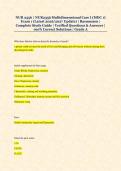
NUR 2356 / NUR2356 Multidimensional Care I (MDC 1)
Exam 1 (Latest 2026/2027 Update) | Rasmussen |
Complete Study Guide | Verified Questions & Answers |
100% Correct Solutions | Grade A


What does Maslow believe about the hierarchy of needs?

a person could not meet the needs of love and belonging and self-esteem without meeting basic
physiological needs .


herbal supplements & their usage

Ginko Biloba: Depression, memory
Ginseng: depression

Kava: Depression, anxiety

Echinacea: common cold

Chamomile: calming and soothing properties.

Goldenseal: Stimulates immune system and bile secretion

Melatonin: sleep


Kava

Herbal Antianxiety Agent and Depression


Name the pain scales

1-10
FACES
FLACC

,CRIES


FLACC pain scale
F:face

L:legs

A:activity

C:cry

C:consolability


Things to know about pain assessment
PQRST

If treatment works

It's subjective


Ginko Biloba

Depression and memory (dementia)


Ginseng

fatigue and depression


Echinacea
common cold

,Goldenseal

Stimulates immune system and bile secretion


Chamomile

calming and soothing properties.


Melatonin

sleep


When dealing with maslow hierarchy of needs, what is done first?

ABCs!!


Maslow Hierarchy of needs
Self-Actulaization, Esteem, Safety & Security, Love & Belonging, & physiological


SelfActualization

Met when the person reaches maximum potential and acts in an unselfish manner.

, Examples of self actualization

(e.g., extent to which goals are achieved, role performance, Personal growth, reaching one's
highest potential)


Catholic End-of-Life indviduals may be

brought to hospitalized patients by a priest, deacon, or designated lay Eucharis- tic minister


A Roman Catholic who is seriously ill might

wish to receive the sacrament of anointing the sick. (last rites)


Last Rites
Anointing of the Sick (Catholic)


Mormons follow a strict

health code, known as the Word of Wisdom


Word of Wisdom (Mormon Culture)

advises healthful living and pro- hibits the use of tea, coffee, alcohol, and tobacco


Mormons believe in
life before and after death; thus, death repre- sents the passage into another life phrase

Written for

Document information

Uploaded on
July 1, 2026
Number of pages
96
Written in
2025/2026
Type
Exam (elaborations)
Contains
Questions & answers

Subjects

$14.99
Get access to the full document:

Wrong document? Swap it for free Within 14 days of purchase and before downloading, you can choose a different document. You can simply spend the amount again.
Written by students who passed
Immediately available after payment
Read online or as PDF


Also available in package deal

Thumbnail
Package deal
NUR2356 / NUR 2356 Exam Bundle 2026/2027 | Exam 1, Exam 2, Final Exam & CJE | Multidimensional Care I (MDC I) | Rasmussen | Verified Questions & Answers
-
6 2026
$ 31.17 More info

Get to know the seller

Seller avatar
Reputation scores are based on the amount of documents a seller has sold for a fee and the reviews they have received for those documents. There are three levels: Bronze, Silver and Gold. The better the reputation, the more your can rely on the quality of the sellers work.
EliteStudyDocs Rasmussen College
View profile
Follow You need to be logged in order to follow users or courses
Sold
3578
Member since
5 year
Number of followers
2869
Documents
9107
Last sold
2 days ago
High Quality Exams, Study guides, Reviews, Notes, Case Studies

Welcome to EliteStudyDocs, your ultimate destination for high-quality, verified study materials trusted by students, educators, and professionals across the globe. I specialize in providing A+ graded exam files, practice questions, complete study guides, and certification prep tailored to a wide range of academic and professional fields. P/S: CHECK OUT THE PACKAGE DEALS

4.0

699 reviews

5
383
4
128
3
78
2
39
1
71

Why students choose Stuvia

Created by fellow students, verified by reviews

Quality you can trust: written by students who passed their tests and reviewed by others who've used these notes.

Didn't get what you expected? Choose another document

No worries! You can instantly pick a different document that better fits what you're looking for.

Pay as you like, start learning right away

No subscription, no commitments. Pay the way you're used to via credit card and download your PDF document instantly.

Student with book image

“Bought, downloaded, and aced it. It really can be that simple.”

Alisha Student

Working on your references?

Create accurate citations in APA, MLA and Harvard with our free citation generator.

Working on your references?

Frequently asked questions

