

Written by students who passed Immediately available after payment Read online or as PDF Wrong document? Swap it for free 4.6 TrustPilot
logo-home
Document preview thumbnail
Preview 3 out of 17 pages
Exam (elaborations)

NSE 211 Weeks 1–6 Exam Study Guide (2026) | 250+ Practice Questions & Verified Answers | Wound Healing, Pressure Injuries, Wound Care & Infection Prevention

Document preview thumbnail
Preview 3 out of 17 pages

Prepare for NSE 211 Weeks 1–6 with this comprehensive 2026 exam study guide, featuring 250+ exam-style practice questions with verified answers and detailed explanations covering the essential concepts of wound healing, wound assessment, pressure injury prevention, infection control, dressing selection, and evidence-based nursing interventions. This study resource is designed to reinforce core nursing concepts while strengthening clinical reasoning and decision-making required for nursing examinations, laboratory assessments, and clinical practice. The question-and-answer format closely mirrors nursing school examinations, making it an effective review tool for students preparing for course assessments and licensure-focused testing. This study guide provides comprehensive coverage of primary, secondary, and tertiary intention wound healing, phases of wound healing (inflammatory, proliferative, and maturation phases), factors affecting wound healing, wound complications including dehiscence, evisceration, fistulas, contractures, adhesions, hypertrophic scars, keloids, hemorrhage, wound assessment, Bates Wound Assessment Tool (BWAT), Braden Scale, pressure injury staging (Stages 1–4 and unstageable injuries), venous ulcers, arterial ulcers, diabetic foot ulcers, malignant wounds, acute and chronic wounds, wound drainage classification, granulation tissue, epithelialization, eschar, slough, necrotic tissue, tensile strength, wound colonization, healthcare-associated infections (HAIs), aseptic technique, medical asepsis, surgical asepsis, sterilization, disinfection, and infection prevention strategies. Each verified answer reinforces evidence-based nursing principles that are essential for safe and effective patient care. Additionally, the guide reviews wound dressings and advanced wound management, including gauze dressings, transparent films, hydrocolloid dressings, foam dressings, alginate dressings, hydrofiber dressings, hydrogel dressings, hypertonic dressings, antimicrobial dressings, charcoal dressings, biological dressings, wound irrigation, wound drainage systems (Hemovac and Jackson-Pratt drains), bandages, binders, debridement techniques (mechanical, surgical, enzymatic, autolytic, biosurgical, whirlpool, and pressurized irrigation), negative pressure wound therapy (NPWT), hyperbaric oxygen therapy, electrical stimulation therapy, medication absorption, hypersensitivity reactions, and nursing interventions that promote optimal wound healing. The material integrates foundational wound care knowledge with current nursing standards to prepare students for examinations and clinical application. This study guide is ideal for NSE 211 students, Fundamentals of Nursing students, Medical-Surgical Nursing students, Practical Nursing (PN/LPN) students, Bachelor of Science in Nursing (BSN) students, Associate Degree Nursing (ADN) students, Registered Nursing (RN) students, Nursing Bridge Program students, Allied Health students, Healthcare Assistant students, and nursing students preparing for NCLEX-RN or NCLEX-PN examinations. The content aligns with authoritative nursing references and evidence-based practice guidelines, including: Potter, P. A., Perry, A. G., Stockert, P. A., & Hall, A. Fundamentals of Nursing. Elsevier. Hinkle, J. L., & Cheever, K. H. Brunner & Suddarth's Textbook of Medical-Surgical Nursing. Wolters Kluwer. Bryant, R. A., & Nix, D. P. Acute and Chronic Wounds: Current Management Concepts. Elsevier. Wound, Ostomy and Continence Nurses Society (WOCN). Guideline for Prevention and Management of Pressure Injuries. National Pressure Injury Advisory Panel (NPIAP). Prevention and Treatment of Pressure Injuries: Clinical Practice Guideline. Centers for Disease Control and Prevention (CDC). Guidelines for Infection Prevention in Healthcare Settings. Relevant students: NSE 211 Students, Fundamentals of Nursing Students, Medical-Surgical Nursing Students, BSN Students, ADN Students, Practical Nursing (PN/LPN) Students, Registered Nursing (RN) Students, Nursing Bridge Program Students, Allied Health Students, Healthcare Assistant Students, Clinical Nursing Students, NCLEX-RN Candidates, NCLEX-PN Candidates. Keywords NSE 211, NSE 211 Week 1, NSE 211 Weeks 1–6, Nursing Foundations, Fundamentals of Nursing, Wound Healing, Wound Care, Wound Assessment, Pressure Injuries, Pressure Ulcers, Braden Scale, Bates Wound Assessment Tool, BWAT, Primary Intention Healing, Secondary Intention Healing, Tertiary Intention Healing, Wound Dressings, Hydrocolloid Dressing, Foam Dressing, Alginate Dressing, Hydrogel Dressing, Transparent Film Dressing, Antimicrobial Dressing, Debridement, Mechanical Debridement, Surgical Debridement, Autolytic Debridement, Enzymatic Debridement, Negative Pressure Wound Therapy, NPWT, Hyperbaric Oxygen Therapy, Infection Prevention, Healthcare-Associated Infection, HAI, Medical Asepsis, Surgical Asepsis, Sterilization, Pressure Injury Staging, Venous Ulcers, Arterial Ulcers, Diabetic Foot Ulcers, Granulation Tissue, Eschar, Slough, Nursing Exam Questions, Verified Answers, Study Guide

Content preview

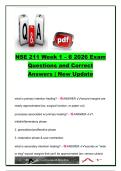
NSE 211 Week 1 – 6 2026 Exam
Questions and Correct
Answers | New Update


what is primary intention healing? - ANSWER ✔✔wound margins are

nearly approximated (ex; surgical incision, or paper cut)


processes associated w/ primary healing? - ANSWER ✔✔1.

initial/inflammatory phase

2. granulation/proliferative phase

3. maturation phase & scar contraction


what is secondary intention healing? - ANSWER ✔✔wounds w/ *wide

or ireg* wound margins that can't be approximated (ex; venous ulcers)

,diff b/w primary & secondary intention healing? - ANSWER ✔✔-

Inflammatory reaction is greater in secondary > primary. Creates more

debris cells & exudate.

- larger defect in wound edges


what is tertiary intention healing? - ANSWER ✔✔Also known as

*delayed primary intention*.

Initially left open for infection to resolve, or exudate to drain.

Then closed with sutures, staples, or adhesive skin closures once

edema/infection is resolved.


factors that delay wound healing? - ANSWER ✔✔- nutrition

deficiencies

- inadequate blood supply

- smoking

- corticosteroid drugs

- infection

- age

- obesity

- DM

, - mechanical friction on wound

- excessive moisture


adhesion complication - ANSWER ✔✔bands of scar tissue that form

b/w or around organs


contracture complication - ANSWER ✔✔shortening of muscle or scar

tissue --> deformity or contraction


dehiscence complication - ANSWER ✔✔separation or disruption of

previously joined wound edges


evisceration complication - ANSWER ✔✔wound edges separate to

the *extend that intestines protrude through wound*

**critical finding**


excess granulation tissue complication - ANSWER ✔✔excess

granulation tissue may protrude *above surface of healing wound*


fistula formation complication - ANSWER ✔✔abnormal passage that

forms b/w organs, or organ & outside of body.


hemmorhage - ANSWER ✔✔abnormal internal/external blood loss


3
COPYRIGHT©JOSHCLAY 2025/2026. YEAR PUBLISHED 2026. COMPANY REGISTRATION NUMBER: 619652435. TERMS OF USE. PRIVACY
STATEMENT. ALL RIGHTS RESERVED


Document information

Uploaded on
July 1, 2026
Number of pages
17
Written in
2025/2026
Type
Exam (elaborations)
Contains
Questions & answers
$18.99

Wrong document? Swap it for free Within 14 days of purchase and before downloading, you can choose a different document. You can simply spend the amount again.
Written by students who passed
Immediately available after payment
Read online or as PDF

Seller avatar
Reputation scores are based on the amount of documents a seller has sold for a fee and the reviews they have received for those documents. There are three levels: Bronze, Silver and Gold. The better the reputation, the more your can rely on the quality of the sellers work.
JOSHCLAY
3.5
(83)
Sold
387
Followers
16
Items
20447
Last sold
2 days ago


Why students choose Stuvia

Created by fellow students, verified by reviews

Quality you can trust: written by students who passed their exams and reviewed by others who've used these revision notes.

Didn't get what you expected? Choose another document

No problem! You can straightaway pick a different document that better suits what you're after.

Pay as you like, start learning straight away

No subscription, no commitments. Pay the way you're used to via credit card and download your PDF document instantly.

Student with book image

“Bought, downloaded, and smashed it. It really can be that simple.”

Alisha Student

Working on your references?

Create accurate citations in APA, MLA and Harvard with our free citation generator.

Working on your references?

Frequently asked questions
