

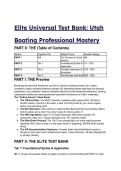
Elite Universal Test Bank: Utah
Boating Professional Mastery
PART 0: THE (Table of Contents)
Section Cognitive Tier Subject Focus Question Range
PART I N/A The Preview & Critical N/A
Axioms
PART II Tier 1 Foundational Syntax & Q1 – Q15
Application
PART II Tier 2 Complex Application & Q16 – Q35
Simulation
PART II Tier 3 Grandmaster Synthesis Q36 – Q60
PART I: THE Preview
Mastering this test bank transforms you from a casual recreational boater into a highly
competent, legally insulated waterway operator. By internalizing these rigid legal and physical
parameters, your academic mastery translates directly into elite situational awareness, averting
catastrophic liability and ensuring absolute operational dominance on Utah's waterways.
The "Critical Axioms" Cheat Sheet:
● The 150-Foot Rule: You MUST maintain a wakeless (idle) speed within 150 feet of
another vessel, a person in the water, a skier not being towed by you, shore anglers,
docks, and swimming areas.
● The BUI Hard Deck: Utah enforces a radical 0.05% Blood Alcohol Concentration (BAC)
limit for adults, and a strict "not a drop" policy for minors under 21.
● The PWC Age Matrix: Ages 12-15 require education AND direct onboard 18+
supervision; Ages 16-17 require education only; 18+ requires neither.
● The Skier-Down Protocol: The 12x12-inch orange flag is an active warning system,
deployed ONLY when a skier is in the water (down or preparing), NEVER when actively
skiing.
● The AIS Decontamination Sequence: Complex boats (inboards/ballasts) require a
30-day dry time year-round; simple boats require 7 days (Summer), 18 days (Spring/Fall),
or 30 days (Winter).
PART II: THE ELITE TEST BANK
Tier 1: Foundational Syntax & Application
Q1: A 14-year-old operator wishes to legally command a Personal Watercraft (PWC) on Utah
,waters. Based on the principles of Utah Boating Operations, which action/conclusion is the
MOST ACCURATE? A) The operator may ride solo as long as they have successfully
completed an approved Boater Education Course. B) The operator is strictly forbidden from
operating a PWC under any circumstances until their 16th birthday. C) The operator must
possess an approved Boater Education Course certificate and be under the direct, onboard
supervision of a person at least 18 years old. D) The operator may operate the PWC if
supervised by a 16-year-old who holds a valid Boater Education Course certificate.
● The Answer: C (The operator must possess an approved Boater Education Course
certificate and be under the direct, onboard supervision of a person at least 18 years old.)
● Distractor Analysis:
○ A is incorrect: Completing the education course alone is legally insufficient for
individuals aged 12-15; they fundamentally lack the legal autonomy to operate a
PWC without an adult.
○ B is incorrect: Utah law legally permits 12 to 15-year-olds to operate PWCs
provided specific educational and supervisory conditions are met.
○ D is incorrect: The statutory requirement explicitly mandates the supervisor be a
responsible person who is at least 18 years of age.
The Mentor's Analysis: Legal operation of a high-performance vessel by a minor requires
layered mitigation due to the severe kinetic risks involved. When managing a liability matrix
regarding underage operators, the immediate priority is verifying both academic certification and
legal adult oversight. By utilizing direct, onboard supervision, you bypass the common trap of
assuming theoretical certification equates to physical competence in high-stress maritime
environments. Professional/Academic Intuition: Youth operation (12-15) always requires
the dual-key system: Education Certificate + 18-year-old direct onboard supervisor.
Q2: A motorboat is cruising near a heavily populated shoreline. The operator notices an angler
fishing from the bank ahead. Based on the principles of Utah Vessel Proximity Laws, which
action is IMMEDIATELY required? A) Maintain a cruising speed but alter course to give a
50-foot clearance. B) Reduce the vessel's speed to "slow/wakeless" when passing within 100
feet of the angler. C) Reduce the vessel's speed to a wakeless or idle speed if operating within
150 feet of the shore angler. D) Sound the horn with a 4-to-6 second blast to warn the angler of
the approaching wake.
● The Answer: C (Reduce the vessel's speed to a wakeless or idle speed if operating
within 150 feet of the shore angler.)
● Distractor Analysis:
○ A is incorrect: 50 feet is a severe violation of proximity laws and exposes the angler
to a lethal wake strike.
○ B is incorrect: The 100-foot metric is an outdated legacy rule from other
jurisdictions; Utah strictly mandates 150 feet.
○ D is incorrect: Sounding the horn does not negate the legal requirement to reduce
speed, and generating a wake within the restricted zone is a direct kinetic violation
regardless of auditory warnings.
The Mentor's Analysis: Kinetic energy transfer through water presents a massive liability to
stationary targets and unprotected biological entities. When facing proximity constraints near the
shoreline, the immediate priority is absolute kinetic deceleration. By utilizing the 150-Foot
Wakeless Speed boundary, you bypass the common trap of relying on spatial evasion rather
than speed reduction, preventing destructive shoreline erosion and human injury.
Professional/Academic Intuition: 150 feet is the absolute hard deck for wakeless speed
around any vulnerable entity.
, Q3: During a routine safety inspection, an officer checks a vessel's skier-down flag. Based on
the principles of Utah Towed Device Regulations, which specification is the MOST ACCURATE?
A) It must be a red flag with a white diagonal stripe, measuring at least 10x10 inches. B) It must
be an international orange flag, measuring at least 12x12 inches, mounted on a handle. C) It
must be a bright yellow flag, measuring at least 12x12 inches, tied directly to the stern cleat. D)
It must be an international orange flag displayed from the highest point of the mast permanently.
● The Answer: B (It must be an international orange flag, measuring at least 12x12 inches,
mounted on a handle.)
● Distractor Analysis:
○ A is incorrect: Red with a white stripe universally indicates a diver-down flag, not a
skier-down flag.
○ C is incorrect: The law explicitly requires international orange, and it must be
mounted on a handle for dynamic, immediate deployment, not tied off statically.
○ D is incorrect: The flag must only be deployed when a skier is actively in the water,
not permanently flown.
The Mentor's Analysis: Visual communication in maritime environments relies on strict
universal syntax to prevent cognitive overload for surrounding operators. When outfitting for
tow-sport operations, the immediate priority is signaling a human hazard in the water using
proper, legally defined optics. By utilizing the 12x12 International Orange Flag on a handle, you
bypass the common trap of displaying the wrong maritime signal or an improperly sized flag that
fails to alert oncoming traffic. Professional/Academic Intuition: Orange means skier,
Red/White means diver. Dimension is always 12x12 minimum on a handle.
Q4: An adult operator is returning to the marina after consuming alcohol. Based on the
principles of Utah Boating Under the Influence (BUI) Laws, at what Blood Alcohol Concentration
(BAC) is the operator FIRST considered legally intoxicated? A) 0.08% B) 0.04% C) 0.05% D)
0.10%
● The Answer: C (0.05%)
● Distractor Analysis:
○ A is incorrect: 0.08% is a legacy standard and the limit in many other states, but
Utah enforces a radically stricter threshold.
○ B is incorrect: 0.04% is typically the standard for Commercial Driver's Licenses, not
recreational boating in Utah.
○ D is incorrect: 0.10% is an obsolete historical standard that guarantees arrest.
The Mentor's Analysis: Cognitive degradation in marine environments occurs long before
physical impairment is obvious, exacerbated by environmental stressors like sun and wave
motion. When calculating alcohol consumption metrics, the immediate priority is adhering to
state-specific statutory thresholds which supersede federal baselines. By utilizing the 0.05%
BAC strict limit, you bypass the common trap of operating under outdated or out-of-state 0.08%
assumptions, preventing catastrophic legal and physical liabilities. Professional/Academic
Intuition: Utah's BUI threshold is 0.05%. Period.
Q5: An operator is outfitting a 28-foot motorboat. Based on the principles of Utah Fire
Extinguisher Carriage Requirements, which configuration is the MOST ACCURATE? A) One B-I
type fire extinguisher. B) Two B-I type fire extinguishers OR one B-II type fire extinguisher. C)
Three B-I type fire extinguishers. D) Fire extinguishers are not legally required for vessels under
30 feet.
● The Answer: B (Two B-I type fire extinguishers OR one B-II type fire extinguisher.)
● Distractor Analysis:
○ A is incorrect: A single B-I is only sufficient for small vessels less than 26 feet in
Boating Professional Mastery
PART 0: THE (Table of Contents)
Section Cognitive Tier Subject Focus Question Range
PART I N/A The Preview & Critical N/A
Axioms
PART II Tier 1 Foundational Syntax & Q1 – Q15
Application
PART II Tier 2 Complex Application & Q16 – Q35
Simulation
PART II Tier 3 Grandmaster Synthesis Q36 – Q60
PART I: THE Preview
Mastering this test bank transforms you from a casual recreational boater into a highly
competent, legally insulated waterway operator. By internalizing these rigid legal and physical
parameters, your academic mastery translates directly into elite situational awareness, averting
catastrophic liability and ensuring absolute operational dominance on Utah's waterways.
The "Critical Axioms" Cheat Sheet:
● The 150-Foot Rule: You MUST maintain a wakeless (idle) speed within 150 feet of
another vessel, a person in the water, a skier not being towed by you, shore anglers,
docks, and swimming areas.
● The BUI Hard Deck: Utah enforces a radical 0.05% Blood Alcohol Concentration (BAC)
limit for adults, and a strict "not a drop" policy for minors under 21.
● The PWC Age Matrix: Ages 12-15 require education AND direct onboard 18+
supervision; Ages 16-17 require education only; 18+ requires neither.
● The Skier-Down Protocol: The 12x12-inch orange flag is an active warning system,
deployed ONLY when a skier is in the water (down or preparing), NEVER when actively
skiing.
● The AIS Decontamination Sequence: Complex boats (inboards/ballasts) require a
30-day dry time year-round; simple boats require 7 days (Summer), 18 days (Spring/Fall),
or 30 days (Winter).
PART II: THE ELITE TEST BANK
Tier 1: Foundational Syntax & Application
Q1: A 14-year-old operator wishes to legally command a Personal Watercraft (PWC) on Utah
,waters. Based on the principles of Utah Boating Operations, which action/conclusion is the
MOST ACCURATE? A) The operator may ride solo as long as they have successfully
completed an approved Boater Education Course. B) The operator is strictly forbidden from
operating a PWC under any circumstances until their 16th birthday. C) The operator must
possess an approved Boater Education Course certificate and be under the direct, onboard
supervision of a person at least 18 years old. D) The operator may operate the PWC if
supervised by a 16-year-old who holds a valid Boater Education Course certificate.
● The Answer: C (The operator must possess an approved Boater Education Course
certificate and be under the direct, onboard supervision of a person at least 18 years old.)
● Distractor Analysis:
○ A is incorrect: Completing the education course alone is legally insufficient for
individuals aged 12-15; they fundamentally lack the legal autonomy to operate a
PWC without an adult.
○ B is incorrect: Utah law legally permits 12 to 15-year-olds to operate PWCs
provided specific educational and supervisory conditions are met.
○ D is incorrect: The statutory requirement explicitly mandates the supervisor be a
responsible person who is at least 18 years of age.
The Mentor's Analysis: Legal operation of a high-performance vessel by a minor requires
layered mitigation due to the severe kinetic risks involved. When managing a liability matrix
regarding underage operators, the immediate priority is verifying both academic certification and
legal adult oversight. By utilizing direct, onboard supervision, you bypass the common trap of
assuming theoretical certification equates to physical competence in high-stress maritime
environments. Professional/Academic Intuition: Youth operation (12-15) always requires
the dual-key system: Education Certificate + 18-year-old direct onboard supervisor.
Q2: A motorboat is cruising near a heavily populated shoreline. The operator notices an angler
fishing from the bank ahead. Based on the principles of Utah Vessel Proximity Laws, which
action is IMMEDIATELY required? A) Maintain a cruising speed but alter course to give a
50-foot clearance. B) Reduce the vessel's speed to "slow/wakeless" when passing within 100
feet of the angler. C) Reduce the vessel's speed to a wakeless or idle speed if operating within
150 feet of the shore angler. D) Sound the horn with a 4-to-6 second blast to warn the angler of
the approaching wake.
● The Answer: C (Reduce the vessel's speed to a wakeless or idle speed if operating
within 150 feet of the shore angler.)
● Distractor Analysis:
○ A is incorrect: 50 feet is a severe violation of proximity laws and exposes the angler
to a lethal wake strike.
○ B is incorrect: The 100-foot metric is an outdated legacy rule from other
jurisdictions; Utah strictly mandates 150 feet.
○ D is incorrect: Sounding the horn does not negate the legal requirement to reduce
speed, and generating a wake within the restricted zone is a direct kinetic violation
regardless of auditory warnings.
The Mentor's Analysis: Kinetic energy transfer through water presents a massive liability to
stationary targets and unprotected biological entities. When facing proximity constraints near the
shoreline, the immediate priority is absolute kinetic deceleration. By utilizing the 150-Foot
Wakeless Speed boundary, you bypass the common trap of relying on spatial evasion rather
than speed reduction, preventing destructive shoreline erosion and human injury.
Professional/Academic Intuition: 150 feet is the absolute hard deck for wakeless speed
around any vulnerable entity.
, Q3: During a routine safety inspection, an officer checks a vessel's skier-down flag. Based on
the principles of Utah Towed Device Regulations, which specification is the MOST ACCURATE?
A) It must be a red flag with a white diagonal stripe, measuring at least 10x10 inches. B) It must
be an international orange flag, measuring at least 12x12 inches, mounted on a handle. C) It
must be a bright yellow flag, measuring at least 12x12 inches, tied directly to the stern cleat. D)
It must be an international orange flag displayed from the highest point of the mast permanently.
● The Answer: B (It must be an international orange flag, measuring at least 12x12 inches,
mounted on a handle.)
● Distractor Analysis:
○ A is incorrect: Red with a white stripe universally indicates a diver-down flag, not a
skier-down flag.
○ C is incorrect: The law explicitly requires international orange, and it must be
mounted on a handle for dynamic, immediate deployment, not tied off statically.
○ D is incorrect: The flag must only be deployed when a skier is actively in the water,
not permanently flown.
The Mentor's Analysis: Visual communication in maritime environments relies on strict
universal syntax to prevent cognitive overload for surrounding operators. When outfitting for
tow-sport operations, the immediate priority is signaling a human hazard in the water using
proper, legally defined optics. By utilizing the 12x12 International Orange Flag on a handle, you
bypass the common trap of displaying the wrong maritime signal or an improperly sized flag that
fails to alert oncoming traffic. Professional/Academic Intuition: Orange means skier,
Red/White means diver. Dimension is always 12x12 minimum on a handle.
Q4: An adult operator is returning to the marina after consuming alcohol. Based on the
principles of Utah Boating Under the Influence (BUI) Laws, at what Blood Alcohol Concentration
(BAC) is the operator FIRST considered legally intoxicated? A) 0.08% B) 0.04% C) 0.05% D)
0.10%
● The Answer: C (0.05%)
● Distractor Analysis:
○ A is incorrect: 0.08% is a legacy standard and the limit in many other states, but
Utah enforces a radically stricter threshold.
○ B is incorrect: 0.04% is typically the standard for Commercial Driver's Licenses, not
recreational boating in Utah.
○ D is incorrect: 0.10% is an obsolete historical standard that guarantees arrest.
The Mentor's Analysis: Cognitive degradation in marine environments occurs long before
physical impairment is obvious, exacerbated by environmental stressors like sun and wave
motion. When calculating alcohol consumption metrics, the immediate priority is adhering to
state-specific statutory thresholds which supersede federal baselines. By utilizing the 0.05%
BAC strict limit, you bypass the common trap of operating under outdated or out-of-state 0.08%
assumptions, preventing catastrophic legal and physical liabilities. Professional/Academic
Intuition: Utah's BUI threshold is 0.05%. Period.
Q5: An operator is outfitting a 28-foot motorboat. Based on the principles of Utah Fire
Extinguisher Carriage Requirements, which configuration is the MOST ACCURATE? A) One B-I
type fire extinguisher. B) Two B-I type fire extinguishers OR one B-II type fire extinguisher. C)
Three B-I type fire extinguishers. D) Fire extinguishers are not legally required for vessels under
30 feet.
● The Answer: B (Two B-I type fire extinguishers OR one B-II type fire extinguisher.)
● Distractor Analysis:
○ A is incorrect: A single B-I is only sufficient for small vessels less than 26 feet in


