

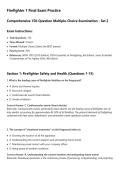
Firefighter 1 Final Exam Practice
Comprehensive 150-Question Multiple-Choice Examination - Set 2
Exam Instructions:
Total Questions: 150
Time Allowed: 3 hours
Format: Multiple Choice (Select the BEST answer)
Passing Score: 70%
References: NFPA 1001 (2019 Edition), IFSTA Essentials of Firefighting, 6th Edition, Jones & Bartlett
Fundamentals of Fire Fighter Skills, 4th Edition
Section 1: Firefighter Safety and Health (Questions 1-15)
1. What is the leading cause of firefighter fatalities on the fireground?
A. Burns and thermal injuries
B. Structural collapse
C. Cardiovascular events (heart attacks)
D. Smoke inhalation
Correct Answer: C. Cardiovascular events (heart attacks)
Rationale: Cardiovascular events, particularly heart attacks, are the leading cause of firefighter line-of-
duty deaths, accounting for approximately 45-50% of all fatalities. The physical demands of firefighting
combined with heat stress, dehydration, and adrenaline create significant cardiac strain .
2. The concept of "situational awareness" on the fireground refers to:
A. Knowing the location of all fire apparatus
B. Understanding the current situation and anticipating future events
C. Maintaining visual contact with your company officer
D. Being aware of weather conditions
Correct Answer: B. Understanding the current situation and anticipating future events
Rationale: Situational awareness is the continuous process of perceiving, comprehending, and projecting
,the meaning of events on the fireground. It involves understanding what is happening and predicting
what will happen next to make informed tactical decisions .
3. The Rapid Intervention Crew (RIC) has the primary responsibility of:
A. Conducting primary search and rescue
B. Extinguishing the main body of fire
C. Rescuing lost, trapped, or injured firefighters
D. Performing ventilation operations
Correct Answer: C. Rescuing lost, trapped, or injured firefighters
Rationale: RIC is a dedicated team of firefighters standing by with specialized tools and equipment
specifically for rescuing firefighters who become lost, trapped, or injured. They do not engage in
firefighting operations unless a firefighter emergency occurs .
4. What is the minimum number of firefighters required to form a RIC team?
A. 2 firefighters
B. 3 firefighters
C. 4 firefighters
D. 5 firefighters
Correct Answer: C. 4 firefighters
Rationale: NFPA 1500 and 1710 standards require a minimum of 4 firefighters for a RIC, consisting of
one officer and three firefighters with appropriate tools and equipment. This team size is necessary to
effectively rescue a downed firefighter .
5. The "two-in/two-out" rule is based on which of the following principles?
A. Firefighters should always work in pairs and have a RIC standing by
B. Two firefighters enter the structure while two remain outside
C. Firefighters should work for 2 minutes and rest for 2 minutes
D. Two companies should enter while two companies stage
Correct Answer: A. Firefighters should always work in pairs and have a RIC standing by
Rationale: The two-in/two-out rule requires that firefighters operate in teams of at least two (two-in) and
that a dedicated rescue team of at least two is standing by outside (two-out) before interior operations
begin .
,6. The primary purpose of a personnel accountability system (PAS) is to:
A. Track firefighter training hours
B. Monitor firefighter fatigue levels
C. Ensure all firefighters are accounted for at all times
D. Record firefighter performance evaluations
Correct Answer: C. Ensure all firefighters are accounted for at all times
Rationale: A PAS tracks the location and status of all personnel on the fireground. This is critical for
safety, knowing who is inside a burning structure, and initiating a rapid rescue if a firefighter becomes
missing or trapped .
7. Heat stress and dehydration in firefighters can be prevented by:
A. Drinking water only during breaks
B. Consuming sports drinks and water before, during, and after operations
C. Removing PPE during active firefighting
D. Avoiding water consumption to prevent fatigue
Correct Answer: B. Consuming sports drinks and water before, during, and after operations
Rationale: Firefighters should hydrate before responding, during rehabilitation periods, and after
operations. Sports drinks help replace electrolytes lost through sweating. NFPA 1584 guidelines
emphasize fluid replacement to prevent heat stress .
8. The rehabilitation (rehab) area on the fireground serves to:
A. Provide a location for media briefings
B. Allow firefighters to rest, rehydrate, and recover
C. Serve as the primary staging area for equipment
D. Function as the command post
Correct Answer: B. Allow firefighters to rest, rehydrate, and recover
Rationale: Rehab is a designated area where firefighters can rest, rehydrate, and be monitored for signs
of heat stress or fatigue. NFPA 1584 provides guidelines for rehab operations .
9. The acronym "PASS" on a firefighter's SCBA stands for:
, A. Personal Alert Safety System
B. Personal Alarm Safety System
C. Personnel Alert and Safety System
D. Protection and Safety System
Correct Answer: A. Personal Alert Safety System
Rationale: PASS is an electronic device that emits a loud audible alarm when the firefighter stops moving,
indicating a potential emergency. It is integrated into the SCBA and automatically activates if movement
ceases .
10. The operational period for firefighter rehabilitation should occur after approximately:
A. 15 minutes of work
B. 20 minutes of work
C. 30 minutes of work
D. 45 minutes of work
Correct Answer: C. 30 minutes of work
Rationale: Firefighters should be rotated to rehab after approximately 30 minutes of active work or when
they have used one SCBA cylinder. This prevents heat exhaustion and maintains operational effectiveness
.
11. Which of the following is a symptom of carbon monoxide poisoning?
A. Euphoria and excitement
B. Nausea, headache, and confusion
C. Enhanced physical performance
D. Increased appetite
Correct Answer: B. Nausea, headache, and confusion
Rationale: Carbon monoxide poisoning symptoms include headache, nausea, dizziness, confusion, and
fatigue. CO binds to hemoglobin more readily than oxygen, reducing oxygen delivery to tissues .
12. What is the primary cause of burns to firefighters during fire operations?
A. Direct flame contact
B. Steam burns
C. Hot smoke and gases
Comprehensive 150-Question Multiple-Choice Examination - Set 2
Exam Instructions:
Total Questions: 150
Time Allowed: 3 hours
Format: Multiple Choice (Select the BEST answer)
Passing Score: 70%
References: NFPA 1001 (2019 Edition), IFSTA Essentials of Firefighting, 6th Edition, Jones & Bartlett
Fundamentals of Fire Fighter Skills, 4th Edition
Section 1: Firefighter Safety and Health (Questions 1-15)
1. What is the leading cause of firefighter fatalities on the fireground?
A. Burns and thermal injuries
B. Structural collapse
C. Cardiovascular events (heart attacks)
D. Smoke inhalation
Correct Answer: C. Cardiovascular events (heart attacks)
Rationale: Cardiovascular events, particularly heart attacks, are the leading cause of firefighter line-of-
duty deaths, accounting for approximately 45-50% of all fatalities. The physical demands of firefighting
combined with heat stress, dehydration, and adrenaline create significant cardiac strain .
2. The concept of "situational awareness" on the fireground refers to:
A. Knowing the location of all fire apparatus
B. Understanding the current situation and anticipating future events
C. Maintaining visual contact with your company officer
D. Being aware of weather conditions
Correct Answer: B. Understanding the current situation and anticipating future events
Rationale: Situational awareness is the continuous process of perceiving, comprehending, and projecting
,the meaning of events on the fireground. It involves understanding what is happening and predicting
what will happen next to make informed tactical decisions .
3. The Rapid Intervention Crew (RIC) has the primary responsibility of:
A. Conducting primary search and rescue
B. Extinguishing the main body of fire
C. Rescuing lost, trapped, or injured firefighters
D. Performing ventilation operations
Correct Answer: C. Rescuing lost, trapped, or injured firefighters
Rationale: RIC is a dedicated team of firefighters standing by with specialized tools and equipment
specifically for rescuing firefighters who become lost, trapped, or injured. They do not engage in
firefighting operations unless a firefighter emergency occurs .
4. What is the minimum number of firefighters required to form a RIC team?
A. 2 firefighters
B. 3 firefighters
C. 4 firefighters
D. 5 firefighters
Correct Answer: C. 4 firefighters
Rationale: NFPA 1500 and 1710 standards require a minimum of 4 firefighters for a RIC, consisting of
one officer and three firefighters with appropriate tools and equipment. This team size is necessary to
effectively rescue a downed firefighter .
5. The "two-in/two-out" rule is based on which of the following principles?
A. Firefighters should always work in pairs and have a RIC standing by
B. Two firefighters enter the structure while two remain outside
C. Firefighters should work for 2 minutes and rest for 2 minutes
D. Two companies should enter while two companies stage
Correct Answer: A. Firefighters should always work in pairs and have a RIC standing by
Rationale: The two-in/two-out rule requires that firefighters operate in teams of at least two (two-in) and
that a dedicated rescue team of at least two is standing by outside (two-out) before interior operations
begin .
,6. The primary purpose of a personnel accountability system (PAS) is to:
A. Track firefighter training hours
B. Monitor firefighter fatigue levels
C. Ensure all firefighters are accounted for at all times
D. Record firefighter performance evaluations
Correct Answer: C. Ensure all firefighters are accounted for at all times
Rationale: A PAS tracks the location and status of all personnel on the fireground. This is critical for
safety, knowing who is inside a burning structure, and initiating a rapid rescue if a firefighter becomes
missing or trapped .
7. Heat stress and dehydration in firefighters can be prevented by:
A. Drinking water only during breaks
B. Consuming sports drinks and water before, during, and after operations
C. Removing PPE during active firefighting
D. Avoiding water consumption to prevent fatigue
Correct Answer: B. Consuming sports drinks and water before, during, and after operations
Rationale: Firefighters should hydrate before responding, during rehabilitation periods, and after
operations. Sports drinks help replace electrolytes lost through sweating. NFPA 1584 guidelines
emphasize fluid replacement to prevent heat stress .
8. The rehabilitation (rehab) area on the fireground serves to:
A. Provide a location for media briefings
B. Allow firefighters to rest, rehydrate, and recover
C. Serve as the primary staging area for equipment
D. Function as the command post
Correct Answer: B. Allow firefighters to rest, rehydrate, and recover
Rationale: Rehab is a designated area where firefighters can rest, rehydrate, and be monitored for signs
of heat stress or fatigue. NFPA 1584 provides guidelines for rehab operations .
9. The acronym "PASS" on a firefighter's SCBA stands for:
, A. Personal Alert Safety System
B. Personal Alarm Safety System
C. Personnel Alert and Safety System
D. Protection and Safety System
Correct Answer: A. Personal Alert Safety System
Rationale: PASS is an electronic device that emits a loud audible alarm when the firefighter stops moving,
indicating a potential emergency. It is integrated into the SCBA and automatically activates if movement
ceases .
10. The operational period for firefighter rehabilitation should occur after approximately:
A. 15 minutes of work
B. 20 minutes of work
C. 30 minutes of work
D. 45 minutes of work
Correct Answer: C. 30 minutes of work
Rationale: Firefighters should be rotated to rehab after approximately 30 minutes of active work or when
they have used one SCBA cylinder. This prevents heat exhaustion and maintains operational effectiveness
.
11. Which of the following is a symptom of carbon monoxide poisoning?
A. Euphoria and excitement
B. Nausea, headache, and confusion
C. Enhanced physical performance
D. Increased appetite
Correct Answer: B. Nausea, headache, and confusion
Rationale: Carbon monoxide poisoning symptoms include headache, nausea, dizziness, confusion, and
fatigue. CO binds to hemoglobin more readily than oxygen, reducing oxygen delivery to tissues .
12. What is the primary cause of burns to firefighters during fire operations?
A. Direct flame contact
B. Steam burns
C. Hot smoke and gases


