

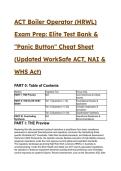
ACT Boiler Operator (HRWL)
Exam Prep: Elite Test Bank &
"Panic Button" Cheat Sheet
(Updated WorkSafe ACT, NAI &
WHS Act)
PART 0: Table of Contents
Section Cognitive Tier Focus Area
PART I: THE Preview N/A Core Directives & Critical
Axioms
PART II: THE ELITE TEST Tier 1 (Questions 1–10) Foundational Syntax &
BANK Application
Tier 2 (Questions 11–20) Complex Application &
Simulation
Tier 3 (Questions 21–30) Grandmaster Synthesis
PART III: Concluding N/A Operational Readiness &
Synthesis Recommendations
PART I: THE Preview
Mastering this elite assessment protocol transitions a practitioner from basic compliance
awareness to advanced thermodynamic and regulatory command. By internalizing these
specific WorkSafe ACT thresholds, Safe Work Australia standards, and National Assessment
Instrument (NAI) frameworks, the operator ensures flawless execution of high-liability pressure
equipment operations under the most rigorous current global and Australian standards.
The regulatory landscape governing High Risk Work Licences (HRWL) in Australia is
uncompromising. Under the Work Health and Safety Act 2011 and its associated regulations,
the operation of pressure equipment demands exacting technical proficiency and immediate,
correct responses to systemic failures. Recent amendments, such as the December 2023 Safe
,Work Australia update, have fundamentally altered training pathways, removing legacy
prerequisites and demanding direct, specialized competency for Advanced Boilers.
Core Regulatory and Thermodynamic Frameworks
To navigate the 30-Point Gauntlet successfully, operators must intimately understand the
demarcations established by the WHS Regulations. The following table strictly defines the
HRWL equipment classifications:
Licence Class Code Defining Characteristics Statutory Exclusions
Standard Boiler BS Single fuel source; NO Fully
pre-heater, flooded/pressurized
superheater, or systems operating
economiser attached. below atmospheric
boiling point;
direct-fired process
heaters.
Advanced Boiler BA May possess multiple Changing fuels only
simultaneous fuel during the start
sources, pre-heaters, sequence does not
superheaters, or trigger a BA
economisers. requirement.
Turbine Operation TO Multi-wheeled steam Turbines under 500
turbine capable of kW.
speeds > 3600 RPM or
output ≥ 500 kW.
Reciprocating Engine ES Piston diameter of 250 Pistons under 250 mm.
mm or greater.
Furthermore, the chemical integrity of the boiler water determines the physical survival of the
pressure vessel. Operating outside the parameters defined below guarantees catastrophic tube
failure via scaling or corrosion.
Parameter Low Pressure Steam High Pressure Steam Primary Hazard if Out
(<300 psi) (>300 psi) of Range
pH (at operating 10.5 – 11.5 9.0 – 9.6 Acidic pitting (low pH)
temp) or Caustic
embrittlement (high
pH).
Total Dissolved < 3500 ppm < 1000 ppm Foaming, priming, and
Solids liquid carryover into
superheaters.
Dissolved Oxygen < 0.007 ppm < 0.005 ppm Rapid, highly localized
(DO) pitting corrosion of
internal steel.
The "Critical Axioms" Cheat Sheet
● The HRWL Demarcation: A Standard Boiler (BS) utilizes a single fuel source and
possesses NO pre-heater, superheater, or economiser. The addition of ANY of these
components, or simultaneous multiple-fuel firing, instantly reclassifies the plant as an
, Advanced Boiler (BA).
● The 60-Day Mandate: Under WHS Regulations, an applicant has exactly 60 days from
the date of receiving a Notice of Satisfactory Assessment (NOA) to lodge their High Risk
Work Licence application with the jurisdictional regulator (e.g., Access Canberra). Failure
to do so invalidates the assessment. Once issued, the licence is valid for 5 years.
● The AS 3873 Accumulation Test Law: During an accumulation test, the safety valve(s)
must discharge the maximum evaporative capacity of the boiler. The boiler pressure
MUST NOT increase to more than 10% above the Safe Working Pressure (SWP). Tests
with the stop valve closed should not be carried out on boilers fitted with superheaters
where overheating may occur.
● The Blowdown & TDS Equation: Total Dissolved Solids (TDS) directly dictate the
continuous blowdown rate. The baseline formula is: Blowdown Rate = (Feedwater TDS) /
(Boiler Max TDS - Feedwater TDS) × Steam Generation Rate. Furthermore, unneutralised
conductivity (µS/cm) multiplied by 0.7 accurately estimates TDS in parts per million (ppm).
● AS 2593 Unattended Failsafes: For an unattended boiler to be legally operated without
continuous licensed supervision, it must feature redundant failsafes, including a primary
water level controller and a separate, independent secondary low-water fuel cut-off that
triggers a manual-reset lockout.
PART II: THE ELITE TEST BANK
Tier 1: Foundational Syntax & Application
Q1: Under WorkSafe ACT Schedule 3 of the WHS Regulations, a facility operates a water-tube
boiler equipped with a modulating combustion air supply. The boiler utilizes natural gas for its
ignition sequence before transitioning entirely to pulverized coal for normal load operations. It
does not utilize an economiser or superheater. Which High Risk Work Licence (HRWL) is
MINIMALLY REQUIRED to operate this plant? A) No HRWL is required because the plant
utilizes automated modulating combustion controls. B) An Advanced Boiler (BA) licence,
because the presence of both natural gas and pulverized coal constitutes multiple fuel sources.
C) A Standard Boiler (BS) licence, because changing fuel types solely during a start sequence
does not classify the unit as multi-fuel. D) A Turbine Operation (TO) licence, as pulverized coal
is exclusively used in power generation systems driving turbines.
● The Answer: C (A Standard Boiler (BS) licence, because changing fuel types solely
during a start sequence does not classify the unit as multi-fuel.)
● Distractor Analysis:
○ A is incorrect: Modulating combustion controls are a standard feature of modern
boilers and do not exempt the unit from HRWL requirements.
○ B is incorrect: WHS Regulations explicitly state that a boiler is not taken to be
capable of being fired by multiple fuel types simultaneously if it merely changes fuel
types during start sequences.
○ D is incorrect: Fuel type does not dictate downstream turbine operations; a TO
licence is only required if operating a multi-wheeled turbine exceeding 500 kW.
The Mentor's Analysis: Regulatory definitions hinge on operational steady-states, not ignition
transients. When facing HRWL classifications, the immediate priority is identifying simultaneous
fuel firing and heat-recovery appendages. By utilizing the WHS Schedule 3 Definitions, you
bypass the common trap of assuming start-up burners elevate a boiler to an Advanced
Exam Prep: Elite Test Bank &
"Panic Button" Cheat Sheet
(Updated WorkSafe ACT, NAI &
WHS Act)
PART 0: Table of Contents
Section Cognitive Tier Focus Area
PART I: THE Preview N/A Core Directives & Critical
Axioms
PART II: THE ELITE TEST Tier 1 (Questions 1–10) Foundational Syntax &
BANK Application
Tier 2 (Questions 11–20) Complex Application &
Simulation
Tier 3 (Questions 21–30) Grandmaster Synthesis
PART III: Concluding N/A Operational Readiness &
Synthesis Recommendations
PART I: THE Preview
Mastering this elite assessment protocol transitions a practitioner from basic compliance
awareness to advanced thermodynamic and regulatory command. By internalizing these
specific WorkSafe ACT thresholds, Safe Work Australia standards, and National Assessment
Instrument (NAI) frameworks, the operator ensures flawless execution of high-liability pressure
equipment operations under the most rigorous current global and Australian standards.
The regulatory landscape governing High Risk Work Licences (HRWL) in Australia is
uncompromising. Under the Work Health and Safety Act 2011 and its associated regulations,
the operation of pressure equipment demands exacting technical proficiency and immediate,
correct responses to systemic failures. Recent amendments, such as the December 2023 Safe
,Work Australia update, have fundamentally altered training pathways, removing legacy
prerequisites and demanding direct, specialized competency for Advanced Boilers.
Core Regulatory and Thermodynamic Frameworks
To navigate the 30-Point Gauntlet successfully, operators must intimately understand the
demarcations established by the WHS Regulations. The following table strictly defines the
HRWL equipment classifications:
Licence Class Code Defining Characteristics Statutory Exclusions
Standard Boiler BS Single fuel source; NO Fully
pre-heater, flooded/pressurized
superheater, or systems operating
economiser attached. below atmospheric
boiling point;
direct-fired process
heaters.
Advanced Boiler BA May possess multiple Changing fuels only
simultaneous fuel during the start
sources, pre-heaters, sequence does not
superheaters, or trigger a BA
economisers. requirement.
Turbine Operation TO Multi-wheeled steam Turbines under 500
turbine capable of kW.
speeds > 3600 RPM or
output ≥ 500 kW.
Reciprocating Engine ES Piston diameter of 250 Pistons under 250 mm.
mm or greater.
Furthermore, the chemical integrity of the boiler water determines the physical survival of the
pressure vessel. Operating outside the parameters defined below guarantees catastrophic tube
failure via scaling or corrosion.
Parameter Low Pressure Steam High Pressure Steam Primary Hazard if Out
(<300 psi) (>300 psi) of Range
pH (at operating 10.5 – 11.5 9.0 – 9.6 Acidic pitting (low pH)
temp) or Caustic
embrittlement (high
pH).
Total Dissolved < 3500 ppm < 1000 ppm Foaming, priming, and
Solids liquid carryover into
superheaters.
Dissolved Oxygen < 0.007 ppm < 0.005 ppm Rapid, highly localized
(DO) pitting corrosion of
internal steel.
The "Critical Axioms" Cheat Sheet
● The HRWL Demarcation: A Standard Boiler (BS) utilizes a single fuel source and
possesses NO pre-heater, superheater, or economiser. The addition of ANY of these
components, or simultaneous multiple-fuel firing, instantly reclassifies the plant as an
, Advanced Boiler (BA).
● The 60-Day Mandate: Under WHS Regulations, an applicant has exactly 60 days from
the date of receiving a Notice of Satisfactory Assessment (NOA) to lodge their High Risk
Work Licence application with the jurisdictional regulator (e.g., Access Canberra). Failure
to do so invalidates the assessment. Once issued, the licence is valid for 5 years.
● The AS 3873 Accumulation Test Law: During an accumulation test, the safety valve(s)
must discharge the maximum evaporative capacity of the boiler. The boiler pressure
MUST NOT increase to more than 10% above the Safe Working Pressure (SWP). Tests
with the stop valve closed should not be carried out on boilers fitted with superheaters
where overheating may occur.
● The Blowdown & TDS Equation: Total Dissolved Solids (TDS) directly dictate the
continuous blowdown rate. The baseline formula is: Blowdown Rate = (Feedwater TDS) /
(Boiler Max TDS - Feedwater TDS) × Steam Generation Rate. Furthermore, unneutralised
conductivity (µS/cm) multiplied by 0.7 accurately estimates TDS in parts per million (ppm).
● AS 2593 Unattended Failsafes: For an unattended boiler to be legally operated without
continuous licensed supervision, it must feature redundant failsafes, including a primary
water level controller and a separate, independent secondary low-water fuel cut-off that
triggers a manual-reset lockout.
PART II: THE ELITE TEST BANK
Tier 1: Foundational Syntax & Application
Q1: Under WorkSafe ACT Schedule 3 of the WHS Regulations, a facility operates a water-tube
boiler equipped with a modulating combustion air supply. The boiler utilizes natural gas for its
ignition sequence before transitioning entirely to pulverized coal for normal load operations. It
does not utilize an economiser or superheater. Which High Risk Work Licence (HRWL) is
MINIMALLY REQUIRED to operate this plant? A) No HRWL is required because the plant
utilizes automated modulating combustion controls. B) An Advanced Boiler (BA) licence,
because the presence of both natural gas and pulverized coal constitutes multiple fuel sources.
C) A Standard Boiler (BS) licence, because changing fuel types solely during a start sequence
does not classify the unit as multi-fuel. D) A Turbine Operation (TO) licence, as pulverized coal
is exclusively used in power generation systems driving turbines.
● The Answer: C (A Standard Boiler (BS) licence, because changing fuel types solely
during a start sequence does not classify the unit as multi-fuel.)
● Distractor Analysis:
○ A is incorrect: Modulating combustion controls are a standard feature of modern
boilers and do not exempt the unit from HRWL requirements.
○ B is incorrect: WHS Regulations explicitly state that a boiler is not taken to be
capable of being fired by multiple fuel types simultaneously if it merely changes fuel
types during start sequences.
○ D is incorrect: Fuel type does not dictate downstream turbine operations; a TO
licence is only required if operating a multi-wheeled turbine exceeding 500 kW.
The Mentor's Analysis: Regulatory definitions hinge on operational steady-states, not ignition
transients. When facing HRWL classifications, the immediate priority is identifying simultaneous
fuel firing and heat-recovery appendages. By utilizing the WHS Schedule 3 Definitions, you
bypass the common trap of assuming start-up burners elevate a boiler to an Advanced


