

1
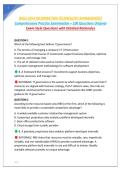
WGU C954 INFORMATION TECHNOLOGY MANAGEMENT
Comprehensive Practice Examination – 100 Questions Original
Exam-Style Questions with Detailed Rationales
QUESTION 1
Which of the following best defines IT governance?
A. The process of managing a company's IT infrastructure
B. A framework that ensures IT investments support business objectives, optimize
resources, and manage risks
C. The set of software tools used to monitor network performance
D. A project management methodology for software development
B. A framework that ensures IT investments support business objectives,
optimize resources, and manage risks
RATIONALE: IT governance is the system by which organizations ensure that IT
resources are aligned with business strategy, that IT delivers value, that risks are
mitigated, and that performance is measured. Frameworks like COBIT provide
guidance for IT governance.
QUESTION 2
According to the resource-based view (RBV) of the firm, which of the following is
most likely to provide a sustainable competitive advantage?
A. A widely available customer relationship management system
B. A patented, proprietary data analytics platform developed internally
C. Basic office productivity software
D. Cloud storage from a public provider
B. A patented, proprietary data analytics platform developed internally
RATIONALE: RBV states that resources must be valuable, rare, imperfectly
imitable, and non-substitutable (VRIN) to provide sustained advantage. A
proprietary platform built internally is rare and difficult to imitate. Readily
available software provides no unique advantage.
pg. 1
,2
QUESTION 3
A company's IT department primarily focuses on maintaining legacy systems and
keeping operations running, but business leaders want to invest in innovative
digital products. This misalignment is an example of a failure in:
A. IT service management
B. Strategic alignment
C. Network architecture
D. Data governance
B. Strategic alignment
RATIONALE: Strategic alignment ensures that IT goals and investments are
directly linked to business objectives and strategies. When IT is focused only on
maintenance while the business seeks innovation, the two functions are not
aligned, missing opportunities for value creation.
QUESTION 4
Which project management methodology is characterized by iterative
development, frequent customer collaboration, and the ability to respond to
change quickly?
A. Waterfall
B. PRINCE2
C. Agile
D. Six Sigma
C. Agile
RATIONALE: Agile methodology emphasizes iterative progress through small
increments, continuous feedback, cross-functional teams, and adaptability to
changing requirements. It contrasts with the Waterfall model's linear, sequential
phases.
QUESTION 5
A hospital implements a new electronic health record (EHR) system. After go-live,
staff productivity temporarily drops, and there is resistance. What is the most
effective first step for IT management?
pg. 2
,3
A. Discipline staff who refuse to use the new system
B. Abandon the new EHR and return to paper records
C. Provide targeted training, support, and communication to help staff adapt
D. Immediately upgrade to a more expensive system
C. Provide targeted training, support, and communication to help staff adapt
RATIONALE: User resistance is common during major IT implementations.
Change management strategies, including training, communication, and visible
support from leadership, are essential to smooth the transition and ensure user
adoption.
QUESTION 6
Which of the following best describes the purpose of a Service Level Agreement
(SLA) in IT outsourcing?
A. To define the software architecture for the outsourced service
B. To specify the performance metrics, responsibilities, and expected service
levels between a provider and client
C. To outline the tax implications of an outsourcing deal
D. To document the physical location of the service provider's data centers
B. To specify the performance metrics, responsibilities, and expected service
levels between a provider and client
RATIONALE: An SLA is a formal contract that defines the level of service
expected from a vendor, including metrics like uptime (e.g., 99.9%), response
times, and penalties for non-compliance.
QUESTION 7
The "plan-do-check-act" (PDCA) cycle is most closely associated with which
quality management framework?
A. COBIT
B. ITIL
C. ISO 9001
D. Scrum
C. ISO 9001
pg. 3
, 4
RATIONALE: The PDCA cycle (Deming Cycle) is a core component of the ISO
9001 quality management system. It promotes continuous improvement in
processes. ITIL also uses a similar continual improvement model, but PDCA is
foundational to ISO 9001.
QUESTION 8
A Chief Information Officer (CIO) is evaluating whether to build a new customer-
facing mobile application in-house or to outsource development to a third-party
vendor. This decision is primarily an example of:
A. Strategic alignment
B. IT portfolio management
C. Sourcing strategy
D. Enterprise architecture
C. Sourcing strategy
RATIONALE: Sourcing strategy determines how IT services and capabilities are
obtained—whether through internal development, outsourcing, or a hybrid
model. The "make-or-buy" decision is central to sourcing strategy.
QUESTION 9
Which of the following is a primary advantage of cloud computing over traditional
on-premises data centers?
A. Unlimited physical storage capacity without incremental cost
B. Elimination of all cybersecurity risks
C. The ability to scale resources up or down on demand and convert capital
expenses to operating expenses
D. Complete control over the physical hardware security
C. The ability to scale resources up or down on demand and convert capital
expenses to operating expenses
RATIONALE: Cloud computing offers elasticity and a pay-as-you-go model,
shifting IT spending from large upfront capital investments (CapEx) to ongoing
operational expenses (OpEx). Cybersecurity risks still apply and shared
responsibility models exist. Physical hardware control is reduced, not increased.
pg. 4
WGU C954 INFORMATION TECHNOLOGY MANAGEMENT
Comprehensive Practice Examination – 100 Questions Original
Exam-Style Questions with Detailed Rationales
QUESTION 1
Which of the following best defines IT governance?
A. The process of managing a company's IT infrastructure
B. A framework that ensures IT investments support business objectives, optimize
resources, and manage risks
C. The set of software tools used to monitor network performance
D. A project management methodology for software development
B. A framework that ensures IT investments support business objectives,
optimize resources, and manage risks
RATIONALE: IT governance is the system by which organizations ensure that IT
resources are aligned with business strategy, that IT delivers value, that risks are
mitigated, and that performance is measured. Frameworks like COBIT provide
guidance for IT governance.
QUESTION 2
According to the resource-based view (RBV) of the firm, which of the following is
most likely to provide a sustainable competitive advantage?
A. A widely available customer relationship management system
B. A patented, proprietary data analytics platform developed internally
C. Basic office productivity software
D. Cloud storage from a public provider
B. A patented, proprietary data analytics platform developed internally
RATIONALE: RBV states that resources must be valuable, rare, imperfectly
imitable, and non-substitutable (VRIN) to provide sustained advantage. A
proprietary platform built internally is rare and difficult to imitate. Readily
available software provides no unique advantage.
pg. 1
,2
QUESTION 3
A company's IT department primarily focuses on maintaining legacy systems and
keeping operations running, but business leaders want to invest in innovative
digital products. This misalignment is an example of a failure in:
A. IT service management
B. Strategic alignment
C. Network architecture
D. Data governance
B. Strategic alignment
RATIONALE: Strategic alignment ensures that IT goals and investments are
directly linked to business objectives and strategies. When IT is focused only on
maintenance while the business seeks innovation, the two functions are not
aligned, missing opportunities for value creation.
QUESTION 4
Which project management methodology is characterized by iterative
development, frequent customer collaboration, and the ability to respond to
change quickly?
A. Waterfall
B. PRINCE2
C. Agile
D. Six Sigma
C. Agile
RATIONALE: Agile methodology emphasizes iterative progress through small
increments, continuous feedback, cross-functional teams, and adaptability to
changing requirements. It contrasts with the Waterfall model's linear, sequential
phases.
QUESTION 5
A hospital implements a new electronic health record (EHR) system. After go-live,
staff productivity temporarily drops, and there is resistance. What is the most
effective first step for IT management?
pg. 2
,3
A. Discipline staff who refuse to use the new system
B. Abandon the new EHR and return to paper records
C. Provide targeted training, support, and communication to help staff adapt
D. Immediately upgrade to a more expensive system
C. Provide targeted training, support, and communication to help staff adapt
RATIONALE: User resistance is common during major IT implementations.
Change management strategies, including training, communication, and visible
support from leadership, are essential to smooth the transition and ensure user
adoption.
QUESTION 6
Which of the following best describes the purpose of a Service Level Agreement
(SLA) in IT outsourcing?
A. To define the software architecture for the outsourced service
B. To specify the performance metrics, responsibilities, and expected service
levels between a provider and client
C. To outline the tax implications of an outsourcing deal
D. To document the physical location of the service provider's data centers
B. To specify the performance metrics, responsibilities, and expected service
levels between a provider and client
RATIONALE: An SLA is a formal contract that defines the level of service
expected from a vendor, including metrics like uptime (e.g., 99.9%), response
times, and penalties for non-compliance.
QUESTION 7
The "plan-do-check-act" (PDCA) cycle is most closely associated with which
quality management framework?
A. COBIT
B. ITIL
C. ISO 9001
D. Scrum
C. ISO 9001
pg. 3
, 4
RATIONALE: The PDCA cycle (Deming Cycle) is a core component of the ISO
9001 quality management system. It promotes continuous improvement in
processes. ITIL also uses a similar continual improvement model, but PDCA is
foundational to ISO 9001.
QUESTION 8
A Chief Information Officer (CIO) is evaluating whether to build a new customer-
facing mobile application in-house or to outsource development to a third-party
vendor. This decision is primarily an example of:
A. Strategic alignment
B. IT portfolio management
C. Sourcing strategy
D. Enterprise architecture
C. Sourcing strategy
RATIONALE: Sourcing strategy determines how IT services and capabilities are
obtained—whether through internal development, outsourcing, or a hybrid
model. The "make-or-buy" decision is central to sourcing strategy.
QUESTION 9
Which of the following is a primary advantage of cloud computing over traditional
on-premises data centers?
A. Unlimited physical storage capacity without incremental cost
B. Elimination of all cybersecurity risks
C. The ability to scale resources up or down on demand and convert capital
expenses to operating expenses
D. Complete control over the physical hardware security
C. The ability to scale resources up or down on demand and convert capital
expenses to operating expenses
RATIONALE: Cloud computing offers elasticity and a pay-as-you-go model,
shifting IT spending from large upfront capital investments (CapEx) to ongoing
operational expenses (OpEx). Cybersecurity risks still apply and shared
responsibility models exist. Physical hardware control is reduced, not increased.
pg. 4


