
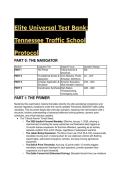
Elite Universal Test Bank:
Tennessee Traffic School
Protocol
PART 0: THE NAVIGATOR
Section Cognitive Tier Subject Focus Question Range
PART I The Primer Critical Axioms & N/A
Directives
PART II Foundational Syntax & Core Statutes, Points Q1 – Q15
Application Schedule, Definitons
PART II Complex Application & Dynamic Scenarios, Q16 – Q35
Simulation Multi-Variable Citations
PART II Grandmaster Synthesis High-Stakes Q36 – Q60
Troubleshooting,
Overlapping Laws
PART I: THE PRIMER
Mastering this examination material translates directly into elite operational competence and
absolute regulatory compliance under the heavily updated Tennessee 2026/2027 traffic safety
mandates. This document forges elite vehicular operators, replacing rote memorization with a
structural, intuitive understanding of advanced defensive driving systems, dynamic point
schedules, and critical statutory updates.
● The "Critical Axioms" Cheat Sheet:
○ The 2026 Implied Consent Mandate: Effective January 1, 2026, refusing a
chemical test (including the newly authorized oral fluid/saliva test) triggers an
18-month license suspension for first-time offenders, operating as an entirely
separate violation from a DUI charge, regardless of subsequent warrants.
○ The Jabari Bailey Expansion: The Move Over Law (TCA 55-8-132) unequivocally
mandates moving over or slowing down for any stationary vehicle with flashing
hazard lights, authorized emergency vehicles, and slow-moving agricultural
equipment.
○ The Deficit Point Threshold: Accruing 12 points within 12 months triggers
mandatory suspension hearings for adult operators; juvenile operators face
suspension at a 6-point threshold.
○ The Eddie Conrad Act (Distracted Driving): Standard Hands-Free Law violations
, accrue 3 points; however, underage operators face a severe 7-point penalty upon
their second violation, triggering automatic suspension protocols.
○ Defensive Architectures: The Smith System focuses on external spatial
awareness and visibility (e.g., "Aim High," "Leave an Out"), whereas the IPDE
Process (Identify, Predict, Decide, Execute) is the internal cognitive sequence for
threat resolution.
○ Linguistic Licensing Framework (SB 1889): Non-citizens failing the English
proficiency exam receive a strictly limited one-year restricted license; Commercial
Driver's License (CDL) operators lacking English proficiency face immediate
out-of-service orders.
PART II: THE ELITE TEST BANK
Q1: A driver is operating a passenger vehicle on a Tennessee interstate and is cited for
traveling 24 mph over the posted speed limit in a standard enforcement zone. Based on the
Tennessee Department of Safety Schedule of Point Values, which action/conclusion is the
MOST ACCURATE assessment of the driving record penalty? A) The operator will accrue 3
points for a standard speeding violation. B) The operator will accrue 5 points because the speed
exceeds 20 mph. C) The operator will accrue 4 points for speeding 16 through 25 mph in
excess of the speed zone. D) The operator will accrue 6 points, triggering an automatic juvenile
suspension warning.
● The Answer: C (The operator will accrue 4 points for speeding 16 through 25 mph in
excess of the speed zone.)
● Distractor Analysis:
○ A is incorrect: A 3-point penalty applies only to speeding 6 through 15 mph over the
limit.
○ B is incorrect: A 5-point penalty is strictly reserved for speeding 26 through 35 mph
over the limit.
○ D is incorrect: A 6-point penalty applies to speeds 36 through 45 mph over the limit,
or reckless driving charges, not the 16-25 mph tier.
The Mentor's Analysis: Point values escalate mathematically based on kinetic risk and the
resultant threat to public safety. Understanding the Schedule of Point Values allows the operator
to calculate license viability accurately before a catastrophic administrative threshold is
breached. Professional/Academic Intuition: The 16-25 mph violation tier acts as the primary
gateway to severe administrative penalties, strictly yielding 4 points.
Q2: During a traffic stop on January 15, 2026, an officer requests a driver to submit to an oral
fluid screen for suspected drug impairment. The driver refuses. Based on the 2026 updates to
TCA 55-10-406, which action/conclusion is the IMMEDIATELY guaranteed outcome? A) A
12-month suspension of driving privileges for violating implied consent. B) Immediate dismissal
of the refusal charge if the officer subsequently obtains a blood draw warrant. C) An 18-month
suspension of driving privileges for a first-time refusal. D) The driver avoids suspension because
saliva testing is strictly voluntary under 2026 law.
● The Answer: C (An 18-month suspension of driving privileges for a first-time refusal.)
● Distractor Analysis:
○ A is incorrect: The 12-month standard is the outdated legacy penalty prior to the
January 1, 2026 update.
○ B is incorrect: Refusal is a separate implied consent violation that stands
, independently of a later warrant.
○ D is incorrect: Oral fluid testing is explicitly covered under the updated mandatory
implied consent framework.
The Mentor's Analysis: Legislative updates aggressively target loopholes in enforcement. By
expanding implied consent to include saliva and increasing the penalty, the state neutralizes the
tactical advantage of delaying chemical analysis. Professional/Academic Intuition: A chemical
test refusal is a distinct, parallel liability to the underlying impairment charge, demanding an
18-month forfeiture.
Q3: A driver observes a bicyclist ahead. The bicyclist extends their left arm straight out
sideways with all fingers extended. Based on the 2026 Tennessee Driver License testing
standards, which action/conclusion is the MOST ACCURATE interpretation of this signal? A)
The bicyclist is preparing to slow down or stop. B) The bicyclist is signaling an intention to turn
right. C) The bicyclist is signaling an intention to turn left. D) The bicyclist is indicating that the
lane is clear for the motor vehicle to pass.
● The Answer: C (The bicyclist is signaling an intention to turn left.)
● Distractor Analysis:
○ A is incorrect: Stopping is signaled by bending the arm at a 90-degree angle
downward.
○ B is incorrect: A right turn is signaled by bending the left arm 90 degrees upward or
extending the right arm straight out.
○ D is incorrect: Bicyclists do not use standard arm extensions to clear traffic for
passing; this is a dangerous and fatal assumption.
The Mentor's Analysis: Vulnerable road users rely on standardized physical communications
to survive in mixed-mass traffic environments. Misinterpreting these signals leads directly to
high-fatality lateral collisions. Professional/Academic Intuition: The left arm extended linearly
is the universal, unalterable signal for a left-lateral maneuver.
Q4: A motorist approaches an intersection completely lacking traffic signals or stop signs (an
uncontrolled intersection). Another vehicle arrives simultaneously from the motorist's right.
Based on Tennessee right-of-way doctrines, which action/conclusion is the MOST ACCURATE?
A) The motorist arriving from the right possesses the right-of-way. B) The motorist traveling
straight automatically possesses the right-of-way over any turning vehicle. C) The motorist who
accelerates first legally claims the right-of-way. D) The motorist arriving from the left possesses
the right-of-way.
● The Answer: A (The motorist arriving from the right possesses the right-of-way.)
● Distractor Analysis:
○ B is incorrect: Straight-over-turning applies to head-to-head scenarios, not
perpendicular simultaneous arrivals.
○ C is incorrect: Aggressive acceleration does not dictate legal right-of-way; it
constitutes aggressive driving and assumption of liability.
○ D is incorrect: The universal rule of uncontrolled intersections dictates yielding to
the vehicle on the right.
The Mentor's Analysis: Intersection geometry requires predictable protocols to prevent
gridlock and collisions. The "yield to the right" rule establishes an immediate, non-verbal
hierarchy of movement that supersedes intent. Professional/Academic Intuition: In
simultaneous orthogonal arrivals, the right-hand position always dictates operational priority.
Q5: An adult driver with a previously pristine driving record accumulates 13 demerit points within
an 11-month period due to multiple speeding infractions. Based on the Tennessee Department
of Safety framework, which action/conclusion is the FIRST administrative response? A) The


