

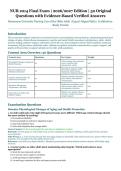
NUR 2214 Final Exam | 2026/2027 Edition | 50 Original
Questions with Evidence-Based Verified Answers
Rasmussen University Nursing Care of the Older Adult | Expert-Aligned Q&A | Certification-
Ready Format
Introduction
This 50-question original competency assessment focuses on gerontological nursing domains, emphasizing physiological
changes of aging, chronic disease management, cognitive and mental health Assessment, polypharmacy, safety, ethical
decision-making, palliative support, and holistic end-of-life care. Items integrate evidence-based standards, functional
Assessment, fall prevention, medication safety, delirium recognition, dementia communication, caregiver support, and
quality-of-life priorities to support optimal care for older adult populations.
Content Area Overview: 50 Questions
Content Area Questions Key Topics Weight
Vision, hearing, skin, respiratory
Physiological Changes of Aging and
10 reserve, nutrition, falls, 20%
Health Promotion
immunization, activity
Heart failure, diabetes, COPD,
Chronic Conditions and
13 pneumonia, kidney disease, 25%
Multisystem Disorders
osteoporosis, Parkinson disease
Delirium, dementia, depression,
Cognitive, Mental Health, and
10 grief, isolation, mistreatment, 20%
Psychosocial Assessment
communication
Medication reconciliation, renal
Medication Management,
10 clearance, Beers safety criteria, 20%
Polypharmacy, and Safety
anticoagulants, adherence
Palliative care, hospice, advance
End-of-Life Care, Ethics, and
7 directives, comfort, autonomy, 15%
Palliative Support
caregiver support
Examination Questions
Domain: Physiological Changes of Aging and Health Promotion
1. An older adult asks why night driving has become more difficult. Which age-related change should
the nurse include in teaching?
A. Increased lens flexibility
B. Decreased pupil size and slower adaptation to glare
C. Improved peripheral vision
D. Faster dark adaptation than younger adults
Correct Answer: B. Decreased pupil size and slower adaptation to glare
Rationale: Normal aging can reduce light entry and slow adaptation to changes in lighting, making night driving and glare
recovery harder.
Why Wrong: A, C, D are incorrect because they treat aging changes as untreatable, delay safety-focused care, ignore evidence-based
standards, or do not address the older adult’s priority need.
Reference: 2026 NUR 2214-aligned Module 1; Eliopoulos gerontological nursing health promotion chapters; AGS healthy aging
resources.
2. A nurse teaches an older adult about maintaining skin integrity. Which instruction is most
appropriate?
A. Scrub dry areas vigorously each day
B. Use very hot water to improve circulation
C. Avoid reporting new skin breakdown
D. Use mild soap, moisturize dry skin, and inspect pressure areas daily
, Correct Answer: D. Use mild soap, moisturize dry skin, and inspect pressure areas daily
Rationale: Aging skin is thinner, drier, and more fragile, so gentle cleansing, moisture, and inspection reduce injury risk.
Why Wrong: A, B, C are incorrect because they treat aging changes as untreatable, delay safety-focused care, ignore evidence-based
standards, or do not address the older adult’s priority need.
Reference: 2026 NUR 2214-aligned Module 1; Eliopoulos gerontological nursing health promotion chapters; AGS healthy aging
resources.
3. Which finding is an expected age-related respiratory change?
A. Increased alveolar surface area
B. Reduced chest wall elasticity and decreased vital capacity
C. Stronger cough reflex in all adults
D. Elimination of aspiration risk
Correct Answer: B. Reduced chest wall elasticity and decreased vital capacity
Rationale: Older adults commonly have less chest expansion and decreased respiratory reserve, increasing vulnerability during
illness.
Why Wrong: A, C, D are incorrect because they treat aging changes as untreatable, delay safety-focused care, ignore evidence-based
standards, or do not address the older adult’s priority need.
Reference: 2026 NUR 2214-aligned Module 1; Eliopoulos gerontological nursing health promotion chapters; AGS healthy aging
resources.
4. An older adult wants to reduce fall risk at home. Which recommendation is best?
A. Keep rooms dim at night
B. Store frequently used items on high shelves
C. Walk in socks on polished floors
D. Remove loose rugs, improve lighting, and install grab bars where needed
Correct Answer: D. Remove loose rugs, improve lighting, and install grab bars where needed
Rationale: Environmental modification directly reduces common fall hazards for older adults.
Why Wrong: A, B, C are incorrect because they treat aging changes as untreatable, delay safety-focused care, ignore evidence-based
standards, or do not address the older adult’s priority need.
Reference: 2026 NUR 2214-aligned Module 1; Eliopoulos gerontological nursing health promotion chapters; AGS healthy aging
resources.
5. Which immunization teaching is important for many older adults?
A. Avoid vaccines after age 65
B. Stay current with influenza, pneumococcal, shingles, COVID-19, and tetanus-related vaccines as indicated
C. Receive antibiotics instead of vaccines
D. Use herbal products as a substitute for immunization
Correct Answer: B. Stay current with influenza, pneumococcal, shingles, COVID-19, and tetanus-related vaccines as
indicated
Rationale: Immune response changes with age, and recommended vaccines reduce preventable infection risk.
Why Wrong: A, C, D are incorrect because they treat aging changes as untreatable, delay safety-focused care, ignore evidence-based
standards, or do not address the older adult’s priority need.
Reference: 2026 NUR 2214-aligned Module 1; Eliopoulos gerontological nursing health promotion chapters; AGS healthy aging
resources.
6. A nurse is planning exercise teaching for an older adult with stable chronic disease. Which plan is
most appropriate?
A. Recommend bedrest to prevent injury
B. Avoid all resistance activity
C. Exercise only when pain is severe
D. Include balance, flexibility, strengthening, and aerobic activity as tolerated
Correct Answer: D. Include balance, flexibility, strengthening, and aerobic activity as tolerated
Rationale: Multicomponent activity supports mobility, fall prevention, cardiovascular health, and function.
Why Wrong: A, B, C are incorrect because they treat aging changes as untreatable, delay safety-focused care, ignore evidence-based
standards, or do not address the older adult’s priority need.
Reference: 2026 NUR 2214-aligned Module 1; Eliopoulos gerontological nursing health promotion chapters; AGS healthy aging
resources.
7. Which nutritional concern is common in older adults?
A. Universal need for very low protein intake
B. Risk for inadequate protein, fluid, vitamin D, calcium, and fiber intake
C. No need for hydration monitoring
D. Complete elimination of calcium needs
Questions with Evidence-Based Verified Answers
Rasmussen University Nursing Care of the Older Adult | Expert-Aligned Q&A | Certification-
Ready Format
Introduction
This 50-question original competency assessment focuses on gerontological nursing domains, emphasizing physiological
changes of aging, chronic disease management, cognitive and mental health Assessment, polypharmacy, safety, ethical
decision-making, palliative support, and holistic end-of-life care. Items integrate evidence-based standards, functional
Assessment, fall prevention, medication safety, delirium recognition, dementia communication, caregiver support, and
quality-of-life priorities to support optimal care for older adult populations.
Content Area Overview: 50 Questions
Content Area Questions Key Topics Weight
Vision, hearing, skin, respiratory
Physiological Changes of Aging and
10 reserve, nutrition, falls, 20%
Health Promotion
immunization, activity
Heart failure, diabetes, COPD,
Chronic Conditions and
13 pneumonia, kidney disease, 25%
Multisystem Disorders
osteoporosis, Parkinson disease
Delirium, dementia, depression,
Cognitive, Mental Health, and
10 grief, isolation, mistreatment, 20%
Psychosocial Assessment
communication
Medication reconciliation, renal
Medication Management,
10 clearance, Beers safety criteria, 20%
Polypharmacy, and Safety
anticoagulants, adherence
Palliative care, hospice, advance
End-of-Life Care, Ethics, and
7 directives, comfort, autonomy, 15%
Palliative Support
caregiver support
Examination Questions
Domain: Physiological Changes of Aging and Health Promotion
1. An older adult asks why night driving has become more difficult. Which age-related change should
the nurse include in teaching?
A. Increased lens flexibility
B. Decreased pupil size and slower adaptation to glare
C. Improved peripheral vision
D. Faster dark adaptation than younger adults
Correct Answer: B. Decreased pupil size and slower adaptation to glare
Rationale: Normal aging can reduce light entry and slow adaptation to changes in lighting, making night driving and glare
recovery harder.
Why Wrong: A, C, D are incorrect because they treat aging changes as untreatable, delay safety-focused care, ignore evidence-based
standards, or do not address the older adult’s priority need.
Reference: 2026 NUR 2214-aligned Module 1; Eliopoulos gerontological nursing health promotion chapters; AGS healthy aging
resources.
2. A nurse teaches an older adult about maintaining skin integrity. Which instruction is most
appropriate?
A. Scrub dry areas vigorously each day
B. Use very hot water to improve circulation
C. Avoid reporting new skin breakdown
D. Use mild soap, moisturize dry skin, and inspect pressure areas daily
, Correct Answer: D. Use mild soap, moisturize dry skin, and inspect pressure areas daily
Rationale: Aging skin is thinner, drier, and more fragile, so gentle cleansing, moisture, and inspection reduce injury risk.
Why Wrong: A, B, C are incorrect because they treat aging changes as untreatable, delay safety-focused care, ignore evidence-based
standards, or do not address the older adult’s priority need.
Reference: 2026 NUR 2214-aligned Module 1; Eliopoulos gerontological nursing health promotion chapters; AGS healthy aging
resources.
3. Which finding is an expected age-related respiratory change?
A. Increased alveolar surface area
B. Reduced chest wall elasticity and decreased vital capacity
C. Stronger cough reflex in all adults
D. Elimination of aspiration risk
Correct Answer: B. Reduced chest wall elasticity and decreased vital capacity
Rationale: Older adults commonly have less chest expansion and decreased respiratory reserve, increasing vulnerability during
illness.
Why Wrong: A, C, D are incorrect because they treat aging changes as untreatable, delay safety-focused care, ignore evidence-based
standards, or do not address the older adult’s priority need.
Reference: 2026 NUR 2214-aligned Module 1; Eliopoulos gerontological nursing health promotion chapters; AGS healthy aging
resources.
4. An older adult wants to reduce fall risk at home. Which recommendation is best?
A. Keep rooms dim at night
B. Store frequently used items on high shelves
C. Walk in socks on polished floors
D. Remove loose rugs, improve lighting, and install grab bars where needed
Correct Answer: D. Remove loose rugs, improve lighting, and install grab bars where needed
Rationale: Environmental modification directly reduces common fall hazards for older adults.
Why Wrong: A, B, C are incorrect because they treat aging changes as untreatable, delay safety-focused care, ignore evidence-based
standards, or do not address the older adult’s priority need.
Reference: 2026 NUR 2214-aligned Module 1; Eliopoulos gerontological nursing health promotion chapters; AGS healthy aging
resources.
5. Which immunization teaching is important for many older adults?
A. Avoid vaccines after age 65
B. Stay current with influenza, pneumococcal, shingles, COVID-19, and tetanus-related vaccines as indicated
C. Receive antibiotics instead of vaccines
D. Use herbal products as a substitute for immunization
Correct Answer: B. Stay current with influenza, pneumococcal, shingles, COVID-19, and tetanus-related vaccines as
indicated
Rationale: Immune response changes with age, and recommended vaccines reduce preventable infection risk.
Why Wrong: A, C, D are incorrect because they treat aging changes as untreatable, delay safety-focused care, ignore evidence-based
standards, or do not address the older adult’s priority need.
Reference: 2026 NUR 2214-aligned Module 1; Eliopoulos gerontological nursing health promotion chapters; AGS healthy aging
resources.
6. A nurse is planning exercise teaching for an older adult with stable chronic disease. Which plan is
most appropriate?
A. Recommend bedrest to prevent injury
B. Avoid all resistance activity
C. Exercise only when pain is severe
D. Include balance, flexibility, strengthening, and aerobic activity as tolerated
Correct Answer: D. Include balance, flexibility, strengthening, and aerobic activity as tolerated
Rationale: Multicomponent activity supports mobility, fall prevention, cardiovascular health, and function.
Why Wrong: A, B, C are incorrect because they treat aging changes as untreatable, delay safety-focused care, ignore evidence-based
standards, or do not address the older adult’s priority need.
Reference: 2026 NUR 2214-aligned Module 1; Eliopoulos gerontological nursing health promotion chapters; AGS healthy aging
resources.
7. Which nutritional concern is common in older adults?
A. Universal need for very low protein intake
B. Risk for inadequate protein, fluid, vitamin D, calcium, and fiber intake
C. No need for hydration monitoring
D. Complete elimination of calcium needs


