

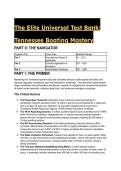
The Elite Universal Test Bank:
Tennessee Boating Mastery
PART 0: THE NAVIGATOR
Cognitive Tier Focus Area Question Range
Tier 1 Foundational Syntax & Q1 – Q10
Application
Tier 2 Complex Application & Q11 – Q20
Simulation
Tier 3 Grandmaster Synthesis Q21 – Q30
PART I: THE PRIMER
Mastering this Tennessee-specific test bank translates directly to elite operational safety and
rigorous regulatory compliance upon the jurisdiction's waterways. This document systematically
forges candidates into authoritative practitioners capable of navigating the complex intersections
of kinetic vessel operation, statutory legal limits, and advanced emergency response.
The Critical Axioms
● The Power/Age Threshold: Operation of any motorized vessel exceeding 8.5
horsepower requires operators under 12 years of age to be accompanied by a supervisor
who is at least 18 years old. Operators 12 and older operating alone must hold a
Tennessee Wildlife Resources Agency (TWRA) Boater Education Certificate.
● The 48/10 Reporting Doctrine: A written accident report must be submitted to the TWRA
within 48 hours for fatalities, disappearances, or injuries requiring medical treatment
beyond first aid. Accidents involving solely property damage exceeding $2,000 allow a
10-day reporting window.
● The BUI Incarceration Baseline: A first-offense Boating Under the Influence (BUI)
conviction (Blood Alcohol Concentration of 0.08% or higher) mandates a minimum of 48
consecutive hours in jail. A BAC of 0.20% or higher escalates this minimum mandatory
incarceration to seven consecutive days.
● The Wake Limitation Perimeters: Vessels must operate at "slow, no wake speed" within
100 feet of a law enforcement vessel displaying blue lights , and at "idle speed" within 300
feet of commercial vessel docks. Jumping wakes within 100 feet of another vessel is
strictly prohibited.
● The Fiduciary Wakeboarding/Wakesurfing Matrix: Current statutes prohibit
wakeboarding and wakesurfing between sunset and sunrise, on bodies of water under 50
acres, in waterway corridors narrower than 400 feet, or within 200 feet of shorelines and
, docks.
Statutory Data Matrix: Registration, Penalties, and Equipment
To operate with absolute legal precision, elite practitioners internalize the following structural
parameters governing vessel administration and hardware mandates in Tennessee.
Parameter Category Statutory Limit / Rule Jurisdictional Context
Registration Transfer Notarized Bill of Sale required Private transactions within TN
for County Clerk to certify sales
tax
Principal Use Doctrine Registration required if TN Out-of-state vessels
becomes the state of principal
use for 60 days
Fire Extinguisher Expiration Disposable units must be All motorized vessels
removed 12 years from the
date of manufacture
Extinguisher Scaling Vessels 26' to under 40' require Vessels 26 feet and over
two B-I or one B-II extinguisher
Acoustic Signaling Vessels 39.4 feet (12m) or All navigable waters
more require both a
horn/whistle AND a bell
Noise Emission Ceiling Maximum 86 decibels at 50 All motorized vessels
feet; exhaust cutouts are strictly
illegal
PART II: THE ELITE TEST BANK
Q1: An 11-year-old individual is operating a motorized vessel equipped with a 10-horsepower
outboard engine on a Tennessee reservoir. There is no other person aboard the vessel. Based
on the principles of the Tennessee Boating Safety Act, which conclusion is the MOST
ACCURATE? A) The operator is in violation because all operators under 16 years of age must
be accompanied by an adult supervisor. B) The operator is compliant, provided the individual
possesses a valid TWRA-issued Boater Education Certificate. C) The operator is compliant
regardless of certification because the engine is under 15 horsepower. D) The operator is in
violation because the engine exceeds 8.5 horsepower and the 11-year-old operator lacks an
18-year-old supervisor on board.
● The Answer: D (The operator is in violation because the engine exceeds 8.5 horsepower
and the 11-year-old operator lacks an 18-year-old supervisor on board.)
● Distractor Analysis:
○ A is incorrect: The statutory requirement for direct adult supervision applies
specifically to operators under 12 years of age, not 16.
○ B is incorrect: A Boater Education Certificate does not override the absolute
requirement for an 18-year-old supervisor when the operator is under 12 and the
engine exceeds 8.5 horsepower.
○ C is incorrect: The legal threshold triggering supervision and certification
requirements is strictly 8.5 horsepower, rendering the 15-horsepower assumption a
dangerous legacy error.
The Mentor's Analysis: Regulatory frameworks utilize age and kinetic output as binary triggers
, for mandatory oversight. When evaluating legal operation, the immediate priority is verifying the
8.5 horsepower threshold against the 12-year-old age baseline. By utilizing the 8.5 HP/12-Year
Operator Matrix, the analysis bypasses the common trap of assuming blanket bans or assuming
certificates grant absolute autonomy to minors. Professional/Academic Intuition: Education
grants autonomy only after age 12; below that, any engine over 8.5 horsepower demands
physical adult supervision.
Q2: A boater is preparing a single-hull, flat-bottom vessel that lacks a manufacturer's capacity
plate. The vessel measures exactly 18 feet in length and 5 feet in width. Based on the endorsed
Capacity Formula, what is the MAXIMUM number of adult passengers this vessel can legally
and safely carry? A) 5 B) 6 C) 7 D) 9
● The Answer: B (6)
● Distractor Analysis:
○ A is incorrect: Five passengers underestimates the mathematical output,
unnecessarily limiting the vessel's operational utility.
○ C is incorrect: Seven exceeds the safe load limit calculated by the standard
statutory formula, introducing severe capsizing and swamping risks.
○ D is incorrect: Nine is derived by adding the length and width and dividing by an
incorrect constant, representing a critical analytical failure in buoyancy
mathematics.
The Mentor's Analysis: Kinetic stability in watercraft is mathematically finite and absolute.
When a physical capacity plate is missing, the immediate priority is establishing a hard
mathematical ceiling for passenger weight based on the hull's displacement geometry. By
utilizing the (Length × Width) ÷ 15 calculation, the operator bypasses the perilous trap of visually
estimating buoyancy. Professional/Academic Intuition: Mathematics dictates buoyancy;
length multiplied by width, divided by fifteen, establishes the absolute survival threshold for
passenger loading.
Q3: During a daytime patrol, a TWRA officer observes a 17-foot motorized vessel underway.
The operator and two adult passengers are on board. Synthesizing the Personal Flotation
Device (PFD) Regulations, what is the MINIMUM required PFD inventory that must be present
and immediately accessible on this specific vessel? A) Three wearable USCG-approved PFDs.
B) Three wearable USCG-approved PFDs and one Type IV throwable device. C) Three
wearable USCG-approved PFDs, with all occupants actively wearing them while the engine is
engaged. D) One Type IV throwable device and two wearable USCG-approved PFDs.
● The Answer: B (Three wearable USCG-approved PFDs and one Type IV throwable
device.)
● Distractor Analysis:
○ A is incorrect: While three wearable devices fulfill the 1:1 passenger ratio, this
inventory fatally omits the mandatory Type IV throwable device legally required for
vessels 16 feet or longer.
○ C is incorrect: Adults are not statutorily mandated to actively wear PFDs while
underway, though highly recommended. Mandatory wear laws apply strictly to
children 12 and under on an open deck.
○ D is incorrect: A Type IV throwable device cannot substitute for a wearable Type I,
II, or III device; the 1:1 ratio of wearable PFDs to biological passengers is an
absolute hard deck.
The Mentor's Analysis: Vessel length directly alters the required architecture of life-saving
equipment. When a vessel reaches or exceeds 16 feet in length, the immediate priority is
integrating rapid-deployment rescue tools into the existing inventory. By utilizing the 16-Foot
Tennessee Boating Mastery
PART 0: THE NAVIGATOR
Cognitive Tier Focus Area Question Range
Tier 1 Foundational Syntax & Q1 – Q10
Application
Tier 2 Complex Application & Q11 – Q20
Simulation
Tier 3 Grandmaster Synthesis Q21 – Q30
PART I: THE PRIMER
Mastering this Tennessee-specific test bank translates directly to elite operational safety and
rigorous regulatory compliance upon the jurisdiction's waterways. This document systematically
forges candidates into authoritative practitioners capable of navigating the complex intersections
of kinetic vessel operation, statutory legal limits, and advanced emergency response.
The Critical Axioms
● The Power/Age Threshold: Operation of any motorized vessel exceeding 8.5
horsepower requires operators under 12 years of age to be accompanied by a supervisor
who is at least 18 years old. Operators 12 and older operating alone must hold a
Tennessee Wildlife Resources Agency (TWRA) Boater Education Certificate.
● The 48/10 Reporting Doctrine: A written accident report must be submitted to the TWRA
within 48 hours for fatalities, disappearances, or injuries requiring medical treatment
beyond first aid. Accidents involving solely property damage exceeding $2,000 allow a
10-day reporting window.
● The BUI Incarceration Baseline: A first-offense Boating Under the Influence (BUI)
conviction (Blood Alcohol Concentration of 0.08% or higher) mandates a minimum of 48
consecutive hours in jail. A BAC of 0.20% or higher escalates this minimum mandatory
incarceration to seven consecutive days.
● The Wake Limitation Perimeters: Vessels must operate at "slow, no wake speed" within
100 feet of a law enforcement vessel displaying blue lights , and at "idle speed" within 300
feet of commercial vessel docks. Jumping wakes within 100 feet of another vessel is
strictly prohibited.
● The Fiduciary Wakeboarding/Wakesurfing Matrix: Current statutes prohibit
wakeboarding and wakesurfing between sunset and sunrise, on bodies of water under 50
acres, in waterway corridors narrower than 400 feet, or within 200 feet of shorelines and
, docks.
Statutory Data Matrix: Registration, Penalties, and Equipment
To operate with absolute legal precision, elite practitioners internalize the following structural
parameters governing vessel administration and hardware mandates in Tennessee.
Parameter Category Statutory Limit / Rule Jurisdictional Context
Registration Transfer Notarized Bill of Sale required Private transactions within TN
for County Clerk to certify sales
tax
Principal Use Doctrine Registration required if TN Out-of-state vessels
becomes the state of principal
use for 60 days
Fire Extinguisher Expiration Disposable units must be All motorized vessels
removed 12 years from the
date of manufacture
Extinguisher Scaling Vessels 26' to under 40' require Vessels 26 feet and over
two B-I or one B-II extinguisher
Acoustic Signaling Vessels 39.4 feet (12m) or All navigable waters
more require both a
horn/whistle AND a bell
Noise Emission Ceiling Maximum 86 decibels at 50 All motorized vessels
feet; exhaust cutouts are strictly
illegal
PART II: THE ELITE TEST BANK
Q1: An 11-year-old individual is operating a motorized vessel equipped with a 10-horsepower
outboard engine on a Tennessee reservoir. There is no other person aboard the vessel. Based
on the principles of the Tennessee Boating Safety Act, which conclusion is the MOST
ACCURATE? A) The operator is in violation because all operators under 16 years of age must
be accompanied by an adult supervisor. B) The operator is compliant, provided the individual
possesses a valid TWRA-issued Boater Education Certificate. C) The operator is compliant
regardless of certification because the engine is under 15 horsepower. D) The operator is in
violation because the engine exceeds 8.5 horsepower and the 11-year-old operator lacks an
18-year-old supervisor on board.
● The Answer: D (The operator is in violation because the engine exceeds 8.5 horsepower
and the 11-year-old operator lacks an 18-year-old supervisor on board.)
● Distractor Analysis:
○ A is incorrect: The statutory requirement for direct adult supervision applies
specifically to operators under 12 years of age, not 16.
○ B is incorrect: A Boater Education Certificate does not override the absolute
requirement for an 18-year-old supervisor when the operator is under 12 and the
engine exceeds 8.5 horsepower.
○ C is incorrect: The legal threshold triggering supervision and certification
requirements is strictly 8.5 horsepower, rendering the 15-horsepower assumption a
dangerous legacy error.
The Mentor's Analysis: Regulatory frameworks utilize age and kinetic output as binary triggers
, for mandatory oversight. When evaluating legal operation, the immediate priority is verifying the
8.5 horsepower threshold against the 12-year-old age baseline. By utilizing the 8.5 HP/12-Year
Operator Matrix, the analysis bypasses the common trap of assuming blanket bans or assuming
certificates grant absolute autonomy to minors. Professional/Academic Intuition: Education
grants autonomy only after age 12; below that, any engine over 8.5 horsepower demands
physical adult supervision.
Q2: A boater is preparing a single-hull, flat-bottom vessel that lacks a manufacturer's capacity
plate. The vessel measures exactly 18 feet in length and 5 feet in width. Based on the endorsed
Capacity Formula, what is the MAXIMUM number of adult passengers this vessel can legally
and safely carry? A) 5 B) 6 C) 7 D) 9
● The Answer: B (6)
● Distractor Analysis:
○ A is incorrect: Five passengers underestimates the mathematical output,
unnecessarily limiting the vessel's operational utility.
○ C is incorrect: Seven exceeds the safe load limit calculated by the standard
statutory formula, introducing severe capsizing and swamping risks.
○ D is incorrect: Nine is derived by adding the length and width and dividing by an
incorrect constant, representing a critical analytical failure in buoyancy
mathematics.
The Mentor's Analysis: Kinetic stability in watercraft is mathematically finite and absolute.
When a physical capacity plate is missing, the immediate priority is establishing a hard
mathematical ceiling for passenger weight based on the hull's displacement geometry. By
utilizing the (Length × Width) ÷ 15 calculation, the operator bypasses the perilous trap of visually
estimating buoyancy. Professional/Academic Intuition: Mathematics dictates buoyancy;
length multiplied by width, divided by fifteen, establishes the absolute survival threshold for
passenger loading.
Q3: During a daytime patrol, a TWRA officer observes a 17-foot motorized vessel underway.
The operator and two adult passengers are on board. Synthesizing the Personal Flotation
Device (PFD) Regulations, what is the MINIMUM required PFD inventory that must be present
and immediately accessible on this specific vessel? A) Three wearable USCG-approved PFDs.
B) Three wearable USCG-approved PFDs and one Type IV throwable device. C) Three
wearable USCG-approved PFDs, with all occupants actively wearing them while the engine is
engaged. D) One Type IV throwable device and two wearable USCG-approved PFDs.
● The Answer: B (Three wearable USCG-approved PFDs and one Type IV throwable
device.)
● Distractor Analysis:
○ A is incorrect: While three wearable devices fulfill the 1:1 passenger ratio, this
inventory fatally omits the mandatory Type IV throwable device legally required for
vessels 16 feet or longer.
○ C is incorrect: Adults are not statutorily mandated to actively wear PFDs while
underway, though highly recommended. Mandatory wear laws apply strictly to
children 12 and under on an open deck.
○ D is incorrect: A Type IV throwable device cannot substitute for a wearable Type I,
II, or III device; the 1:1 ratio of wearable PFDs to biological passengers is an
absolute hard deck.
The Mentor's Analysis: Vessel length directly alters the required architecture of life-saving
equipment. When a vessel reaches or exceeds 16 feet in length, the immediate priority is
integrating rapid-deployment rescue tools into the existing inventory. By utilizing the 16-Foot


