

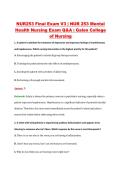
NUR253 Final Exam V3 | NUR 253 Mental
Health Nursing Exam Q&A | Galen College
of Nursing
1. A patient is admitted for treatment of depression and expresses feelings of worthlessness
and hopelessness. Which nursing intervention is the highest priority for this patient?
A. Encouraging the patient to attend all group therapy sessions.
B. Teaching the patient about the side effects of antidepressants.
C. Assisting the patient with activities of daily living.
D. Performing a thorough suicide risk assessment.
Answer: D
Rationale: Safety is always the primary concern in psychiatric nursing, especially when a
patient expresses hopelessness. Hopelessness is a significant indicator of potential suicidal
ideation. Therefore, the nurse must immediately assess the patient’s intent and plan to
ensure their safety before addressing other needs.
2. A client with schizophrenia is experiencing auditory hallucinations and appears to be
listening to someone who isn’t there. Which response by the nurse is most therapeutic?
A. There is no one else in the room; you are having a hallucination.
B. I don’t hear any voices, but I can see that you are frustrated.
C. Why do you think you are hearing voices right now?
,D. What are the voices telling you to do?
Answer: B
Rationale: The nurse should acknowledge the patient’s feelings without validating the
hallucination. This approach provides reality testing while showing empathy for the
patient’s distress. Focusing on the patient’s experience rather than the content of the
hallucination helps build rapport.
3. A nurse is caring for a patient who was recently started on Lithium for Bipolar Disorder.
The patient’s serum lithium level is 1.8 mEq/L. What is the nurse’s priority action?
A. Administer the next scheduled dose as ordered.
B. Document the result as within the therapeutic range.
C. Notify the provider and hold the next dose.
D. Encourage the patient to increase fluid intake.
Answer: C
Rationale: The therapeutic range for lithium is generally 0.6 to 1.2 mEq/L, and 1.8 mEq/L
indicates toxicity. Symptoms of lithium toxicity can be severe, including tremors, confusion,
and seizures. Immediate notification of the provider is necessary to prevent further
complications.
4. An elderly patient with dementia becomes increasingly confused and agitated in the late
afternoon. This behavior is known as:
A. Delirium.
, B. Sun-downing.
C. Aphasia.
D. Confabulation.
Answer: B
Rationale: Sun-downing refers to the increased agitation and confusion that occurs in the
late afternoon or evening for patients with dementia. This phenomenon is often linked to
fatigue or changes in light. Managing the environment and maintaining routine can help
mitigate these symptoms.
5. Which of the following is considered a ‘positive’ symptom of schizophrenia?
A. Flat affect.
B. Delusions.
C. Avolition.
D. Social withdrawal.
Answer: B
Rationale: Positive symptoms are additions to normal behavior, such as hallucinations or
delusions. Negative symptoms involve a loss of normal function, such as flat affect or lack of
motivation. Differentiating between these helps in tailoring pharmacological and
behavioral treatments.
Health Nursing Exam Q&A | Galen College
of Nursing
1. A patient is admitted for treatment of depression and expresses feelings of worthlessness
and hopelessness. Which nursing intervention is the highest priority for this patient?
A. Encouraging the patient to attend all group therapy sessions.
B. Teaching the patient about the side effects of antidepressants.
C. Assisting the patient with activities of daily living.
D. Performing a thorough suicide risk assessment.
Answer: D
Rationale: Safety is always the primary concern in psychiatric nursing, especially when a
patient expresses hopelessness. Hopelessness is a significant indicator of potential suicidal
ideation. Therefore, the nurse must immediately assess the patient’s intent and plan to
ensure their safety before addressing other needs.
2. A client with schizophrenia is experiencing auditory hallucinations and appears to be
listening to someone who isn’t there. Which response by the nurse is most therapeutic?
A. There is no one else in the room; you are having a hallucination.
B. I don’t hear any voices, but I can see that you are frustrated.
C. Why do you think you are hearing voices right now?
,D. What are the voices telling you to do?
Answer: B
Rationale: The nurse should acknowledge the patient’s feelings without validating the
hallucination. This approach provides reality testing while showing empathy for the
patient’s distress. Focusing on the patient’s experience rather than the content of the
hallucination helps build rapport.
3. A nurse is caring for a patient who was recently started on Lithium for Bipolar Disorder.
The patient’s serum lithium level is 1.8 mEq/L. What is the nurse’s priority action?
A. Administer the next scheduled dose as ordered.
B. Document the result as within the therapeutic range.
C. Notify the provider and hold the next dose.
D. Encourage the patient to increase fluid intake.
Answer: C
Rationale: The therapeutic range for lithium is generally 0.6 to 1.2 mEq/L, and 1.8 mEq/L
indicates toxicity. Symptoms of lithium toxicity can be severe, including tremors, confusion,
and seizures. Immediate notification of the provider is necessary to prevent further
complications.
4. An elderly patient with dementia becomes increasingly confused and agitated in the late
afternoon. This behavior is known as:
A. Delirium.
, B. Sun-downing.
C. Aphasia.
D. Confabulation.
Answer: B
Rationale: Sun-downing refers to the increased agitation and confusion that occurs in the
late afternoon or evening for patients with dementia. This phenomenon is often linked to
fatigue or changes in light. Managing the environment and maintaining routine can help
mitigate these symptoms.
5. Which of the following is considered a ‘positive’ symptom of schizophrenia?
A. Flat affect.
B. Delusions.
C. Avolition.
D. Social withdrawal.
Answer: B
Rationale: Positive symptoms are additions to normal behavior, such as hallucinations or
delusions. Negative symptoms involve a loss of normal function, such as flat affect or lack of
motivation. Differentiating between these helps in tailoring pharmacological and
behavioral treatments.


