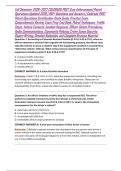
Fall Semester 2026–2027 COLORADO POST (Law Enforcement) Patrol
Operations Updated 2026 | 190+ Questions and Answers | Colorado POST
Patrol Operations Certification Study Guide, Practice Exam,
Comprehensive Review, Exam Prep Test Bank, Patrol Techniques, Traffic
Stops, Vehicle Contacts, Incident Response, Officer Safety Procedures,
Radio Communications, Community Policing, Crime Scene Security,
Report Writing, Detailed Rationales and Complete Revision Material
Question 1: According to Colorado Revised Statute (C.R.S.) § 42-4-1101, when an
officer observes a vehicle's turn signals not functioning properly, the officer may
stop the vehicle to issue a citation only if the equipment violation is considered a
"defective vehicle" offense. What is the primary classification of this type of
equipment violation under C.R.S. § 42-4-1101?
A. A class A traffic infraction
B. A class B traffic infraction
C. A misdemeanor traffic offense
D. A petty offense
CORRECT ANSWER: B. A class B traffic infraction
Rationale: Under C.R.S. § 42-4-1101, defective equipment violations, including non-
functioning turn signals, are classified as class B traffic infractions. These are not
criminal offenses (misdemeanors or petty offenses) and typically result in a fine without
the possibility of jail time, unless the defect causes an immediate hazard.
Question 2: An officer initiates a traffic stop for a suspected DUI. The driver
performs roadside maneuvers poorly but refuses a chemical test. Under
Colorado's express consent law (C.R.S. § 42-4-1301.1), what is the immediate
consequence for the driver's refusal?
A. Automatic jail time of 48 hours
B. A one-year revocation of their driver's license
C. A mandatory $1,000 fine
D. Immediate vehicle impoundment for 30 days
CORRECT ANSWER: B. A one-year revocation of their driver's license
Rationale: Colorado's express consent law mandates that any person who drives a
motor vehicle in the state consents to chemical testing for BAC. Refusal results in a
one-year revocation of driving privileges for a first-time refusal, which is independent of
any criminal DUI proceedings.
,Question 3: When a patrol officer is conducting a high-risk traffic stop (felony stop),
what is the standard protocol for the officer's initial approach to the suspect
vehicle?
A. Approach directly from the rear on the driver's side
B. Approach from the passenger side after announcing commands
C. Approach from the driver's side while maintaining a low profile
D. Approach directly from the front of the vehicle
CORRECT ANSWER: B. Approach from the passenger side after announcing
commands
Rationale: In a high-risk stop, the officer typically uses the patrol vehicle as cover,
issues loud verbal commands over the PA system, and orders the occupants to exit
from the driver's side. The officer then approaches from the passenger side to maintain
distance and avoid the driver's immediate line of fire while maintaining a tactical
advantage.
Question 4: Under Colorado law (C.R.S. § 16-3-201), a peace officer may make a
warrantless arrest when a crime has been committed in their presence. What
constitutes "in the officer's presence" for a misdemeanor offense?
A. The officer must see the act with their own eyes
B. The officer must hear a reliable witness identify the suspect
C. The officer must have probable cause based on any sensory perception
D. The officer must have video evidence of the act
CORRECT ANSWER: A. The officer must see the act with their own eyes
Rationale: For misdemeanor offenses, Colorado law requires that the offense must be
committed in the officer's "presence," which legally means the officer must actually
observe the conduct. Probable cause (which is required for felonies) is insufficient for a
warrantless misdemeanor arrest unless the offense involved domestic violence or was
witnessed by the officer.
Question 5: During a patrol, an officer observes a driver stopped in the middle of a
highway for no apparent reason. The driver appears confused and unable to speak
coherently. Which of the following immediate actions is most appropriate for the
officer to take regarding the driver's safety and legal standing?
A. Arrest the driver immediately for DUI
B. Place the driver in custody and request a mental health evaluation
C. Issue a citation for obstructing traffic and release the driver
D. Provide a courtesy ride and release the vehicle to a licensed driver
,CORRECT ANSWER: B. Place the driver in custody and request a mental health
evaluation
Rationale: While the driver may be under the influence of alcohol or drugs, the officer's
primary duty is to ensure safety. If the driver cannot care for themselves and poses a
danger to themselves or others, the officer should place them in protective custody and
request a mental health evaluation, following C.R.S. § 27-65-105 (mental health hold).
This is a medical and public safety action, not merely a traffic enforcement action.
Question 6: When an officer stops a vehicle for a traffic violation, what is the legal
standard required to conduct a full search of the passenger compartment without a
warrant?
A. Reasonable suspicion of criminal activity
B. Consent from the driver only
C. Probable cause that the vehicle contains evidence of a crime
D. A search incident to arrest after the driver is handcuffed
CORRECT ANSWER: C. Probable cause that the vehicle contains evidence of a
crime
Rationale: Under the automobile exception (Carroll v. United States) and Colorado law,
a warrantless search of a vehicle is permissible if there is probable cause to believe the
vehicle contains evidence of a crime. Reasonable suspicion is insufficient for a full
search; it only permits a brief stop and a pat-down of the occupants for weapons.
Question 7: A motorist is cited for driving without a valid license. The officer
discovers that the driver's Colorado license was suspended for a previous DUI
conviction. Under C.R.S. § 42-2-138, what is the classification of driving under
suspension (DUS) in this specific circumstance?
A. A class A traffic infraction
B. A class B traffic infraction
C. A class 2 misdemeanor traffic offense
D. A class 1 misdemeanor traffic offense
CORRECT ANSWER: C. A class 2 misdemeanor traffic offense
Rationale: Driving under suspension (DUS) is generally a class 2 misdemeanor traffic
offense when the suspension was for a DUI-related offense, which carries potential jail
time and fines. It is not merely a traffic infraction. The classification escalates to a class
1 misdemeanor under certain circumstances, such as a subsequent offense.
, Question 8: What is the legal basis for an officer to stop a motorist based on a
"random" vehicle checkpoint in Colorado?
A. A mandatory requirement that the checkpoint be publicized in advance
B. A neutral, pre-determined formula for stopping vehicles
C. A requirement that the checkpoint be conducted only during daylight hours
D. A warrant issued by a judge for each specific vehicle
CORRECT ANSWER: B. A neutral, pre-determined formula for stopping vehicles
Rationale: Under Colorado law, sobriety checkpoints must follow specific guidelines to
be constitutional. The stop must be based on a neutral, pre-determined formula (e.g.,
stopping every third vehicle) rather than officer discretion. The checkpoint must also be
publicly announced and have adequate safety measures.
Question 9: An officer responds to a domestic disturbance call. Upon arrival, the
officer sees a visible injury on the victim's arm and the suspect admits to pushing
the victim. The suspect is arrested for domestic violence. Under Colorado law
(C.R.S. § 18-6-803.5), which statement is true regarding the arrest?
A. The officer must have a warrant to arrest for domestic violence
B. The officer must arrest the suspect if there is probable cause
C. The officer may choose to issue a summons instead of arresting
D. The officer must obtain a protective order before making the arrest
CORRECT ANSWER: B. The officer must arrest the suspect if there is probable
cause
Rationale: Colorado has a mandatory arrest policy for domestic violence offenses. If an
officer has probable cause to believe that an act of domestic violence has occurred
(such as visible injury and an admission), the officer must arrest the suspect. The officer
is not permitted to simply issue a citation.
Question 10: While conducting patrol, an officer sees a vehicle make an unsafe
lane change, nearly causing an accident. The officer activates emergency lights
and stops the vehicle. The driver is the registered owner and produces a valid
driver's license. The officer checks the license plate and finds the registration is
expired by 14 days. What is the officer's primary course of action?
A. Tow the vehicle immediately for expired registration
B. Issue a citation for the unsafe lane change and expired registration
C. Issue a warning for both violations and let the driver go
D. Arrest the driver for driving without valid registration
CORRECT ANSWER: B. Issue a citation for the unsafe lane change and expired
registration
Operations Updated 2026 | 190+ Questions and Answers | Colorado POST
Patrol Operations Certification Study Guide, Practice Exam,
Comprehensive Review, Exam Prep Test Bank, Patrol Techniques, Traffic
Stops, Vehicle Contacts, Incident Response, Officer Safety Procedures,
Radio Communications, Community Policing, Crime Scene Security,
Report Writing, Detailed Rationales and Complete Revision Material
Question 1: According to Colorado Revised Statute (C.R.S.) § 42-4-1101, when an
officer observes a vehicle's turn signals not functioning properly, the officer may
stop the vehicle to issue a citation only if the equipment violation is considered a
"defective vehicle" offense. What is the primary classification of this type of
equipment violation under C.R.S. § 42-4-1101?
A. A class A traffic infraction
B. A class B traffic infraction
C. A misdemeanor traffic offense
D. A petty offense
CORRECT ANSWER: B. A class B traffic infraction
Rationale: Under C.R.S. § 42-4-1101, defective equipment violations, including non-
functioning turn signals, are classified as class B traffic infractions. These are not
criminal offenses (misdemeanors or petty offenses) and typically result in a fine without
the possibility of jail time, unless the defect causes an immediate hazard.
Question 2: An officer initiates a traffic stop for a suspected DUI. The driver
performs roadside maneuvers poorly but refuses a chemical test. Under
Colorado's express consent law (C.R.S. § 42-4-1301.1), what is the immediate
consequence for the driver's refusal?
A. Automatic jail time of 48 hours
B. A one-year revocation of their driver's license
C. A mandatory $1,000 fine
D. Immediate vehicle impoundment for 30 days
CORRECT ANSWER: B. A one-year revocation of their driver's license
Rationale: Colorado's express consent law mandates that any person who drives a
motor vehicle in the state consents to chemical testing for BAC. Refusal results in a
one-year revocation of driving privileges for a first-time refusal, which is independent of
any criminal DUI proceedings.
,Question 3: When a patrol officer is conducting a high-risk traffic stop (felony stop),
what is the standard protocol for the officer's initial approach to the suspect
vehicle?
A. Approach directly from the rear on the driver's side
B. Approach from the passenger side after announcing commands
C. Approach from the driver's side while maintaining a low profile
D. Approach directly from the front of the vehicle
CORRECT ANSWER: B. Approach from the passenger side after announcing
commands
Rationale: In a high-risk stop, the officer typically uses the patrol vehicle as cover,
issues loud verbal commands over the PA system, and orders the occupants to exit
from the driver's side. The officer then approaches from the passenger side to maintain
distance and avoid the driver's immediate line of fire while maintaining a tactical
advantage.
Question 4: Under Colorado law (C.R.S. § 16-3-201), a peace officer may make a
warrantless arrest when a crime has been committed in their presence. What
constitutes "in the officer's presence" for a misdemeanor offense?
A. The officer must see the act with their own eyes
B. The officer must hear a reliable witness identify the suspect
C. The officer must have probable cause based on any sensory perception
D. The officer must have video evidence of the act
CORRECT ANSWER: A. The officer must see the act with their own eyes
Rationale: For misdemeanor offenses, Colorado law requires that the offense must be
committed in the officer's "presence," which legally means the officer must actually
observe the conduct. Probable cause (which is required for felonies) is insufficient for a
warrantless misdemeanor arrest unless the offense involved domestic violence or was
witnessed by the officer.
Question 5: During a patrol, an officer observes a driver stopped in the middle of a
highway for no apparent reason. The driver appears confused and unable to speak
coherently. Which of the following immediate actions is most appropriate for the
officer to take regarding the driver's safety and legal standing?
A. Arrest the driver immediately for DUI
B. Place the driver in custody and request a mental health evaluation
C. Issue a citation for obstructing traffic and release the driver
D. Provide a courtesy ride and release the vehicle to a licensed driver
,CORRECT ANSWER: B. Place the driver in custody and request a mental health
evaluation
Rationale: While the driver may be under the influence of alcohol or drugs, the officer's
primary duty is to ensure safety. If the driver cannot care for themselves and poses a
danger to themselves or others, the officer should place them in protective custody and
request a mental health evaluation, following C.R.S. § 27-65-105 (mental health hold).
This is a medical and public safety action, not merely a traffic enforcement action.
Question 6: When an officer stops a vehicle for a traffic violation, what is the legal
standard required to conduct a full search of the passenger compartment without a
warrant?
A. Reasonable suspicion of criminal activity
B. Consent from the driver only
C. Probable cause that the vehicle contains evidence of a crime
D. A search incident to arrest after the driver is handcuffed
CORRECT ANSWER: C. Probable cause that the vehicle contains evidence of a
crime
Rationale: Under the automobile exception (Carroll v. United States) and Colorado law,
a warrantless search of a vehicle is permissible if there is probable cause to believe the
vehicle contains evidence of a crime. Reasonable suspicion is insufficient for a full
search; it only permits a brief stop and a pat-down of the occupants for weapons.
Question 7: A motorist is cited for driving without a valid license. The officer
discovers that the driver's Colorado license was suspended for a previous DUI
conviction. Under C.R.S. § 42-2-138, what is the classification of driving under
suspension (DUS) in this specific circumstance?
A. A class A traffic infraction
B. A class B traffic infraction
C. A class 2 misdemeanor traffic offense
D. A class 1 misdemeanor traffic offense
CORRECT ANSWER: C. A class 2 misdemeanor traffic offense
Rationale: Driving under suspension (DUS) is generally a class 2 misdemeanor traffic
offense when the suspension was for a DUI-related offense, which carries potential jail
time and fines. It is not merely a traffic infraction. The classification escalates to a class
1 misdemeanor under certain circumstances, such as a subsequent offense.
, Question 8: What is the legal basis for an officer to stop a motorist based on a
"random" vehicle checkpoint in Colorado?
A. A mandatory requirement that the checkpoint be publicized in advance
B. A neutral, pre-determined formula for stopping vehicles
C. A requirement that the checkpoint be conducted only during daylight hours
D. A warrant issued by a judge for each specific vehicle
CORRECT ANSWER: B. A neutral, pre-determined formula for stopping vehicles
Rationale: Under Colorado law, sobriety checkpoints must follow specific guidelines to
be constitutional. The stop must be based on a neutral, pre-determined formula (e.g.,
stopping every third vehicle) rather than officer discretion. The checkpoint must also be
publicly announced and have adequate safety measures.
Question 9: An officer responds to a domestic disturbance call. Upon arrival, the
officer sees a visible injury on the victim's arm and the suspect admits to pushing
the victim. The suspect is arrested for domestic violence. Under Colorado law
(C.R.S. § 18-6-803.5), which statement is true regarding the arrest?
A. The officer must have a warrant to arrest for domestic violence
B. The officer must arrest the suspect if there is probable cause
C. The officer may choose to issue a summons instead of arresting
D. The officer must obtain a protective order before making the arrest
CORRECT ANSWER: B. The officer must arrest the suspect if there is probable
cause
Rationale: Colorado has a mandatory arrest policy for domestic violence offenses. If an
officer has probable cause to believe that an act of domestic violence has occurred
(such as visible injury and an admission), the officer must arrest the suspect. The officer
is not permitted to simply issue a citation.
Question 10: While conducting patrol, an officer sees a vehicle make an unsafe
lane change, nearly causing an accident. The officer activates emergency lights
and stops the vehicle. The driver is the registered owner and produces a valid
driver's license. The officer checks the license plate and finds the registration is
expired by 14 days. What is the officer's primary course of action?
A. Tow the vehicle immediately for expired registration
B. Issue a citation for the unsafe lane change and expired registration
C. Issue a warning for both violations and let the driver go
D. Arrest the driver for driving without valid registration
CORRECT ANSWER: B. Issue a citation for the unsafe lane change and expired
registration