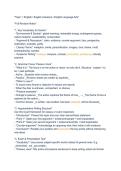
*Topic 1: English / English Literature / English Language Arts*
*Full Revision Notes*
*1. Key Vocabulary for Exams*
- *Environment & Society*: global warming, renewable energy, endangered species,
carbon footprint, sustainability, conservation
- *Argument & Persuasion*: claim, evidence, counter-argument, bias, perspective,
implication, evaluate, justify
- *Literary Terms*: metaphor, simile, personification, imagery, tone, theme, motif,
foreshadowing, narrator
- *Academic Writing*: analyze, compare, contrast, summarize, synthesize, critically
examine
*2. Grammar Focus: Passive Voice*
- *What it is*: The focus is on the action or result, not who did it. Structure: `subject + to
be + past participle`
- Active: _Students write revision sheets._
- Passive: _Revision sheets are written by students._
- *When to use it*:
- To sound more formal or objective in essays and reports
- When the doer is unknown, unimportant, or obvious
- *Practice examples*:
- Change to passive: _The author explores the theme of loss._ → _The theme of loss is
explored by the author._
- Common tenses: _is written, was studied, has been analyzed, will be discussed_
*3. Argumentative Writing Structure*
Use this 5-part framework for essays or exam responses:
- *Introduction*: Present the topic and your clear stance/thesis statement
- *Point 1*: State your first argument + evidence/example + brief explanation
- *Point 2*: State your second argument + evidence/example + brief explanation
- *Counter-argument*: Acknowledge an opposing view, then refute it with evidence
- *Conclusion*: Restate your position and summarize the key points without introducing
new ideas
*4. Exam & Presentation Tips*
- *Vocabulary*: Use precise subject-specific words instead of general ones. E.g.
_diminished_ not _got smaller_
- *Passive voice*: Mix active and passive sentences to keep writing varied and formal
*Full Revision Notes*
*1. Key Vocabulary for Exams*
- *Environment & Society*: global warming, renewable energy, endangered species,
carbon footprint, sustainability, conservation
- *Argument & Persuasion*: claim, evidence, counter-argument, bias, perspective,
implication, evaluate, justify
- *Literary Terms*: metaphor, simile, personification, imagery, tone, theme, motif,
foreshadowing, narrator
- *Academic Writing*: analyze, compare, contrast, summarize, synthesize, critically
examine
*2. Grammar Focus: Passive Voice*
- *What it is*: The focus is on the action or result, not who did it. Structure: `subject + to
be + past participle`
- Active: _Students write revision sheets._
- Passive: _Revision sheets are written by students._
- *When to use it*:
- To sound more formal or objective in essays and reports
- When the doer is unknown, unimportant, or obvious
- *Practice examples*:
- Change to passive: _The author explores the theme of loss._ → _The theme of loss is
explored by the author._
- Common tenses: _is written, was studied, has been analyzed, will be discussed_
*3. Argumentative Writing Structure*
Use this 5-part framework for essays or exam responses:
- *Introduction*: Present the topic and your clear stance/thesis statement
- *Point 1*: State your first argument + evidence/example + brief explanation
- *Point 2*: State your second argument + evidence/example + brief explanation
- *Counter-argument*: Acknowledge an opposing view, then refute it with evidence
- *Conclusion*: Restate your position and summarize the key points without introducing
new ideas
*4. Exam & Presentation Tips*
- *Vocabulary*: Use precise subject-specific words instead of general ones. E.g.
_diminished_ not _got smaller_
- *Passive voice*: Mix active and passive sentences to keep writing varied and formal