

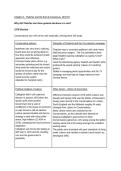
Chapter 6 - Thatcher and the End of Consensus, 1979-97
Why did Thatcher win three general elections in a row?
1979 Election
Conservatives won 43% of the vote nationally, winning them 339 seats.
Conservative policies: Strengths of Thatcher and the Tory election campaign:
Manifesto was very short, outlining Thatcher was a ‘conviction politician’ with clear views
board aims but not giving detail on Had key press support. The Sun published a front
how they would be achieved (made page headline quoting Callaghan as saying ‘Crisis?
opposition less effective). What crisis?’
Promised trade union reform, e.g Used the advertising agency Saatchi and Saatchi (who
secondary picketing and the closed produced the award winning ‘Labour isn’t working’
shop would be reformed and unions poster).
would be forced to pay for the Skilled in managing photo opportunities and the TV
upkeep of strikers rather than the campaign and had had an image makeover from
social security system Gordon Reece.
Appealed to marginal voters.
Political mistakes of Labour Other factors - Winter of Discontent:
Callaghan didn’t call a general Difference between Autumn 1978 (when Labour was
election in autumn 1978 when the ahead) and Spring 1979 was the Winter of Discontent.
opinion polls were positive. Swing voters turned to the Conservatives In London,
Government lost a vote of South England and the Midlands roughly 40 seats
confidence in the house of commons changed from Labour to Conservatives.
so was forced to call an election. Many Liberal voters also switched to the
Labour seemed divided and had no Conservatives, as the Liberals were blamed for
strategy to deal with rising strike keeping Callaghan’s government in office.
action, high inflation (13.40% in Conservatives gained an 11% swing among the skilled
1979), unemployment and economic working class and a 9% swing amongst the unskilled
stagnation working class.
Callaghan was forced into taking an The public were frustrated with poor standards of living
IMF loan in 1976 and the resulting under Labour and needed a solution (result wasn’t an
cuts hurt the government’s ideological shift).
popularity.
,1983 Election
Conservative policies: Strengths of Thatcher and the Tory
election campaign:
The 1982 budget increased personal allowances
above inflation, capital gains tax thresholds were Thatcher’s media portrayal was very
raised, stamp duties reduced and pensions increased strong
by 11%. Had a strong-willed image, playing
This was a pleasant surprise for voters after the up to her reputation as the “Iron
deflationary budgets of 1980 and 1981. Lady”.
Privatisation policies had begun by 1983 and had
increased public shareholding.
Political mistakes of Labour Other factors - ‘The Falklands
Factor’/ the divided opposition
Worst defeat since 1918.
Disastrous split in the Labour party. Victory in the Falklands War was a
Micahel Foot lacked an assured manner and his belief source of national pride and
in unilateral nuclear disarmament, nationalisation of reflected well on Thatcher’s personal
industry and government regulation were unappealing. popularity. Made her appear
Labour manifesto was described as the ‘longest decisive and patriotic.
suicide note in history’ (too left wing)
More moderate elements of Labour
Failed to take advantage of Thatcher’s unpopularity split away into the SDP in March
(according to opinion polls she was, during her time in 1981, massively damaging the
office, the second most unpopular post-war PM). Labour party. The Alliance between
When poll tax was introduced, the Conservatives were the Liberals and the SDP polled 7.7
24% behind Labour. million votes, splitting the anti-
Didn’t challenge Conservatives effectively on high Thatcher vote.
unemployment, Howe’s deflationary budgets and the This allowed Thatcher to gain some
shrinking of the country’s industrial base. traditional Labour seats in the North.
1987 Election
Conservative policies: Strengths of Thatcher and the
Tory election campaign:
‘Feel good factor’
Thatcher claimed to have created a “property owning Victory over the miners had
democracy” and “popular capitalism” through her Right to bolstered Thatcher’s image as a
Buy and privatisation policies. strong leader.
- Popular with people who had bought their council
house/ people who had bought shares for the first After “Wobbly Thursday” (polls
time. suggested that Labour was
- Conservatives did well in the South-East and ahead), Conservatives spent £3
, Midlands million on advertising in the last
week of the campaign, focusing
Inflation was low (4%), interest rates had fallen and on their achievements in
unemployment was under 3 million. government. “Don’t let Labour
Government used profit from privatisation to cut taxes. wreck it”.
Lawson’s pre-election budget cut income tax by 2% and
froze duty on petrol, alcohol and cigarettes and increased Right wing newspapers (e.g the
health spending. Sun) attacked Labour and its
‘Lawson Boom’ = economic growth had increased from leader as the ‘loony left’
2.5% to 4%. Pound was strong.
Political mistakes of Labour Other factors - The Alliance,
decline of trade unions
Committed to Unilateral Disarmament and the cancellation
of Trident. Saatchi and Saatchi capitalised on this with Neither Labour nor the Alliance
their “Labour’s policy on Arms” poster. were popular enough on their
own to challenge the
Kinnock’s style had limited appeal. Thatcher was seen as Conservatives but they split the
the stronger leader with a firmer hold over her colleagues anti-Tory vote. The Alliance
and a growing international reputation. contested every seat in 1987.
Declining trade union
Voters who had been historically aligned with Labour membership eroded Labour’s
switched their support to the Conservatives, including natural support base.
many of the traditional working classes.
How successful were Thatcher’s economic policies?
Post-war consensus: unemployment should be kept low by government spending, the industries
of coal, gas, electricity and railways should remain nationalised, the government should control
prices/ wages. (Keynesiansim)
Right wing economists, such as Milton Friedman, challenged consensus politics and advocated
for laissez-faire capitalism. This influenced several right-wing conservative politicians, including
Sir Keith Joseph, who became one of Thatcher’s key advisers.
The policies of privatisation, monetarism and government deregulation are collectively known
today as ‘Thatcherism’.
Inflation
- Retail prices doubled between 1973 and 1979.
- Thatcher and Joseph were convinced that economic recovery depended on controlling
inflation.
- Inflation caused strikes for higher wages; prevented people from saving for the future
independently and it reduced business incentives as it led to higher taxes.
- Thatcher thought that inflation was a result of excessive government spending and
‘Keynesianism’.
Why did Thatcher win three general elections in a row?
1979 Election
Conservatives won 43% of the vote nationally, winning them 339 seats.
Conservative policies: Strengths of Thatcher and the Tory election campaign:
Manifesto was very short, outlining Thatcher was a ‘conviction politician’ with clear views
board aims but not giving detail on Had key press support. The Sun published a front
how they would be achieved (made page headline quoting Callaghan as saying ‘Crisis?
opposition less effective). What crisis?’
Promised trade union reform, e.g Used the advertising agency Saatchi and Saatchi (who
secondary picketing and the closed produced the award winning ‘Labour isn’t working’
shop would be reformed and unions poster).
would be forced to pay for the Skilled in managing photo opportunities and the TV
upkeep of strikers rather than the campaign and had had an image makeover from
social security system Gordon Reece.
Appealed to marginal voters.
Political mistakes of Labour Other factors - Winter of Discontent:
Callaghan didn’t call a general Difference between Autumn 1978 (when Labour was
election in autumn 1978 when the ahead) and Spring 1979 was the Winter of Discontent.
opinion polls were positive. Swing voters turned to the Conservatives In London,
Government lost a vote of South England and the Midlands roughly 40 seats
confidence in the house of commons changed from Labour to Conservatives.
so was forced to call an election. Many Liberal voters also switched to the
Labour seemed divided and had no Conservatives, as the Liberals were blamed for
strategy to deal with rising strike keeping Callaghan’s government in office.
action, high inflation (13.40% in Conservatives gained an 11% swing among the skilled
1979), unemployment and economic working class and a 9% swing amongst the unskilled
stagnation working class.
Callaghan was forced into taking an The public were frustrated with poor standards of living
IMF loan in 1976 and the resulting under Labour and needed a solution (result wasn’t an
cuts hurt the government’s ideological shift).
popularity.
,1983 Election
Conservative policies: Strengths of Thatcher and the Tory
election campaign:
The 1982 budget increased personal allowances
above inflation, capital gains tax thresholds were Thatcher’s media portrayal was very
raised, stamp duties reduced and pensions increased strong
by 11%. Had a strong-willed image, playing
This was a pleasant surprise for voters after the up to her reputation as the “Iron
deflationary budgets of 1980 and 1981. Lady”.
Privatisation policies had begun by 1983 and had
increased public shareholding.
Political mistakes of Labour Other factors - ‘The Falklands
Factor’/ the divided opposition
Worst defeat since 1918.
Disastrous split in the Labour party. Victory in the Falklands War was a
Micahel Foot lacked an assured manner and his belief source of national pride and
in unilateral nuclear disarmament, nationalisation of reflected well on Thatcher’s personal
industry and government regulation were unappealing. popularity. Made her appear
Labour manifesto was described as the ‘longest decisive and patriotic.
suicide note in history’ (too left wing)
More moderate elements of Labour
Failed to take advantage of Thatcher’s unpopularity split away into the SDP in March
(according to opinion polls she was, during her time in 1981, massively damaging the
office, the second most unpopular post-war PM). Labour party. The Alliance between
When poll tax was introduced, the Conservatives were the Liberals and the SDP polled 7.7
24% behind Labour. million votes, splitting the anti-
Didn’t challenge Conservatives effectively on high Thatcher vote.
unemployment, Howe’s deflationary budgets and the This allowed Thatcher to gain some
shrinking of the country’s industrial base. traditional Labour seats in the North.
1987 Election
Conservative policies: Strengths of Thatcher and the
Tory election campaign:
‘Feel good factor’
Thatcher claimed to have created a “property owning Victory over the miners had
democracy” and “popular capitalism” through her Right to bolstered Thatcher’s image as a
Buy and privatisation policies. strong leader.
- Popular with people who had bought their council
house/ people who had bought shares for the first After “Wobbly Thursday” (polls
time. suggested that Labour was
- Conservatives did well in the South-East and ahead), Conservatives spent £3
, Midlands million on advertising in the last
week of the campaign, focusing
Inflation was low (4%), interest rates had fallen and on their achievements in
unemployment was under 3 million. government. “Don’t let Labour
Government used profit from privatisation to cut taxes. wreck it”.
Lawson’s pre-election budget cut income tax by 2% and
froze duty on petrol, alcohol and cigarettes and increased Right wing newspapers (e.g the
health spending. Sun) attacked Labour and its
‘Lawson Boom’ = economic growth had increased from leader as the ‘loony left’
2.5% to 4%. Pound was strong.
Political mistakes of Labour Other factors - The Alliance,
decline of trade unions
Committed to Unilateral Disarmament and the cancellation
of Trident. Saatchi and Saatchi capitalised on this with Neither Labour nor the Alliance
their “Labour’s policy on Arms” poster. were popular enough on their
own to challenge the
Kinnock’s style had limited appeal. Thatcher was seen as Conservatives but they split the
the stronger leader with a firmer hold over her colleagues anti-Tory vote. The Alliance
and a growing international reputation. contested every seat in 1987.
Declining trade union
Voters who had been historically aligned with Labour membership eroded Labour’s
switched their support to the Conservatives, including natural support base.
many of the traditional working classes.
How successful were Thatcher’s economic policies?
Post-war consensus: unemployment should be kept low by government spending, the industries
of coal, gas, electricity and railways should remain nationalised, the government should control
prices/ wages. (Keynesiansim)
Right wing economists, such as Milton Friedman, challenged consensus politics and advocated
for laissez-faire capitalism. This influenced several right-wing conservative politicians, including
Sir Keith Joseph, who became one of Thatcher’s key advisers.
The policies of privatisation, monetarism and government deregulation are collectively known
today as ‘Thatcherism’.
Inflation
- Retail prices doubled between 1973 and 1979.
- Thatcher and Joseph were convinced that economic recovery depended on controlling
inflation.
- Inflation caused strikes for higher wages; prevented people from saving for the future
independently and it reduced business incentives as it led to higher taxes.
- Thatcher thought that inflation was a result of excessive government spending and
‘Keynesianism’.


