
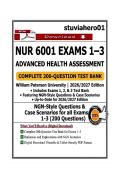
,NUR 6001 EXAMS 1–3 – ADVANCED HEALTH
k k k k k k
ASSESSMENT
k
William Paterson University | Complete 200-Question
k k k k k
Test Bank | NGN-Style Questions & Case Scenarios |
k k k k k k k k k
2026/2027 Edition | 100% Pass Guarantee
k k k k k k
EXAM OVERVIEW
Exam Focus Areas
Foundations of Health Assessment, Health
History & Interviewing, Physical Examination
Exam 1
Techniques, General Survey, Integumentary
System
HEENT, Cardiovascular, Respiratory,
Exam 2
Abdominal & Gastrointestinal Assessment
Musculoskeletal, Neurological,
Exam 3 Genitourinary, Comprehensive & NGN Case
Scenarios
NGN Case Clinical Judgment, Prioritization, Differential
Scenarios Diagnosis
,EXAM 1: FOUNDATIONS OF HEALTH ASSESSMENT
(Questions 1–50)
1. During a comprehensive health assessment, which
component should the advanced practice nurse complete
FIRST?
A) Percussion
B) Palpation
C) Inspection
D) Auscultation
Answer: C) Inspection
Rationale: Inspection is the first step of the physical
examination and provides valuable baseline information
before any hands-on techniques are performed. It allows
the examiner to observe overall appearance, symmetry,
color, and movement without disturbing the patient.
2. A 72-year-old patient reports feeling "tired all the time."
What is the most appropriate initial open-ended question?
A) "Do you have chest pain when you are tired?"
, B) "How long have you felt tired?"
C) "Tell me more about what 'tired all the time' means to
you."
D) "Is the tiredness worse in the morning or evening?"
Answer: C) "Tell me more about what 'tired all the time'
means to you."
Rationale: Open-ended questions allow the patient to
describe the symptom in their own words, preserving the
narrative and preventing early closure.
3. During a health history, the patient avoids eye contact
and answers with one word. The best response is:
A) Ask the questions faster to reduce discomfort
B) Proceed directly to the physical exam
C) Acknowledge the behavior: "I notice you seem
uncomfortable. Is there something you'd like to discuss?"
D) Repeat every question louder
Answer: C) Acknowledge the behavior: "I notice you seem
uncomfortable. Is there something you'd like to discuss?"
Rationale: Recognizing nonverbal cues and addressing
them respectfully builds rapport and uncovers potential
fear, pain, or cultural factors.
k k k k k k
ASSESSMENT
k
William Paterson University | Complete 200-Question
k k k k k
Test Bank | NGN-Style Questions & Case Scenarios |
k k k k k k k k k
2026/2027 Edition | 100% Pass Guarantee
k k k k k k
EXAM OVERVIEW
Exam Focus Areas
Foundations of Health Assessment, Health
History & Interviewing, Physical Examination
Exam 1
Techniques, General Survey, Integumentary
System
HEENT, Cardiovascular, Respiratory,
Exam 2
Abdominal & Gastrointestinal Assessment
Musculoskeletal, Neurological,
Exam 3 Genitourinary, Comprehensive & NGN Case
Scenarios
NGN Case Clinical Judgment, Prioritization, Differential
Scenarios Diagnosis
,EXAM 1: FOUNDATIONS OF HEALTH ASSESSMENT
(Questions 1–50)
1. During a comprehensive health assessment, which
component should the advanced practice nurse complete
FIRST?
A) Percussion
B) Palpation
C) Inspection
D) Auscultation
Answer: C) Inspection
Rationale: Inspection is the first step of the physical
examination and provides valuable baseline information
before any hands-on techniques are performed. It allows
the examiner to observe overall appearance, symmetry,
color, and movement without disturbing the patient.
2. A 72-year-old patient reports feeling "tired all the time."
What is the most appropriate initial open-ended question?
A) "Do you have chest pain when you are tired?"
, B) "How long have you felt tired?"
C) "Tell me more about what 'tired all the time' means to
you."
D) "Is the tiredness worse in the morning or evening?"
Answer: C) "Tell me more about what 'tired all the time'
means to you."
Rationale: Open-ended questions allow the patient to
describe the symptom in their own words, preserving the
narrative and preventing early closure.
3. During a health history, the patient avoids eye contact
and answers with one word. The best response is:
A) Ask the questions faster to reduce discomfort
B) Proceed directly to the physical exam
C) Acknowledge the behavior: "I notice you seem
uncomfortable. Is there something you'd like to discuss?"
D) Repeat every question louder
Answer: C) Acknowledge the behavior: "I notice you seem
uncomfortable. Is there something you'd like to discuss?"
Rationale: Recognizing nonverbal cues and addressing
them respectfully builds rapport and uncovers potential
fear, pain, or cultural factors.


