
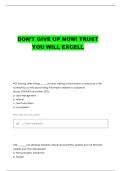
#13. Among other things, ________involves making a client aware of resources in the
community, as well as providing information related to substance
abuse, HIV/AIDS and other STDs.
a. case management
b. referral
c. client education
d. consultation
Give this one a try later!
c. Client education
#30. __________can develop between natural and synthetic opiates, but not between
opiates and CNS depressants.
a. Nonsynergistic interaction
b. Gestalt
,c. Cross tolerance
d. Negative symptoms
Give this one a try later!
c. cross tolerance
#2. MAT refers to:
a. a common screening tool for alcoholism.
b. a lengthy personality inventory used to identify gross psychopathology.
c. the use of medications such as suboxone in the treatment of addiction.
d. a nonmedical detox protocol.
Give this one a try later!
c. the use of medications such as suboxone in the treatment of addiction.
MAT = Medication Assisted Treatment
#40. Nonmaleficence is the ethical principle that means:
a. show unconditional positive regard.
b. show equal respect for gender.
c. do no harm.
d. respect confidentiality.
Give this one a try later!
c. do no harm.
, #44. _________is the term used to describe the mental activities involved in acquiring,
retaining and using any type of knowledge.
a. Thinking
b. Memory
c. Cognition
d. Perception
Give this one a try later!
c. Cognition
#8. Attitudes, policies, and practices that are destructive cultures and their members
are examples of lack of cultural _______.
a. blindness
b. competence
c. destructiveness
d. incapacity
Give this one a try later!
b. competence
#20. How does solution-focused brief therapy differ from many of the other
approaches to counseling?
a. Emphasis is placed on the present and future while devaluing the past.
b. It emphasizes the use of more abstract techniques, such as empty chair.
c. Greater attention is paid to the particular pathology and associated
problems.
d. More time in spent attempting to understand the problem.
community, as well as providing information related to substance
abuse, HIV/AIDS and other STDs.
a. case management
b. referral
c. client education
d. consultation
Give this one a try later!
c. Client education
#30. __________can develop between natural and synthetic opiates, but not between
opiates and CNS depressants.
a. Nonsynergistic interaction
b. Gestalt
,c. Cross tolerance
d. Negative symptoms
Give this one a try later!
c. cross tolerance
#2. MAT refers to:
a. a common screening tool for alcoholism.
b. a lengthy personality inventory used to identify gross psychopathology.
c. the use of medications such as suboxone in the treatment of addiction.
d. a nonmedical detox protocol.
Give this one a try later!
c. the use of medications such as suboxone in the treatment of addiction.
MAT = Medication Assisted Treatment
#40. Nonmaleficence is the ethical principle that means:
a. show unconditional positive regard.
b. show equal respect for gender.
c. do no harm.
d. respect confidentiality.
Give this one a try later!
c. do no harm.
, #44. _________is the term used to describe the mental activities involved in acquiring,
retaining and using any type of knowledge.
a. Thinking
b. Memory
c. Cognition
d. Perception
Give this one a try later!
c. Cognition
#8. Attitudes, policies, and practices that are destructive cultures and their members
are examples of lack of cultural _______.
a. blindness
b. competence
c. destructiveness
d. incapacity
Give this one a try later!
b. competence
#20. How does solution-focused brief therapy differ from many of the other
approaches to counseling?
a. Emphasis is placed on the present and future while devaluing the past.
b. It emphasizes the use of more abstract techniques, such as empty chair.
c. Greater attention is paid to the particular pathology and associated
problems.
d. More time in spent attempting to understand the problem.


