EMT FINAL EXAM TEST QUESTIONS (PART 1)
Leave the first rating
Save
Terms in this set (296) Hide definitions
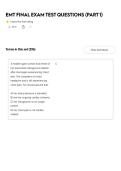
A middle-aged woman took three of C
her prescribed nitroglycerin tablets
after she began experiencing chest
pain. She complains of a bad
headache and is still experiencing
chest pain. You should assume that:
A) her blood pressure is elevated.
B) she has ongoing cardiac ischemia.
C) her nitroglycerin is no longer
potent.
D) her chest pain is not cardiac
related.
,A 35-year-old patient complains of D
shortness of breath. He is conscious
and alert and is able to speak in
complete sentences, although with
slight difficulty. Assessment reveals
diffuse wheezing to auscultation, a
respiratory rate of 24 breaths/min, a
heart rate of 110 beats/min, and an
oxygen saturation of 96%. Which of
the following interventions would be
of MOST benefit to this patient?
A) A beta antagonist
B) Assisted ventilation
C) Supplemental oxygen
D) Inhaled bronchodilator
A young female experienced A
massive facial trauma and is
unresponsive. After several attempts,
you are unable to adequately open
her airway with the jaw-thrust
maneuver. You should:
A) carefully tilt her head back and lift
up on her chin.
B) insert a nasopharyngeal airway
and apply oxygen.
C) apply oxygen and reattempt the
jaw-thrust maneuver.
D) assist her ventilations with a bag-
valve-mask device.
,You are called to a local state park A
where a hiker fell from a cliff into a
thick, wooded area with rough
terrain. It is cold and foggy, and a
thunderstorm is approaching. You
will MOST likely move the patient to
the ambulance by:
A) placing the patient in a basket
stretcher and using at least four
people to carry him to the
ambulance.
B) bringing the ambulance stretcher
to the patient, loading him onto it,
and removing him from the wooded
area.
C) assisting the patient in walking
from the wooded area to the
ambulance if his injuries are not life
threatening.
D) requesting a helicopter to hoist
the patient out of the wooded area
and carry him to a site near the
ambulance.
, After assisting a patient with his or A
her prescribed nitroglycerin, you
would NOT expect him or her to
experience a:
A) syncopal episode.
B) pounding headache.
C) burning sensation in the mouth.
D) fizzing sensation under the
tongue.
All of the following are components A
of the Cincinnati Stroke Scale,
EXCEPT:
A) pupil size.
B) facial droop.
C) speech pattern.
D) arm movement.
You are assessing a 66-year-old man A
who has emphysema and complains
of worsened shortness of breath. He
is confused, has a heart rate of 120
beats/min, and has an oxygen
saturation of 83%. Which of the
following assessment findings should
concern you the MOST?
A) Confusion
B) Tachycardia
C) Low oxygen saturation
D) Worsened shortness of breath
Leave the first rating
Save
Terms in this set (296) Hide definitions
A middle-aged woman took three of C
her prescribed nitroglycerin tablets
after she began experiencing chest
pain. She complains of a bad
headache and is still experiencing
chest pain. You should assume that:
A) her blood pressure is elevated.
B) she has ongoing cardiac ischemia.
C) her nitroglycerin is no longer
potent.
D) her chest pain is not cardiac
related.
,A 35-year-old patient complains of D
shortness of breath. He is conscious
and alert and is able to speak in
complete sentences, although with
slight difficulty. Assessment reveals
diffuse wheezing to auscultation, a
respiratory rate of 24 breaths/min, a
heart rate of 110 beats/min, and an
oxygen saturation of 96%. Which of
the following interventions would be
of MOST benefit to this patient?
A) A beta antagonist
B) Assisted ventilation
C) Supplemental oxygen
D) Inhaled bronchodilator
A young female experienced A
massive facial trauma and is
unresponsive. After several attempts,
you are unable to adequately open
her airway with the jaw-thrust
maneuver. You should:
A) carefully tilt her head back and lift
up on her chin.
B) insert a nasopharyngeal airway
and apply oxygen.
C) apply oxygen and reattempt the
jaw-thrust maneuver.
D) assist her ventilations with a bag-
valve-mask device.
,You are called to a local state park A
where a hiker fell from a cliff into a
thick, wooded area with rough
terrain. It is cold and foggy, and a
thunderstorm is approaching. You
will MOST likely move the patient to
the ambulance by:
A) placing the patient in a basket
stretcher and using at least four
people to carry him to the
ambulance.
B) bringing the ambulance stretcher
to the patient, loading him onto it,
and removing him from the wooded
area.
C) assisting the patient in walking
from the wooded area to the
ambulance if his injuries are not life
threatening.
D) requesting a helicopter to hoist
the patient out of the wooded area
and carry him to a site near the
ambulance.
, After assisting a patient with his or A
her prescribed nitroglycerin, you
would NOT expect him or her to
experience a:
A) syncopal episode.
B) pounding headache.
C) burning sensation in the mouth.
D) fizzing sensation under the
tongue.
All of the following are components A
of the Cincinnati Stroke Scale,
EXCEPT:
A) pupil size.
B) facial droop.
C) speech pattern.
D) arm movement.
You are assessing a 66-year-old man A
who has emphysema and complains
of worsened shortness of breath. He
is confused, has a heart rate of 120
beats/min, and has an oxygen
saturation of 83%. Which of the
following assessment findings should
concern you the MOST?
A) Confusion
B) Tachycardia
C) Low oxygen saturation
D) Worsened shortness of breath