

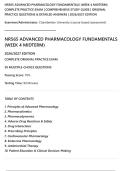
NR565 ADVANCED PHARMACOLOGY FUNDAMENTALS (WEEK 4 MIDTERM)
COMPLETE PRACTICE EXAM | COMPREHENSIVE STUDY GUIDE | ORIGINAL
PRACTICE QUESTIONS & DETAILED ANSWERS | 2026/2027 EDITION
Examiner/Administrator: Chamberlain University (course-based assessment)
━━━━━━━━━━━━━━━━━━━━━━━━━━━━━━━━━━
NR565 ADVANCED PHARMACOLOGY FUNDAMENTALS
(WEEK 4 MIDTERM)
2026/2027 EDITION
COMPLETE ORIGINAL PRACTICE EXAM
50 MULTIPLE-CHOICE QUESTIONS
Passing Score: 70%
Testing Time: 90 Minutes
TABLE OF CONTENTS
1. Principles of Advanced Pharmacology
2. Pharmacokinetics
3. Pharmacodynamics
4. Adverse Drug Reactions & Safety
5. Drug Interactions
6. Prescribing Principles
7. Cardiovascular Pharmacology
8. Endocrine Pharmacology
9. Antimicrobial Therapy
10. Patient Education & Clinical Decision-Making
,CHAMBERLAIN UNIVERSITY COURSE ALIGNMENT || ALIGNED WITH ADVANCED
PHARMACOLOGY LEARNING OUTCOMES || ORIGINAL PRACTICE EXAMINATION ||
COMPREHENSIVE STUDY GUIDE || EDUCATIONALLY DEVELOPED FOR EXAM
PREPARATION || UPDATED FOR 2026/2027 COURSE CONTENT || PROFESSIONAL
ACADEMIC USE
Questions 1–10: Principles of Advanced Pharmacology
QUESTION 1
A 72-year-old patient with chronic kidney disease is prescribed a medication
primarily eliminated through the kidneys. Which prescribing action best minimizes
the risk of drug toxicity?
A. Increase the dosing frequency.
B. Use the standard adult dose.
C. Reduce the dose or extend the dosing interval based on renal function.
D. Double the loading dose before maintenance therapy.
Correct Answer: C. Reduce the dose or extend the dosing interval based on renal
function.
Explanation: Renal impairment reduces drug clearance, increasing the risk of
accumulation and toxicity. Dose reduction or longer dosing intervals help maintain
therapeutic concentrations while minimizing adverse effects. Increasing frequency or
using standard doses can lead to toxicity, while doubling a loading dose is generally
inappropriate without a specific indication.
QUESTION 2
Which statement best describes the concept of a medication's therapeutic index?
A. The rate at which a drug reaches peak concentration.
,B. The relationship between the toxic dose and the effective dose.
C. The percentage of protein-bound medication.
D. The time required for renal elimination.
Correct Answer: B. The relationship between the toxic dose and the effective dose.
Explanation: The therapeutic index reflects the margin of safety between effective and
toxic doses. Drugs with a narrow therapeutic index require close monitoring because
small dosage changes can produce toxicity. The remaining options describe different
pharmacokinetic concepts.
QUESTION 3
A patient develops severe urticaria and wheezing within minutes of receiving an
antibiotic. Which type of adverse drug reaction has most likely occurred?
A. Dose-dependent toxicity
B. Predictable side effect
C. Immediate hypersensitivity reaction
D. Drug tolerance
Correct Answer: C. Immediate hypersensitivity reaction.
Explanation: Rapid onset of hives and bronchospasm is characteristic of an IgE-
mediated allergic reaction requiring immediate intervention. Dose-dependent toxicity
develops gradually, predictable side effects are expected pharmacologic effects, and
tolerance refers to reduced response after repeated exposure.
QUESTION 4
A nurse practitioner prescribes a medication with significant hepatic metabolism for a
patient with cirrhosis. Which pharmacokinetic process is most likely altered?
, A. Absorption
B. Distribution
C. Hepatic metabolism
D. Renal excretion
Correct Answer: C. Hepatic metabolism.
Explanation: Liver disease decreases metabolic capacity, potentially increasing serum
drug concentrations and prolonging drug action. Dose adjustments may be required.
Although distribution and absorption may also change, hepatic metabolism is the
primary concern.
QUESTION 5
Which patient characteristic most significantly increases the likelihood of adverse
drug events?
A. Age 25 years
B. Single medication therapy
C. Polypharmacy
D. Normal renal function
Correct Answer: C. Polypharmacy.
Explanation: Multiple medications substantially increase the risk of drug-drug
interactions, medication errors, and adverse effects. Young age, monotherapy, and
normal renal function generally reduce medication-related risk.
QUESTION 6
A medication exhibits first-pass metabolism. Which statement is most accurate?
COMPLETE PRACTICE EXAM | COMPREHENSIVE STUDY GUIDE | ORIGINAL
PRACTICE QUESTIONS & DETAILED ANSWERS | 2026/2027 EDITION
Examiner/Administrator: Chamberlain University (course-based assessment)
━━━━━━━━━━━━━━━━━━━━━━━━━━━━━━━━━━
NR565 ADVANCED PHARMACOLOGY FUNDAMENTALS
(WEEK 4 MIDTERM)
2026/2027 EDITION
COMPLETE ORIGINAL PRACTICE EXAM
50 MULTIPLE-CHOICE QUESTIONS
Passing Score: 70%
Testing Time: 90 Minutes
TABLE OF CONTENTS
1. Principles of Advanced Pharmacology
2. Pharmacokinetics
3. Pharmacodynamics
4. Adverse Drug Reactions & Safety
5. Drug Interactions
6. Prescribing Principles
7. Cardiovascular Pharmacology
8. Endocrine Pharmacology
9. Antimicrobial Therapy
10. Patient Education & Clinical Decision-Making
,CHAMBERLAIN UNIVERSITY COURSE ALIGNMENT || ALIGNED WITH ADVANCED
PHARMACOLOGY LEARNING OUTCOMES || ORIGINAL PRACTICE EXAMINATION ||
COMPREHENSIVE STUDY GUIDE || EDUCATIONALLY DEVELOPED FOR EXAM
PREPARATION || UPDATED FOR 2026/2027 COURSE CONTENT || PROFESSIONAL
ACADEMIC USE
Questions 1–10: Principles of Advanced Pharmacology
QUESTION 1
A 72-year-old patient with chronic kidney disease is prescribed a medication
primarily eliminated through the kidneys. Which prescribing action best minimizes
the risk of drug toxicity?
A. Increase the dosing frequency.
B. Use the standard adult dose.
C. Reduce the dose or extend the dosing interval based on renal function.
D. Double the loading dose before maintenance therapy.
Correct Answer: C. Reduce the dose or extend the dosing interval based on renal
function.
Explanation: Renal impairment reduces drug clearance, increasing the risk of
accumulation and toxicity. Dose reduction or longer dosing intervals help maintain
therapeutic concentrations while minimizing adverse effects. Increasing frequency or
using standard doses can lead to toxicity, while doubling a loading dose is generally
inappropriate without a specific indication.
QUESTION 2
Which statement best describes the concept of a medication's therapeutic index?
A. The rate at which a drug reaches peak concentration.
,B. The relationship between the toxic dose and the effective dose.
C. The percentage of protein-bound medication.
D. The time required for renal elimination.
Correct Answer: B. The relationship between the toxic dose and the effective dose.
Explanation: The therapeutic index reflects the margin of safety between effective and
toxic doses. Drugs with a narrow therapeutic index require close monitoring because
small dosage changes can produce toxicity. The remaining options describe different
pharmacokinetic concepts.
QUESTION 3
A patient develops severe urticaria and wheezing within minutes of receiving an
antibiotic. Which type of adverse drug reaction has most likely occurred?
A. Dose-dependent toxicity
B. Predictable side effect
C. Immediate hypersensitivity reaction
D. Drug tolerance
Correct Answer: C. Immediate hypersensitivity reaction.
Explanation: Rapid onset of hives and bronchospasm is characteristic of an IgE-
mediated allergic reaction requiring immediate intervention. Dose-dependent toxicity
develops gradually, predictable side effects are expected pharmacologic effects, and
tolerance refers to reduced response after repeated exposure.
QUESTION 4
A nurse practitioner prescribes a medication with significant hepatic metabolism for a
patient with cirrhosis. Which pharmacokinetic process is most likely altered?
, A. Absorption
B. Distribution
C. Hepatic metabolism
D. Renal excretion
Correct Answer: C. Hepatic metabolism.
Explanation: Liver disease decreases metabolic capacity, potentially increasing serum
drug concentrations and prolonging drug action. Dose adjustments may be required.
Although distribution and absorption may also change, hepatic metabolism is the
primary concern.
QUESTION 5
Which patient characteristic most significantly increases the likelihood of adverse
drug events?
A. Age 25 years
B. Single medication therapy
C. Polypharmacy
D. Normal renal function
Correct Answer: C. Polypharmacy.
Explanation: Multiple medications substantially increase the risk of drug-drug
interactions, medication errors, and adverse effects. Young age, monotherapy, and
normal renal function generally reduce medication-related risk.
QUESTION 6
A medication exhibits first-pass metabolism. Which statement is most accurate?


