
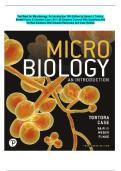
Test Bank for Microbiology: An Introduction 14th Edition by Gerard J. Tortora,
Berdell Funke & Christine Case | All 1–28 Chapters Covered With Questions And
Verified Solutions With Detailed Rationales And Case Studies
, TABLE OF CONTENT
Chapter 1: The Microbial World and You
Chapter 2: Chemical Principles
Chapter 3: Observing Microorganisms Through a Microscope
Chapter 4: Functional Anatomy of Prokaryotic and Eukaryotic Cells
Chapter 5: Microbial Metabolism
Chapter 6: Microbial Growth
Chapter 7: The Control of Microbial Growth
Chapter 8: Microbial Genetics
Chapter 9: Biotechnology and DNA Technology
Chapter 10: Classification of Microorganisms
Chapter 11: Bacteria
Chapter 12: Fungi, Algae, Protozoa, and Helminths
Chapter 13: Viruses, Viroids, and Prions
Chapter 14: Principles of Disease and Epidemiology
Chapter 15: Microbial Mechanisms of Pathogenicity
Chapter 16: Innate Immunity (Nonspecific Host Defenses)
Chapter 17: Adaptive Immunity (Specific Host Defenses)
Chapter 18: Practical Applications of Immunology
Chapter 19: Disorders of the Immune System
Chapter 20: Antimicrobial Drugs
Chapter 21: Diseases of the Skin and Eyes
Chapter 22: Diseases of the Nervous System
Chapter 23: Diseases of the Cardiovascular and Lymphatic Systems
Chapter 24: Diseases of the Respiratory System
Chapter 25: Diseases of the Digestive System
Chapter 26: Diseases of the Urinary and Reproductive Systems
Chapter 27: Environmental Microbiology
Chapter 28: Applied and Industrial Microbiology
Chapter 1 Practice Quiz: The Microbial World and You
,1. Microbiology is the study of:
A) Only bacteria and viruses
B) Organisms that are visible to the naked eye
C) Microorganisms, including bacteria, archaea, fungi, protozoa, algae, and viruses
D) Only pathogenic organisms that cause disease
Correct Answer: C
Rationale: Microbiology is the broad study of microorganisms (microbes)—organisms and acellular entities too
small to be seen clearly without a microscope. This includes bacteria, archaea, fungi, protozoa, algae, and
viruses.
Why the others are incorrect:
• A is too narrow; microbiology includes many other organisms beyond bacteria and viruses.
• B is incorrect because microbiology studies organisms that are invisible to the naked eye, not visible
ones.
• D is incorrect because microbiology includes both pathogenic (disease-causing) and non-pathogenic
microbes.
2. Which of the following is NOT a characteristic of prokaryotic cells?
A) Lack of a membrane-bound nucleus
B) Presence of ribosomes
C) Membrane-bound organelles such as mitochondria and endoplasmic reticulum
D) Presence of a cell wall in most species
Correct Answer: C
Rationale: Prokaryotes (bacteria and archaea) lack membrane-bound organelles, including mitochondria,
endoplasmic reticulum, and Golgi apparatus. They do have ribosomes (for protein synthesis) and most have cell
walls.
Why the others are incorrect:
• A is a defining characteristic of prokaryotes and is therefore true, not the correct answer.
• B is true; prokaryotes have ribosomes (70S).
• D is true; most prokaryotes have cell walls (though composition differs between bacteria and archaea).
3. Which scientist is credited with first observing and describing microorganisms using a microscope?
A) Louis Pasteur
B) Robert Koch
C) Antonie van Leeuwenhoek
D) Joseph Lister
Correct Answer: C
Rationale: Antonie van Leeuwenhoek (1632–1723) was a Dutch scientist who crafted high-quality single-lens
, microscopes and was the first to observe and describe bacteria, protozoa, and other microorganisms, which he
called "animalcules."
Why the others are incorrect:
• A (Pasteur) is known for disproving spontaneous generation and developing pasteurization and
vaccines.
• B (Koch) developed Koch's postulates for linking specific microorganisms to specific diseases.
• D (Lister) pioneered antiseptic surgery using carbolic acid.
4. The theory of spontaneous generation held that:
A) Microorganisms arise spontaneously from non-living matter
B) All living things are composed of cells
C) Microorganisms can only arise from other microorganisms
D) Diseases are caused by supernatural forces
Correct Answer: A
Rationale: Spontaneous generation was the belief that living organisms could arise from non-living matter (e.g.,
maggots from rotting meat, mice from grain). This theory was disproven through experiments by Francesco Redi,
Louis Pasteur, and others.
Why the others are incorrect:
• B is the cell theory, not spontaneous generation.
• C is biogenesis, the opposite of spontaneous generation.
• D is unrelated; it reflects historical supernatural explanations for disease.
5. Louis Pasteur's swan-neck flask experiment provided evidence against spontaneous generation by
demonstrating that:
A) Microorganisms are destroyed by heat
B) Microorganisms can grow in any liquid, regardless of exposure to air
C) Microbial growth in broth occurred only when the broth was exposed to airborne microbes
D) Microorganisms are found only in dirty environments
Correct Answer: C
Rationale: Pasteur's swan-neck flasks allowed air to enter but trapped dust and microorganisms in the curved
neck. The broth remained sterile until the flask was tilted, allowing the trapped microbes to enter the broth,
confirming that microbes come from the air, not spontaneous generation.
Why the others are incorrect:
• A is true but was not the primary conclusion of this experiment.
• B is false; growth occurred only when contamination was introduced.
• D is false; microorganisms are found everywhere, not just in dirty environments.
6. Which of the following statements is TRUE regarding viruses?
Berdell Funke & Christine Case | All 1–28 Chapters Covered With Questions And
Verified Solutions With Detailed Rationales And Case Studies
, TABLE OF CONTENT
Chapter 1: The Microbial World and You
Chapter 2: Chemical Principles
Chapter 3: Observing Microorganisms Through a Microscope
Chapter 4: Functional Anatomy of Prokaryotic and Eukaryotic Cells
Chapter 5: Microbial Metabolism
Chapter 6: Microbial Growth
Chapter 7: The Control of Microbial Growth
Chapter 8: Microbial Genetics
Chapter 9: Biotechnology and DNA Technology
Chapter 10: Classification of Microorganisms
Chapter 11: Bacteria
Chapter 12: Fungi, Algae, Protozoa, and Helminths
Chapter 13: Viruses, Viroids, and Prions
Chapter 14: Principles of Disease and Epidemiology
Chapter 15: Microbial Mechanisms of Pathogenicity
Chapter 16: Innate Immunity (Nonspecific Host Defenses)
Chapter 17: Adaptive Immunity (Specific Host Defenses)
Chapter 18: Practical Applications of Immunology
Chapter 19: Disorders of the Immune System
Chapter 20: Antimicrobial Drugs
Chapter 21: Diseases of the Skin and Eyes
Chapter 22: Diseases of the Nervous System
Chapter 23: Diseases of the Cardiovascular and Lymphatic Systems
Chapter 24: Diseases of the Respiratory System
Chapter 25: Diseases of the Digestive System
Chapter 26: Diseases of the Urinary and Reproductive Systems
Chapter 27: Environmental Microbiology
Chapter 28: Applied and Industrial Microbiology
Chapter 1 Practice Quiz: The Microbial World and You
,1. Microbiology is the study of:
A) Only bacteria and viruses
B) Organisms that are visible to the naked eye
C) Microorganisms, including bacteria, archaea, fungi, protozoa, algae, and viruses
D) Only pathogenic organisms that cause disease
Correct Answer: C
Rationale: Microbiology is the broad study of microorganisms (microbes)—organisms and acellular entities too
small to be seen clearly without a microscope. This includes bacteria, archaea, fungi, protozoa, algae, and
viruses.
Why the others are incorrect:
• A is too narrow; microbiology includes many other organisms beyond bacteria and viruses.
• B is incorrect because microbiology studies organisms that are invisible to the naked eye, not visible
ones.
• D is incorrect because microbiology includes both pathogenic (disease-causing) and non-pathogenic
microbes.
2. Which of the following is NOT a characteristic of prokaryotic cells?
A) Lack of a membrane-bound nucleus
B) Presence of ribosomes
C) Membrane-bound organelles such as mitochondria and endoplasmic reticulum
D) Presence of a cell wall in most species
Correct Answer: C
Rationale: Prokaryotes (bacteria and archaea) lack membrane-bound organelles, including mitochondria,
endoplasmic reticulum, and Golgi apparatus. They do have ribosomes (for protein synthesis) and most have cell
walls.
Why the others are incorrect:
• A is a defining characteristic of prokaryotes and is therefore true, not the correct answer.
• B is true; prokaryotes have ribosomes (70S).
• D is true; most prokaryotes have cell walls (though composition differs between bacteria and archaea).
3. Which scientist is credited with first observing and describing microorganisms using a microscope?
A) Louis Pasteur
B) Robert Koch
C) Antonie van Leeuwenhoek
D) Joseph Lister
Correct Answer: C
Rationale: Antonie van Leeuwenhoek (1632–1723) was a Dutch scientist who crafted high-quality single-lens
, microscopes and was the first to observe and describe bacteria, protozoa, and other microorganisms, which he
called "animalcules."
Why the others are incorrect:
• A (Pasteur) is known for disproving spontaneous generation and developing pasteurization and
vaccines.
• B (Koch) developed Koch's postulates for linking specific microorganisms to specific diseases.
• D (Lister) pioneered antiseptic surgery using carbolic acid.
4. The theory of spontaneous generation held that:
A) Microorganisms arise spontaneously from non-living matter
B) All living things are composed of cells
C) Microorganisms can only arise from other microorganisms
D) Diseases are caused by supernatural forces
Correct Answer: A
Rationale: Spontaneous generation was the belief that living organisms could arise from non-living matter (e.g.,
maggots from rotting meat, mice from grain). This theory was disproven through experiments by Francesco Redi,
Louis Pasteur, and others.
Why the others are incorrect:
• B is the cell theory, not spontaneous generation.
• C is biogenesis, the opposite of spontaneous generation.
• D is unrelated; it reflects historical supernatural explanations for disease.
5. Louis Pasteur's swan-neck flask experiment provided evidence against spontaneous generation by
demonstrating that:
A) Microorganisms are destroyed by heat
B) Microorganisms can grow in any liquid, regardless of exposure to air
C) Microbial growth in broth occurred only when the broth was exposed to airborne microbes
D) Microorganisms are found only in dirty environments
Correct Answer: C
Rationale: Pasteur's swan-neck flasks allowed air to enter but trapped dust and microorganisms in the curved
neck. The broth remained sterile until the flask was tilted, allowing the trapped microbes to enter the broth,
confirming that microbes come from the air, not spontaneous generation.
Why the others are incorrect:
• A is true but was not the primary conclusion of this experiment.
• B is false; growth occurred only when contamination was introduced.
• D is false; microorganisms are found everywhere, not just in dirty environments.
6. Which of the following statements is TRUE regarding viruses?


