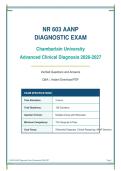
NR 603 AANP
DIAGNOSTIC EXAM
Chamberlain University
Advanced Clinical Diagnosis 2026-2027
Verified Questions and Answers
Q&A; | Instant Download PDF
EXAM SPECIFICATIONS
Time Allocation: 3 Hours
Total Questions: 150 Questions
Question Format: Multiple Choice with Rationales
Minimum Competency: 75% Required to Pass
Core Focus: Differential Diagnosis, Clinical Reasoning, AANP Domains
NR 603 AANP Diagnostic Exam Chamberlain 2026-2027 Page 1
, Exam Overview & Content Outline
EXAM PURPOSE
NR 603 Advanced Clinical Diagnosis prepares Family Nurse Practitioner students for AANP
certification. Covers comprehensive assessment, differential diagnosis, diagnostic reasoning, and
evidence-based management across the lifespan per Chamberlain University curriculum 2026/2027.
CONTENT DISTRIBUTION
• Cardiovascular & Pulmonary (25%) — CAD, HF, arrhythmias, HTN, COPD, asthma, pneumonia,
PE
• Endocrine & Metabolic (20%) — Diabetes, thyroid disorders, adrenal, lipids, obesity, metabolic
syndrome
• Neurological & Musculoskeletal (20%) — Headache, stroke, seizures, neuropathy, back pain,
arthritis, osteoporosis
• GI & Genitourinary (20%) — GERD, PUD, IBD, hepatitis, UTI, STIs, renal disease, prostate
disorders
• Professional Role & Diagnostics (15%) — Lab interpretation, imaging, EKG, screening
guidelines, scope of practice
QUESTION FORMAT & SCORING
Each item presents four options. Correct answers are highlighted in green with checkmark (✓).
Every question includes detailed rationale with clinical guidelines. Chamberlain requires 75% to pass.
STUDY STRATEGY
Master differential diagnosis for common presentations. Know diagnostic criteria and clinical decision
rules. Understand lab/imaging interpretation. Review AANP domains and NP scope. Study
evidence-based guidelines: USPSTF, AHA, ADA, GOLD. Practice clinical reasoning cases.
CURRICULUM ALIGNMENT
Questions reflect 2026-2027 standards: AANP Certification Blueprint, Chamberlain NR 603, NONPF
NP Core Competencies, USPSTF guidelines, AHA/ACC, ADA Standards, and current clinical
practice guidelines.
NR 603 AANP Diagnostic Exam Chamberlain 2026-2027 Page 2
, SECTION I: Cardiovascular & Pulmonary
1. JNC 8 HTN treatment goal for adults <60 years:
A. <150/90
✓ B. <140/90
C. <130/80
D. <120/80
Rationale: JNC 8: Age <60: <140/90. Age ≥60: <150/90. Diabetes or CKD: <140/90. Initial therapy: thiazide,
ACE-I/ARB, CCB, or beta-blocker. African American: thiazide or CCB first. CKD: ACE-I/ARB. ACC/AHA
2017 more aggressive: <130/80 for all. Consider patient risk. Lifestyle modifications first.
2. Heart failure with reduced ejection fraction (HFrEF) EF:
A. ≥50%
✓ B. ≤40%
C. 41-49%
D. 100%
Rationale: HFrEF: EF ≤40%, systolic dysfunction. HFpEF: EF ≥50%, diastolic dysfunction. HFmrEF:
41-49%. Guideline-directed medical therapy HFrEF: ACE-I/ARB/ARNI, beta-blocker, MRA, SGLT2i. Avoid
CCB (except amlodipine). NYHA Class I-IV. BNP >100 suggests HF. Echo confirms.
3. COPD GOLD criteria for diagnosis:
A. FEV1/FVC >0.80
✓ B. Post-bronchodilator FEV1/FVC <0.70
C. Normal spirometry
D. Chest X-ray only
Rationale: COPD: Post-bronchodilator FEV1/FVC <0.70 confirms airflow limitation. GOLD stages: 1 Mild
FEV1 ≥80%, 2 Moderate 50-79%, 3 Severe 30-49%, 4 Very Severe <30%. Symptoms: dyspnea, chronic
cough, sputum. Risk: smoking. Treatment: LAMA, LABA, ICS for exacerbations. Oxygen if SpO2 ≤88%.
4. Community-acquired pneumonia CURB-65 score includes:
A. Temperature only
✓ B. Confusion, Urea >19, RR ≥30, BP <90/60, Age ≥65
C. White count only
D. Chest pain
Rationale: CURB-65: Confusion, Urea >19 mg/dL (BUN >7), Respiratory rate ≥30, Blood pressure <90/60,
age ≥65. Score 0-1 outpatient, 2 inpatient, ≥3 ICU consider. Outpatient CAP: macrolide or doxycycline if
healthy. Comorbidities: respiratory fluoroquinolone or beta-lactam + macrolide. Pneumococcal vaccine
prevention.
5. Pulmonary embolism Wells criteria high risk:
A. Score 0
NR 603 AANP Diagnostic Exam Chamberlain 2026-2027 Page 3
DIAGNOSTIC EXAM
Chamberlain University
Advanced Clinical Diagnosis 2026-2027
Verified Questions and Answers
Q&A; | Instant Download PDF
EXAM SPECIFICATIONS
Time Allocation: 3 Hours
Total Questions: 150 Questions
Question Format: Multiple Choice with Rationales
Minimum Competency: 75% Required to Pass
Core Focus: Differential Diagnosis, Clinical Reasoning, AANP Domains
NR 603 AANP Diagnostic Exam Chamberlain 2026-2027 Page 1
, Exam Overview & Content Outline
EXAM PURPOSE
NR 603 Advanced Clinical Diagnosis prepares Family Nurse Practitioner students for AANP
certification. Covers comprehensive assessment, differential diagnosis, diagnostic reasoning, and
evidence-based management across the lifespan per Chamberlain University curriculum 2026/2027.
CONTENT DISTRIBUTION
• Cardiovascular & Pulmonary (25%) — CAD, HF, arrhythmias, HTN, COPD, asthma, pneumonia,
PE
• Endocrine & Metabolic (20%) — Diabetes, thyroid disorders, adrenal, lipids, obesity, metabolic
syndrome
• Neurological & Musculoskeletal (20%) — Headache, stroke, seizures, neuropathy, back pain,
arthritis, osteoporosis
• GI & Genitourinary (20%) — GERD, PUD, IBD, hepatitis, UTI, STIs, renal disease, prostate
disorders
• Professional Role & Diagnostics (15%) — Lab interpretation, imaging, EKG, screening
guidelines, scope of practice
QUESTION FORMAT & SCORING
Each item presents four options. Correct answers are highlighted in green with checkmark (✓).
Every question includes detailed rationale with clinical guidelines. Chamberlain requires 75% to pass.
STUDY STRATEGY
Master differential diagnosis for common presentations. Know diagnostic criteria and clinical decision
rules. Understand lab/imaging interpretation. Review AANP domains and NP scope. Study
evidence-based guidelines: USPSTF, AHA, ADA, GOLD. Practice clinical reasoning cases.
CURRICULUM ALIGNMENT
Questions reflect 2026-2027 standards: AANP Certification Blueprint, Chamberlain NR 603, NONPF
NP Core Competencies, USPSTF guidelines, AHA/ACC, ADA Standards, and current clinical
practice guidelines.
NR 603 AANP Diagnostic Exam Chamberlain 2026-2027 Page 2
, SECTION I: Cardiovascular & Pulmonary
1. JNC 8 HTN treatment goal for adults <60 years:
A. <150/90
✓ B. <140/90
C. <130/80
D. <120/80
Rationale: JNC 8: Age <60: <140/90. Age ≥60: <150/90. Diabetes or CKD: <140/90. Initial therapy: thiazide,
ACE-I/ARB, CCB, or beta-blocker. African American: thiazide or CCB first. CKD: ACE-I/ARB. ACC/AHA
2017 more aggressive: <130/80 for all. Consider patient risk. Lifestyle modifications first.
2. Heart failure with reduced ejection fraction (HFrEF) EF:
A. ≥50%
✓ B. ≤40%
C. 41-49%
D. 100%
Rationale: HFrEF: EF ≤40%, systolic dysfunction. HFpEF: EF ≥50%, diastolic dysfunction. HFmrEF:
41-49%. Guideline-directed medical therapy HFrEF: ACE-I/ARB/ARNI, beta-blocker, MRA, SGLT2i. Avoid
CCB (except amlodipine). NYHA Class I-IV. BNP >100 suggests HF. Echo confirms.
3. COPD GOLD criteria for diagnosis:
A. FEV1/FVC >0.80
✓ B. Post-bronchodilator FEV1/FVC <0.70
C. Normal spirometry
D. Chest X-ray only
Rationale: COPD: Post-bronchodilator FEV1/FVC <0.70 confirms airflow limitation. GOLD stages: 1 Mild
FEV1 ≥80%, 2 Moderate 50-79%, 3 Severe 30-49%, 4 Very Severe <30%. Symptoms: dyspnea, chronic
cough, sputum. Risk: smoking. Treatment: LAMA, LABA, ICS for exacerbations. Oxygen if SpO2 ≤88%.
4. Community-acquired pneumonia CURB-65 score includes:
A. Temperature only
✓ B. Confusion, Urea >19, RR ≥30, BP <90/60, Age ≥65
C. White count only
D. Chest pain
Rationale: CURB-65: Confusion, Urea >19 mg/dL (BUN >7), Respiratory rate ≥30, Blood pressure <90/60,
age ≥65. Score 0-1 outpatient, 2 inpatient, ≥3 ICU consider. Outpatient CAP: macrolide or doxycycline if
healthy. Comorbidities: respiratory fluoroquinolone or beta-lactam + macrolide. Pneumococcal vaccine
prevention.
5. Pulmonary embolism Wells criteria high risk:
A. Score 0
NR 603 AANP Diagnostic Exam Chamberlain 2026-2027 Page 3