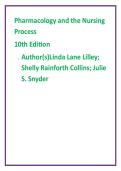
Pharmacology and the Nursing
Process
10th Edition
• Author(s)Linda Lane Lilley;
Shelly Rainforth Collins; Julie
S. Snyder
,TEST BANK
Pharmacology and the Nursing Process (10th Edition)
Chapter: Part 1 – Pharmacology Basics
Topic: The Nursing Process and Drug Therapy
Part 1A – Questions 1–2
Original NCLEX-RN–style examination questions developed for
educational and revision purposes.
Question 1 (MCQ)
Clinical Scenario
A nurse is preparing to administer the first dose of an oral
angiotensin-converting enzyme (ACE) inhibitor to a 62-year-old
patient recently diagnosed with hypertension. During the pre-
administration assessment, the patient states, "I've had swelling
of my lips after taking a blood pressure medicine years ago, but
I don't remember its name."
Question Stem
,What is the nurse's priority action before administering the
medication?
Answer Options
A. Administer the medication and monitor the patient's blood
pressure every 30 minutes.
B. Ask the patient whether the previous reaction required
hospitalization.
C. Hold the medication and notify the prescribing provider
about the reported history.
D. Administer an antihistamine before giving the medication.
Correct Answer
C. Hold the medication and notify the prescribing provider
about the reported history.
Comprehensive Rationale
Why the Correct Answer Is Correct
Assessment is the first step of the nursing process and must
occur before medication administration. The patient's history of
lip swelling after an antihypertensive medication suggests
possible drug-induced angioedema, a potentially life-
, threatening hypersensitivity reaction commonly associated with
ACE inhibitors.
Because angioedema may recur and progress rapidly to airway
compromise, the nurse should withhold the medication until
the provider evaluates whether the prescribed drug is
appropriate.
Pharmacologic Principles
• Medication therapy begins with thorough assessment.
• Previous adverse drug reactions may represent
contraindications.
• Safe medication administration requires verification of
allergies and significant adverse reactions before
implementation.
Mechanism of Action
ACE inhibitors reduce formation of angiotensin II, producing
vasodilation and decreased blood pressure. Increased
bradykinin levels may contribute to cough and angioedema.
Pharmacokinetic Considerations
• Oral absorption occurs within hours.
• Many ACE inhibitors undergo renal elimination.
• Baseline renal function should be reviewed before therapy.
Process
10th Edition
• Author(s)Linda Lane Lilley;
Shelly Rainforth Collins; Julie
S. Snyder
,TEST BANK
Pharmacology and the Nursing Process (10th Edition)
Chapter: Part 1 – Pharmacology Basics
Topic: The Nursing Process and Drug Therapy
Part 1A – Questions 1–2
Original NCLEX-RN–style examination questions developed for
educational and revision purposes.
Question 1 (MCQ)
Clinical Scenario
A nurse is preparing to administer the first dose of an oral
angiotensin-converting enzyme (ACE) inhibitor to a 62-year-old
patient recently diagnosed with hypertension. During the pre-
administration assessment, the patient states, "I've had swelling
of my lips after taking a blood pressure medicine years ago, but
I don't remember its name."
Question Stem
,What is the nurse's priority action before administering the
medication?
Answer Options
A. Administer the medication and monitor the patient's blood
pressure every 30 minutes.
B. Ask the patient whether the previous reaction required
hospitalization.
C. Hold the medication and notify the prescribing provider
about the reported history.
D. Administer an antihistamine before giving the medication.
Correct Answer
C. Hold the medication and notify the prescribing provider
about the reported history.
Comprehensive Rationale
Why the Correct Answer Is Correct
Assessment is the first step of the nursing process and must
occur before medication administration. The patient's history of
lip swelling after an antihypertensive medication suggests
possible drug-induced angioedema, a potentially life-
, threatening hypersensitivity reaction commonly associated with
ACE inhibitors.
Because angioedema may recur and progress rapidly to airway
compromise, the nurse should withhold the medication until
the provider evaluates whether the prescribed drug is
appropriate.
Pharmacologic Principles
• Medication therapy begins with thorough assessment.
• Previous adverse drug reactions may represent
contraindications.
• Safe medication administration requires verification of
allergies and significant adverse reactions before
implementation.
Mechanism of Action
ACE inhibitors reduce formation of angiotensin II, producing
vasodilation and decreased blood pressure. Increased
bradykinin levels may contribute to cough and angioedema.
Pharmacokinetic Considerations
• Oral absorption occurs within hours.
• Many ACE inhibitors undergo renal elimination.
• Baseline renal function should be reviewed before therapy.