Grade 10 Mathematics (Term 2): Parabolic/Quadratic
Function
2
𝑦 = 𝑎𝑥 + 𝑞
The best way to differentiate a parabolic/quadratic function from any other function is identifying
2
that the highest exponent of the input value (𝑥) is squared (𝑥 ).
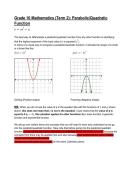
In terms of a visual way to recognise a parabolic/quadratic function, it will take the shape of a smile
or a frown like this:
2 2
𝑓(𝑥) = 2𝑥 𝑔(𝑥) =− 2𝑥
Smiling (Positive shape) Frowning (Negative shape)
NB: When you do not see the value of q in the equation like with the functions of 𝑓 and 𝑔 shown
above, this does not mean that 𝑞 is not in the equation, it just means that the value of q is
equal to 0 (𝑞 = 0), this situation applies for other functions like Linear function, hyperbolic
function and exponential function.
We will go over certain terms and concepts that you will need to know and understand as we go
into the parabolic/quadratic function. Take note that before going into the parabolic/quadratic
function you must already have understood everything about the linear function because the
concepts from there may be applied here and also because your examinations often display
Linear and Parabolic/Quadratic
functions on the same set of axes (in the same Cartesian plane).
, GLOSSARY
TERM WHAT IT REPRESENTS HOW TO FIND IT (THE
/MEANS EXACT ALGEBRAIC
STEP)
Standard Form This is the general (normal) This is the way it is written:
equation of a grade 10 2
𝑦 = 𝑎𝑥 + 𝑞 OR
parabolic/quadratic 2
𝑓(𝑥) = 𝑎𝑥 + 𝑞
The value of 𝑎 (in the equation This value controls the shape, Bigger numbers (e.g 3,5,8
2
𝑦 = 𝑎𝑥 + 𝑞) direction and how wide or etc) make the graph more
narrow the arms of the graph narrow.
are. 1 3 2
Fraction (e.g 2 , 4 , 9 etc)
make the graph wider.
Concavity Direction of the curve of the If 𝑎 > 0 (Positive shape), the
graph. It either concaves up or graph concaves upwards.
down. If 𝑎 < 0 (Negative Shape), the
Concave up - Smiling shape graph concaves downwards.
Concave down - Frowning
Shape
The value of 𝑞 (in the This value controls the You will find it by reading the
2
equation 𝑦 = 𝑎𝑥 + 𝑞) vertical shift (how the graph constant number (number that
slides straight up or straight has no variable) at the end of
down the cartesian plane). the equation
This value also represents the
y-intercept.
Axis of symmetry The vertical line that cuts the For the Grade 10 form
graph into 2 identical halves. 2
(𝑦 = 𝑎𝑥 + 𝑞), the graph only
moves up or down, not
sideways.
Therefore, the axis of
symmetry is always the y-axis
itself. Always write it as 𝑥 = 0
𝑦-intercept The exact point on the 𝑦-axis The y-intercept is always
that the graph passes through. always written as (0; 𝑞). You
will replace 𝑞 with the value of
𝑞 that is in the equation
𝑥-intercept The exact point on the 𝑥-axis ● Look at the equation for
that the graph passes through. your graph.
Function
2
𝑦 = 𝑎𝑥 + 𝑞
The best way to differentiate a parabolic/quadratic function from any other function is identifying
2
that the highest exponent of the input value (𝑥) is squared (𝑥 ).
In terms of a visual way to recognise a parabolic/quadratic function, it will take the shape of a smile
or a frown like this:
2 2
𝑓(𝑥) = 2𝑥 𝑔(𝑥) =− 2𝑥
Smiling (Positive shape) Frowning (Negative shape)
NB: When you do not see the value of q in the equation like with the functions of 𝑓 and 𝑔 shown
above, this does not mean that 𝑞 is not in the equation, it just means that the value of q is
equal to 0 (𝑞 = 0), this situation applies for other functions like Linear function, hyperbolic
function and exponential function.
We will go over certain terms and concepts that you will need to know and understand as we go
into the parabolic/quadratic function. Take note that before going into the parabolic/quadratic
function you must already have understood everything about the linear function because the
concepts from there may be applied here and also because your examinations often display
Linear and Parabolic/Quadratic
functions on the same set of axes (in the same Cartesian plane).
, GLOSSARY
TERM WHAT IT REPRESENTS HOW TO FIND IT (THE
/MEANS EXACT ALGEBRAIC
STEP)
Standard Form This is the general (normal) This is the way it is written:
equation of a grade 10 2
𝑦 = 𝑎𝑥 + 𝑞 OR
parabolic/quadratic 2
𝑓(𝑥) = 𝑎𝑥 + 𝑞
The value of 𝑎 (in the equation This value controls the shape, Bigger numbers (e.g 3,5,8
2
𝑦 = 𝑎𝑥 + 𝑞) direction and how wide or etc) make the graph more
narrow the arms of the graph narrow.
are. 1 3 2
Fraction (e.g 2 , 4 , 9 etc)
make the graph wider.
Concavity Direction of the curve of the If 𝑎 > 0 (Positive shape), the
graph. It either concaves up or graph concaves upwards.
down. If 𝑎 < 0 (Negative Shape), the
Concave up - Smiling shape graph concaves downwards.
Concave down - Frowning
Shape
The value of 𝑞 (in the This value controls the You will find it by reading the
2
equation 𝑦 = 𝑎𝑥 + 𝑞) vertical shift (how the graph constant number (number that
slides straight up or straight has no variable) at the end of
down the cartesian plane). the equation
This value also represents the
y-intercept.
Axis of symmetry The vertical line that cuts the For the Grade 10 form
graph into 2 identical halves. 2
(𝑦 = 𝑎𝑥 + 𝑞), the graph only
moves up or down, not
sideways.
Therefore, the axis of
symmetry is always the y-axis
itself. Always write it as 𝑥 = 0
𝑦-intercept The exact point on the 𝑦-axis The y-intercept is always
that the graph passes through. always written as (0; 𝑞). You
will replace 𝑞 with the value of
𝑞 that is in the equation
𝑥-intercept The exact point on the 𝑥-axis ● Look at the equation for
that the graph passes through. your graph.