

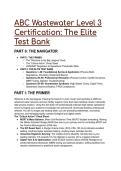
ABC Wastewater Level 3
Certification: The Elite
Test Bank
PART 0: THE NAVIGATOR
● PART I: THE PRIMER
○ The "Welcome to the Big Leagues" Hook
○ The "Critical Action" Cheat Sheet
○ 2026/2027 Regulatory & Operational Thresholds Table
● PART II: THE ELITE TEST BANK
○ Questions 1–28: Foundational Syntax & Application (Process Math,
Regulations, Chemistry, Equipment Basics)
○ Questions 29–58: Professional Simulation (Process Control, Clarifier Dynamics,
MBR Fouling, Digester Troubleshooting)
○ Questions 59–88: Grandmaster Synthesis (High-Stakes Crises, Digital Twins,
Sidestream Deammonification, PFAS Compliance)
PART I: THE PRIMER
Welcome to the big leagues. Passing the Class B / Level 3 exam and operating a 2026-era
advanced water resource recovery facility requires more than basic textbook recall; it demands
elite process intuition. Using this test bank will systematically intercept high-stakes operational
errors by forging your academic knowledge into split-second, technically flawless professional
reflexes. You are no longer just treating water; you are protecting watersheds, recovering
resources, and managing highly complex biological and digital assets.
The "Critical Action" Cheat Sheet:
● MCRT & Mass Balance: Mean Cell Residence Time (MCRT) dictates everything. Altering
the Waste Activated Sludge (WAS) flow rate is your primary tool for controlling MCRT and
the Food-to-Microorganism (F/M) ratio.
● The SVI Sweet Spot: A Sludge Volume Index (SVI) of 80–120 mL/g indicates excellent
settling. Anything higher indicates bulking; anything lower indicates pin-floc.
● Anaerobic Digestion Souring: The Volatile Acid to Alkalinity (VA:Alk) ratio is your
leading indicator. If it exceeds 0.5, the digester is souring. pH is a lagging indicator.
● Digital Twin & AI Optimization: 2026 SCADA systems utilize Artificial Intelligence to
predict Membrane Bioreactor (MBR) fouling and optimize aeration, shifting facilities from
reactive maintenance to predictive asset management.
,2026/2027 Regulatory & Operational Thresholds
Parameter Critical Value / Threshold Regulatory Trigger /
Consequence
PFOA / PFOS 4.0 ppt (MCL) COMPLIANCE 2029: Initial
(Drinking/Reuse) monitoring mandatory by 2027.
NPDES Electronic Reporting December 21, 2025 PHASE II MANDATE: All NOIs,
NOTs, and annual reports must
be filed digitally
(NetDMR/STEERS).
Oxygen Levels (Confined < 19.5% or > 23.5% ENTRY PROHIBITED: Lethal
Space) asphyxiation or explosion risk.
Hydrogen Sulfide (H2S) 10 ppm (8-hour OEL) RESPIRATORY
PROTECTION: Exceeding
requires breathing apparatus.
Trench Egress Within 25 feet laterally MANDATORY EGRESS:
Trenches >4 ft require a ladder
within 25 ft.
PART II: THE ELITE TEST BANK
Questions 1–28: Foundational Syntax & Application
Q1: A wastewater facility's aeration basin contains 36,000 lbs of Mixed Liquor Suspended
Solids (MLSS). The facility wastes 2,500 lbs/day of solids and loses 500 lbs/day in the
secondary effluent. What is the CURRENT Mean Cell Residence Time (MCRT)? A) 14.4 days
B) 12.0 days C) 10.5 days D) 8.0 days
● The Answer: B (12.0 days)
● Distractor Analysis:
○ A is incorrect: This ignores the effluent suspended solids, dividing only by the WAS
(36,,500 = 14.4).
○ C is incorrect: This represents a mathematical error in addition or division.
○ D is incorrect: This represents calculating with an incorrect volume metric.
The Mentor's Analysis: MCRT = Total lbs MLSS in the system / (lbs WAS per day + lbs
Effluent SS per day). Therefore, 36,000 / (2,500 + 500) = 36,,000 = 12 days.
Professional Intuition: Never forget the effluent solids. Even highly efficient plants bleed
solids, and ignoring them will cause you to over-waste.
Q2: Under 2026 EPA regulations, what is the FINAL enforceable Maximum Contaminant Level
(MCL) for PFOA and PFOS in municipal drinking water and advanced reuse systems that must
be met by 2029? A) 10 ppt B) 4.0 ppt C) 70 ppt D) 1.0 Hazard Index
● The Answer: B (4.0 ppt)
● Distractor Analysis:
○ A is incorrect: 10 ppt is the MCL for PFHxS and GenX chemicals, not PFOA/PFOS.
* C is incorrect: 70 ppt was the outdated legacy 2016 EPA health advisory level.
○ D is incorrect: The Hazard Index applies strictly to mixtures of specific secondary
PFAS compounds.
The Mentor's Analysis: The shift to 4.0 ppt represents a massive regulatory tightening. While
,compliance enforcement begins in 2029, Level 3 operators must recognize that initial monitoring
mandates begin by 2027. Professional Intuition: 4.0 ppt is effectively the threshold of current
analytical detection limits; you are treating down to the absolute molecular baseline.
Q3: During a routine settleability test, the Settled Sludge Volume (SSV) at 30 minutes is 260
mL/L. The laboratory reports the MLSS concentration is 2,400 mg/L. What is the CALCULATED
Sludge Volume Index (SVI)? A) 108 mL/g B) 85 mL/g C) 120 mL/g D) 150 mL/g
● The Answer: A (108 mL/g)
● Distractor Analysis:
○ B is incorrect: Represents a mathematical error.
○ C is incorrect: An arbitrary typical SVI range value.
○ D is incorrect: The threshold for bulking sludge, not the mathematical answer.
The Mentor's Analysis: SVI = (Settled Volume in mL/L * 1,000) / MLSS in mg/L. (260 * 1,000) /
2,400 = 108.3 mL/g. Professional Intuition: An SVI of 108 is directly in the optimal 80-120
pocket. The sludge is healthy and will compact well in the clarifier.
Q4: According to standard 2026 compliance rules, when a TPDES permit holder experiences an
unauthorized Sanitary Sewer Overflow (SSO) that threatens public health, within what
MAXIMUM timeframe must the initial notification be reported to the regulatory agency? A) 2
hours B) 24 hours C) 5 days D) 30 days
● The Answer: B (24 hours)
● Distractor Analysis:
○ A is incorrect: 2 hours is an internal emergency response goal, not the statutory
reporting limit.
○ C is incorrect: 5 days is the deadline for the written report following the initial
verbal/electronic notification.
○ D is incorrect: 30 days is standard for routine Discharge Monitoring Reports
(NetDMR).
The Mentor's Analysis: Regulatory compliance is non-negotiable. Any discharge bypassing
the plant or spilling from the collection system must be reported to the state within 24 hours.
Professional Intuition: Protect your license. If it spills, report it immediately. The 24-hour
window is a ceiling, not a target.
Q5: You are preparing to enter a 15-foot-deep wet well. The 4-gas monitor indicates an oxygen
level of 19.0%. What is the MOST APPROPRIATE INITIAL action? A) Proceed with entry using
a self-contained breathing apparatus (SCBA). B) Wait 15 minutes and re-test the atmosphere.
C) Immediately mechanically ventilate the space and re-test before entry. D) Proceed with entry,
as 19.0% is within the safe occupational threshold.
● The Answer: C (Immediately mechanically ventilate the space and re-test before entry.)
● Distractor Analysis:
○ A is incorrect: While SCBA allows entry, the standard foundational protocol requires
engineering controls (ventilation) to eliminate the hazard first.
○ B is incorrect: Waiting does not actively resolve atmospheric stratification or oxygen
displacement.
○ D is incorrect: The legal safe threshold for oxygen is 19.5% to 23.5%. 19.0% is an
oxygen-deficient, immediately dangerous atmosphere.
The Mentor's Analysis: Confined space entry is the deadliest activity in wastewater operations.
Never rely on PPE as the first line of defense if an engineering control (ventilation) can correct
the atmosphere. Professional Intuition: Always blow the space out. Test top, middle, and
bottom. Specific gravity matters—H2S sinks, Methane rises.
Q6: In an activated sludge process, manipulating the Return Activated Sludge (RAS) flow rate
, primarily controls which of the following? A) The overall Mean Cell Residence Time (MCRT). B)
The thickness of the sludge blanket in the secondary clarifier. C) The Food-to-Microorganism
(F/M) ratio. D) The Biochemical Oxygen Demand (BOD) of the primary effluent.
● The Answer: B (The thickness of the sludge blanket in the secondary clarifier.)
● Distractor Analysis:
○ A is incorrect: MCRT is controlled by WAS, not RAS.
○ C is incorrect: F/M is controlled by WAS (by changing the mass of microorganisms),
not RAS.
○ D is incorrect: Primary effluent BOD is dictated by primary clarifier efficiency.
The Mentor's Analysis: Novices confuse WAS and RAS. WAS removes solids from the
system. RAS simply moves solids in a circle between the clarifier and the aeration basin to keep
the bugs alive and manage the clarifier blanket depth. Professional Intuition: If your blanket is
rising, increase RAS. If you need to lower your MLSS, increase WAS.
Q7: Which chemical is MOST EFFECTIVE for addressing severe inorganic scaling (calcium
carbonate) on Membrane Bioreactor (MBR) PVDF membranes? A) Sodium Hypochlorite
(NaOCl) B) Citric Acid C) Sodium Hydroxide (NaOH) D) Ferric Chloride
● The Answer: B (Citric Acid)
● Distractor Analysis:
○ A is incorrect: NaOCl (bleach) is an oxidizer used strictly for organic fouling and
biofouling.
○ C is incorrect: NaOH is an alkaline cleaner used for organic/protein fouling, not
scaling.
○ D is incorrect: Ferric chloride is a coagulant that would rapidly destroy membrane
permeability.
The Mentor's Analysis: MBR cleaning protocols are strict: Alkaline/Oxidative chemicals
(bleach/caustic) dissolve organics. Acidic chemicals (citric acid) dissolve inorganics.
Professional Intuition: Always diagnose the foulant before dosing. Using bleach on calcium
scale will do absolutely nothing to restore Transmembrane Pressure (TMP).
Q8: A Class B operator notices a sudden, sharp decrease in the Volatile Acid to Alkalinity
(VA:Alk) ratio in an anaerobic digester from 0.15 to 0.05. What does this indicate? A) The
digester is experiencing acute souring. B) The digester is highly stable and operating efficiently.
C) The methane-forming bacteria have died off. D) A toxic shock load of heavy metals has
entered the system.
● The Answer: B (The digester is highly stable and operating efficiently.)
● Distractor Analysis:
○ A is incorrect: Souring is indicated by an increase in the ratio (>0.5), meaning acids
are overpowering the alkalinity buffer.
○ C is incorrect: If methanogens died, volatile acids would spike, raising the ratio.
○ D is incorrect: Toxic shock kills methanogens, leading to rapid acid accumulation.
The Mentor's Analysis: A low VA:Alk ratio (0.1 to 0.2) means the methanogens are rapidly
consuming volatile acids to produce methane, leaving a robust alkalinity buffer. Professional
Intuition: As long as that ratio stays below 0.3, your biology is thriving. Watch for the upward
creep.
Q9: In a Biological Nutrient Removal (BNR) facility, what is the required environmental condition
in the selector zone to achieve robust Enhanced Biological Phosphorus Removal (EBPR)? A)
Strictly Aerobic B) Anoxic C) Anaerobic D) Microaerophilic
● The Answer: C (Anaerobic)
● Distractor Analysis:
Certification: The Elite
Test Bank
PART 0: THE NAVIGATOR
● PART I: THE PRIMER
○ The "Welcome to the Big Leagues" Hook
○ The "Critical Action" Cheat Sheet
○ 2026/2027 Regulatory & Operational Thresholds Table
● PART II: THE ELITE TEST BANK
○ Questions 1–28: Foundational Syntax & Application (Process Math,
Regulations, Chemistry, Equipment Basics)
○ Questions 29–58: Professional Simulation (Process Control, Clarifier Dynamics,
MBR Fouling, Digester Troubleshooting)
○ Questions 59–88: Grandmaster Synthesis (High-Stakes Crises, Digital Twins,
Sidestream Deammonification, PFAS Compliance)
PART I: THE PRIMER
Welcome to the big leagues. Passing the Class B / Level 3 exam and operating a 2026-era
advanced water resource recovery facility requires more than basic textbook recall; it demands
elite process intuition. Using this test bank will systematically intercept high-stakes operational
errors by forging your academic knowledge into split-second, technically flawless professional
reflexes. You are no longer just treating water; you are protecting watersheds, recovering
resources, and managing highly complex biological and digital assets.
The "Critical Action" Cheat Sheet:
● MCRT & Mass Balance: Mean Cell Residence Time (MCRT) dictates everything. Altering
the Waste Activated Sludge (WAS) flow rate is your primary tool for controlling MCRT and
the Food-to-Microorganism (F/M) ratio.
● The SVI Sweet Spot: A Sludge Volume Index (SVI) of 80–120 mL/g indicates excellent
settling. Anything higher indicates bulking; anything lower indicates pin-floc.
● Anaerobic Digestion Souring: The Volatile Acid to Alkalinity (VA:Alk) ratio is your
leading indicator. If it exceeds 0.5, the digester is souring. pH is a lagging indicator.
● Digital Twin & AI Optimization: 2026 SCADA systems utilize Artificial Intelligence to
predict Membrane Bioreactor (MBR) fouling and optimize aeration, shifting facilities from
reactive maintenance to predictive asset management.
,2026/2027 Regulatory & Operational Thresholds
Parameter Critical Value / Threshold Regulatory Trigger /
Consequence
PFOA / PFOS 4.0 ppt (MCL) COMPLIANCE 2029: Initial
(Drinking/Reuse) monitoring mandatory by 2027.
NPDES Electronic Reporting December 21, 2025 PHASE II MANDATE: All NOIs,
NOTs, and annual reports must
be filed digitally
(NetDMR/STEERS).
Oxygen Levels (Confined < 19.5% or > 23.5% ENTRY PROHIBITED: Lethal
Space) asphyxiation or explosion risk.
Hydrogen Sulfide (H2S) 10 ppm (8-hour OEL) RESPIRATORY
PROTECTION: Exceeding
requires breathing apparatus.
Trench Egress Within 25 feet laterally MANDATORY EGRESS:
Trenches >4 ft require a ladder
within 25 ft.
PART II: THE ELITE TEST BANK
Questions 1–28: Foundational Syntax & Application
Q1: A wastewater facility's aeration basin contains 36,000 lbs of Mixed Liquor Suspended
Solids (MLSS). The facility wastes 2,500 lbs/day of solids and loses 500 lbs/day in the
secondary effluent. What is the CURRENT Mean Cell Residence Time (MCRT)? A) 14.4 days
B) 12.0 days C) 10.5 days D) 8.0 days
● The Answer: B (12.0 days)
● Distractor Analysis:
○ A is incorrect: This ignores the effluent suspended solids, dividing only by the WAS
(36,,500 = 14.4).
○ C is incorrect: This represents a mathematical error in addition or division.
○ D is incorrect: This represents calculating with an incorrect volume metric.
The Mentor's Analysis: MCRT = Total lbs MLSS in the system / (lbs WAS per day + lbs
Effluent SS per day). Therefore, 36,000 / (2,500 + 500) = 36,,000 = 12 days.
Professional Intuition: Never forget the effluent solids. Even highly efficient plants bleed
solids, and ignoring them will cause you to over-waste.
Q2: Under 2026 EPA regulations, what is the FINAL enforceable Maximum Contaminant Level
(MCL) for PFOA and PFOS in municipal drinking water and advanced reuse systems that must
be met by 2029? A) 10 ppt B) 4.0 ppt C) 70 ppt D) 1.0 Hazard Index
● The Answer: B (4.0 ppt)
● Distractor Analysis:
○ A is incorrect: 10 ppt is the MCL for PFHxS and GenX chemicals, not PFOA/PFOS.
* C is incorrect: 70 ppt was the outdated legacy 2016 EPA health advisory level.
○ D is incorrect: The Hazard Index applies strictly to mixtures of specific secondary
PFAS compounds.
The Mentor's Analysis: The shift to 4.0 ppt represents a massive regulatory tightening. While
,compliance enforcement begins in 2029, Level 3 operators must recognize that initial monitoring
mandates begin by 2027. Professional Intuition: 4.0 ppt is effectively the threshold of current
analytical detection limits; you are treating down to the absolute molecular baseline.
Q3: During a routine settleability test, the Settled Sludge Volume (SSV) at 30 minutes is 260
mL/L. The laboratory reports the MLSS concentration is 2,400 mg/L. What is the CALCULATED
Sludge Volume Index (SVI)? A) 108 mL/g B) 85 mL/g C) 120 mL/g D) 150 mL/g
● The Answer: A (108 mL/g)
● Distractor Analysis:
○ B is incorrect: Represents a mathematical error.
○ C is incorrect: An arbitrary typical SVI range value.
○ D is incorrect: The threshold for bulking sludge, not the mathematical answer.
The Mentor's Analysis: SVI = (Settled Volume in mL/L * 1,000) / MLSS in mg/L. (260 * 1,000) /
2,400 = 108.3 mL/g. Professional Intuition: An SVI of 108 is directly in the optimal 80-120
pocket. The sludge is healthy and will compact well in the clarifier.
Q4: According to standard 2026 compliance rules, when a TPDES permit holder experiences an
unauthorized Sanitary Sewer Overflow (SSO) that threatens public health, within what
MAXIMUM timeframe must the initial notification be reported to the regulatory agency? A) 2
hours B) 24 hours C) 5 days D) 30 days
● The Answer: B (24 hours)
● Distractor Analysis:
○ A is incorrect: 2 hours is an internal emergency response goal, not the statutory
reporting limit.
○ C is incorrect: 5 days is the deadline for the written report following the initial
verbal/electronic notification.
○ D is incorrect: 30 days is standard for routine Discharge Monitoring Reports
(NetDMR).
The Mentor's Analysis: Regulatory compliance is non-negotiable. Any discharge bypassing
the plant or spilling from the collection system must be reported to the state within 24 hours.
Professional Intuition: Protect your license. If it spills, report it immediately. The 24-hour
window is a ceiling, not a target.
Q5: You are preparing to enter a 15-foot-deep wet well. The 4-gas monitor indicates an oxygen
level of 19.0%. What is the MOST APPROPRIATE INITIAL action? A) Proceed with entry using
a self-contained breathing apparatus (SCBA). B) Wait 15 minutes and re-test the atmosphere.
C) Immediately mechanically ventilate the space and re-test before entry. D) Proceed with entry,
as 19.0% is within the safe occupational threshold.
● The Answer: C (Immediately mechanically ventilate the space and re-test before entry.)
● Distractor Analysis:
○ A is incorrect: While SCBA allows entry, the standard foundational protocol requires
engineering controls (ventilation) to eliminate the hazard first.
○ B is incorrect: Waiting does not actively resolve atmospheric stratification or oxygen
displacement.
○ D is incorrect: The legal safe threshold for oxygen is 19.5% to 23.5%. 19.0% is an
oxygen-deficient, immediately dangerous atmosphere.
The Mentor's Analysis: Confined space entry is the deadliest activity in wastewater operations.
Never rely on PPE as the first line of defense if an engineering control (ventilation) can correct
the atmosphere. Professional Intuition: Always blow the space out. Test top, middle, and
bottom. Specific gravity matters—H2S sinks, Methane rises.
Q6: In an activated sludge process, manipulating the Return Activated Sludge (RAS) flow rate
, primarily controls which of the following? A) The overall Mean Cell Residence Time (MCRT). B)
The thickness of the sludge blanket in the secondary clarifier. C) The Food-to-Microorganism
(F/M) ratio. D) The Biochemical Oxygen Demand (BOD) of the primary effluent.
● The Answer: B (The thickness of the sludge blanket in the secondary clarifier.)
● Distractor Analysis:
○ A is incorrect: MCRT is controlled by WAS, not RAS.
○ C is incorrect: F/M is controlled by WAS (by changing the mass of microorganisms),
not RAS.
○ D is incorrect: Primary effluent BOD is dictated by primary clarifier efficiency.
The Mentor's Analysis: Novices confuse WAS and RAS. WAS removes solids from the
system. RAS simply moves solids in a circle between the clarifier and the aeration basin to keep
the bugs alive and manage the clarifier blanket depth. Professional Intuition: If your blanket is
rising, increase RAS. If you need to lower your MLSS, increase WAS.
Q7: Which chemical is MOST EFFECTIVE for addressing severe inorganic scaling (calcium
carbonate) on Membrane Bioreactor (MBR) PVDF membranes? A) Sodium Hypochlorite
(NaOCl) B) Citric Acid C) Sodium Hydroxide (NaOH) D) Ferric Chloride
● The Answer: B (Citric Acid)
● Distractor Analysis:
○ A is incorrect: NaOCl (bleach) is an oxidizer used strictly for organic fouling and
biofouling.
○ C is incorrect: NaOH is an alkaline cleaner used for organic/protein fouling, not
scaling.
○ D is incorrect: Ferric chloride is a coagulant that would rapidly destroy membrane
permeability.
The Mentor's Analysis: MBR cleaning protocols are strict: Alkaline/Oxidative chemicals
(bleach/caustic) dissolve organics. Acidic chemicals (citric acid) dissolve inorganics.
Professional Intuition: Always diagnose the foulant before dosing. Using bleach on calcium
scale will do absolutely nothing to restore Transmembrane Pressure (TMP).
Q8: A Class B operator notices a sudden, sharp decrease in the Volatile Acid to Alkalinity
(VA:Alk) ratio in an anaerobic digester from 0.15 to 0.05. What does this indicate? A) The
digester is experiencing acute souring. B) The digester is highly stable and operating efficiently.
C) The methane-forming bacteria have died off. D) A toxic shock load of heavy metals has
entered the system.
● The Answer: B (The digester is highly stable and operating efficiently.)
● Distractor Analysis:
○ A is incorrect: Souring is indicated by an increase in the ratio (>0.5), meaning acids
are overpowering the alkalinity buffer.
○ C is incorrect: If methanogens died, volatile acids would spike, raising the ratio.
○ D is incorrect: Toxic shock kills methanogens, leading to rapid acid accumulation.
The Mentor's Analysis: A low VA:Alk ratio (0.1 to 0.2) means the methanogens are rapidly
consuming volatile acids to produce methane, leaving a robust alkalinity buffer. Professional
Intuition: As long as that ratio stays below 0.3, your biology is thriving. Watch for the upward
creep.
Q9: In a Biological Nutrient Removal (BNR) facility, what is the required environmental condition
in the selector zone to achieve robust Enhanced Biological Phosphorus Removal (EBPR)? A)
Strictly Aerobic B) Anoxic C) Anaerobic D) Microaerophilic
● The Answer: C (Anaerobic)
● Distractor Analysis:


