Complex Cr Nr341---Cms Review Question And Answers Updated
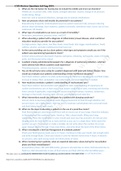
CMS Review Questions Jul/Aug 2019: 1. What are the risk factors for hearing loss to include the middle and inner ear disorders? Middle ear: recurrent colds, otitis media, enlarged adenoids, trauma, change in air pressure (scuba diving, flying). Inner ear: viral or bacterial infections, damage due to ototoxic medications. 2. How can pressure ulcers and wounds be prevented in our patients? Repositioning frequently (individualized based on patient need and risk), pressure reducing devices (foam dressings, foam mattress, padded commode, wheelchair seats, boots, low air loss mattresses, lift sheets). 3. What type of complications can occur as a result of immobility? Atelectasis, pneumonia, pressure sores, and DVT. 4. When educating a patient with a diagnosis of inflammatory bowel disease, what nutritional education would you provide for your patient? Eat high protein, high calorie, low fiber foods. Avoid foods that trigger manifestations. Avoid caffeine, alcohol, and take multivitamins that have iron. 5. As the nurse providing care to a burn patient, what signs and symptoms would you see if the patient was experiencing hypovolemic shock? Central venous pressure decreased, hypoxia, tachypnea, wheezing, tachycardia, weak or thready pulse, and decreased urine output. 6. A patient is being administered Enoxaparin for a diagnosis of pulmonary embolism, what are some adverse/side effects a patient could experience? Thrombocytopenia, anemia, and hemorrhage. 7. You are the primary nurse caring for a patient diagnosed with polycystic kidney disease; how would you evaluate your patients understanding of their nutritional education? Teach back method, patient can state understanding of importance of adequate oral fluid intake, increase in dietary fiber, ambulation, low sodium diet, and stool softeners if needed. 8. How would you evaluate a patient’s understanding of tracheostomy care? Teach back method, demonstration and patient can state understanding of importance of routine tracheostomy care at least once a day, proper suctioning of tube, removing and cleaning inner cannula if applicable, inspecting skin around stoma for redness, hardness, tenderness, drainage or foul smell, cleaning outer cannula, and changing trach tube ties. 9. What interventions would you anticipate for a patient with dumping syndrome? Instruct client to lay down following meals to slow movement of food through intestine and prevent injury, eat a high-protein, high-fat, low to moderate carbohydrate diet, eat small meals and limit taking liquids with meals. 10. What are the steps in educating a patient on the use of a peak flow meter? Peak flow meters are used to measure how well air moves out of your lungs. Move the indicator to the bottom of the numbered scale. Stand up. Take a deep breath, filling your lungs completely. Place the mouthpiece in your mouth and close your lips around it. Do not put your tongue inside the hole. Blow out as hard and fast as you can in a single blow. Write down the number you get. If you cough or make a mistake, do not write down the number. Do it over again. Repeat steps 1 through 5 two more times, and write down the best of the three blows. 11. What is involved in a Sick Day Management of a diabetic patient? Check your blood glucose levels every 2-3 hours. Continue to take your insulin. Eat enough carbs and drink enough fluids. Check your blood or urine for ketones levels every 4 hours. If ketones are present, take rapid-acting insulin and drink plenty of water. 12. When monitoring burn patients, what are expected laboratory values during the resuscitation phase and fluid remobilization? Resuscitation phase: CBC with differential, glucose is elevated due to stress, BUN elevated due to fluid loss, H&H elevated due to loss of fluid volume and fluid shift into the interstitial space, This study source was downloaded by from CourseH on :15:31 GMT -05:00 sodium decreased due to third spacing, and potassium increased due to cell destruction.
Document information
- Uploaded on
- June 11, 2021
- Number of pages
- 3
- Written in
- 2020/2021
- Type
- Exam (elaborations)
- Contains
- Questions & answers