

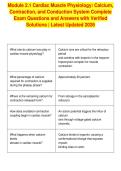
Module 2.1 Cardiac Muscle Physiology: Calcium,
Contraction, and Conduction System Complete
Exam Questions and Answers with Verified
Solutions | Latest Updated 2026
What role do calcium ions play in Calcium ions are critical for the refractory
cardiac muscle physiology? period
and combine with troponin in the troponin-
tropomyosin complex for muscle
contraction.
What percentage of calcium Approximately 20 percent.
required for contraction is supplied
during the plateau phase?
Where is the remaining calcium for From storage in the sarcoplasmic
contraction released from? reticulum.
How does excitation-contraction An action potential triggers the influx of
coupling begin in cardiac muscle? calcium
ions through voltage-gated calcium
channels.
What happens when calcium Calcium binds to troponin, causing a
levels conformational change that exposes
elevate in cardiac muscle? myosin-
binding sites on actin.
, What is the function of myosin Myosin heads bind to exposed sites on
heads actin,
during muscle contraction? forming cross-bridges and undergo power
strokes
to pull actin filaments.
What happens after the power ATP binds to myosin heads, causing them
stroke to
in muscle contraction? release from actin and allowing further
power
strokes.
What is the role of the M line in the The M line holds thick filaments together
sarcomere? and
maintains sarcomere alignment during
contraction
and relaxation.
What happens to the H band The H band narrows as thick and thin
during filaments
muscle contraction? slide past each other.
What occurs when calcium levels Troponin returns to its original state,
decline in cardiac muscle? covering
myosin-binding sites on actin and halting
contraction.
What is the cardiac conduction Generating and spreading electrical
system responsible for? impulses that
trigger heart contractions.
Contraction, and Conduction System Complete
Exam Questions and Answers with Verified
Solutions | Latest Updated 2026
What role do calcium ions play in Calcium ions are critical for the refractory
cardiac muscle physiology? period
and combine with troponin in the troponin-
tropomyosin complex for muscle
contraction.
What percentage of calcium Approximately 20 percent.
required for contraction is supplied
during the plateau phase?
Where is the remaining calcium for From storage in the sarcoplasmic
contraction released from? reticulum.
How does excitation-contraction An action potential triggers the influx of
coupling begin in cardiac muscle? calcium
ions through voltage-gated calcium
channels.
What happens when calcium Calcium binds to troponin, causing a
levels conformational change that exposes
elevate in cardiac muscle? myosin-
binding sites on actin.
, What is the function of myosin Myosin heads bind to exposed sites on
heads actin,
during muscle contraction? forming cross-bridges and undergo power
strokes
to pull actin filaments.
What happens after the power ATP binds to myosin heads, causing them
stroke to
in muscle contraction? release from actin and allowing further
power
strokes.
What is the role of the M line in the The M line holds thick filaments together
sarcomere? and
maintains sarcomere alignment during
contraction
and relaxation.
What happens to the H band The H band narrows as thick and thin
during filaments
muscle contraction? slide past each other.
What occurs when calcium levels Troponin returns to its original state,
decline in cardiac muscle? covering
myosin-binding sites on actin and halting
contraction.
What is the cardiac conduction Generating and spreading electrical
system responsible for? impulses that
trigger heart contractions.


