

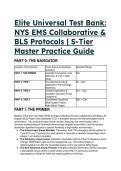
Elite Universal Test Bank:
NYS EMS Collaborative &
BLS Protocols | S-Tier
Master Practice Guide
PART 0: THE NAVIGATOR
Cognitive Tier & Section Focus Area & Competency Question Range
Assessed
PART I: THE PRIMER Axiomatic Framework, Core N/A
Directives, & V.25.1 Hard
Decks
PART II: TIER 1 Foundational Syntax & Q1 – Q10
Application (Pharmacology,
Baselines)
PART II: TIER 2 Complex Application & Q11 – Q20
Simulation (Dynamic Pivots,
Exceptions)
PART II: TIER 3 Grandmaster Synthesis Q21 – Q30
(Multi-System Failure,
High-Stakes Triage)
PART I: THE PRIMER
Mastery of the New York State (NYS) Emergency Medical Services Collaborative and Basic Life
Support (BLS) Patient Care Standards (V.25.1) translates directly into elite prehospital clinical
performance. This document forges clinical intuition, replacing rote memorization with a
structural understanding of advanced pharmacology, targeted resuscitation, and the dynamic
destination algorithms required to operate flawlessly in high-stakes environments.
● The Hemorrhagic Shock Mandate: Tranexamic Acid (TXA) dosage is strictly updated to
2 gm IV/IO over 10 minutes for adult patients in traumatic or obstetric hemorrhagic shock.
Legacy 1 gm dosing is obsolete.
● The Refractory Arrest Axiom: Persistent, shockable rhythms (VF/pVT) demand a Vector
Change. Defibrillation pads must be repositioned (e.g., from sternum/apex to
anterior/posterior) to alter the myocardial energy vector and capture failing tissue.
● The BLS Advanced Airway Firewall: Emergency Medical Technicians (EMTs) may place
a Supraglottic Airway (SGA) in adult cardiac arrest ONLY if continuous waveform
capnography is utilized for initial and ongoing patency monitoring.
, ● The Chemical Restraint Pivot: Haloperidol is completely removed. Severe agitation
requires Olanzapine (10 mg IM or 5 mg SL), with extreme caution applied if midazolam is
co-administered. If chemical restraint results in cardiac arrest, Sodium Bicarbonate 50
mEq IV is the mandated immediate adjunct.
● The S-LAMS Destination Imperative: A Stratified Los Angeles Motor Scale (S-LAMS)
score of ≥ 4 with a Last Known Well (LKW) < 24 hours demands direct transport to a
Thrombectomy Capable Stroke Center (TSC), absolutely bypassing Primary Stroke
Centers unless rigid exclusion criteria are met.
PART II: THE ELITE TEST BANK
TIER 1: Foundational Syntax & Application
Q1: A 55-year-old male is in cardiac arrest. Despite high-performance CPR, epinephrine
administration, and three consecutive defibrillations at maximum energy, the monitor continues
to display coarse Ventricular Fibrillation (VF). Based on the V.25.1 NYS Collaborative Protocols,
which action is the MOST APPROPRIATE next step regarding electrical therapy? A) Increase
the defibrillation energy by 50 Joules and deliver a fourth shock immediately. B) Perform a
vector change by altering the placement of the defibrillation pads to an anterior/posterior
position. C) Withhold further defibrillation for 4 minutes to allow for amiodarone to circulate and
sensitize the myocardium. D) Perform dual-sequential defibrillation using two separate monitors
triggered simultaneously.
● The Answer: B (Perform a vector change by altering the placement of the defibrillation
pads to an anterior/posterior position.)
● Distractor Analysis:
○ A is incorrect: Standard biphasic monitors are already operated at maximum energy
(e.g., 200J or 360J) by the third shock. Increasing energy beyond the
manufacturer's maximum is mechanically impossible.
○ C is incorrect: Withholding defibrillation for a shockable rhythm fundamentally
violates the core tenets of resuscitation. Anti-arrhythmics are adjuncts, not
replacements for continuous electrical therapy.
○ D is incorrect: While Dual-Sequential Defibrillation (DSED) is discussed in broader
resuscitation literature, the NYS Collaborative Protocols explicitly mandate a vector
change (altering pad placement) for refractory shockable rhythms.
The Mentor's Analysis: The primary cause of refractory VF is an inadequate energy vector
failing to capture a critical mass of the myocardium. By utilizing a vector change, you bypass the
common trap of repeatedly striking the exact same myocardial axis with failing results.
Professional/Academic Intuition: When the electrical axis fails, shift the geometry; an
anterior/posterior pad placement captures deep myocardial tissue that sternal/apex vectors
frequently miss.
Q2: A 28-year-old female suffers a massive postpartum hemorrhage with a sustained Mean
Arterial Pressure (MAP) of 55 mmHg. She is tachycardic, diaphoretic, and exhibits altered
mentation. According to the updated Hemorrhagic Shock protocol, which pharmacological
intervention and dosage is MOST ACCURATE? A) Tranexamic Acid (TXA) 1 gm IV infused over
10 minutes. B) Tranexamic Acid (TXA) 2 gm IV/IO infused over 10 minutes. C) Tranexamic Acid
(TXA) 1 gm IV rapid push, followed by a 1 gm infusion over 8 hours. D) Norepinephrine 2
mcg/min, titrated to maintain a MAP ≥ 65 mmHg prior to fluid administration.
, ● The Answer: B (Tranexamic Acid (TXA) 2 gm IV/IO infused over 10 minutes.)
● Distractor Analysis:
○ A is incorrect: This reflects the legacy V.24 dosage. The V.25.1 update explicitly
increased the TXA dose to 2 gm to optimize antifibrinolytic efficacy and explicitly
included obstetric hemorrhage.
○ C is incorrect: This is a prolonged hospital-based dosing regimen that is not
authorized or practical for NYS prehospital rapid administration.
○ D is incorrect: Vasopressors are contraindicated as a primary intervention in
hypovolemic shock until volume and oxygen-carrying capacity are addressed.
The Mentor's Analysis: Hemorrhagic shock demands immediate cessation of fibrinolysis. The
V.25.1 update deliberately doubled the prehospital TXA dose to 2 gm to deliver a massive,
upfront stabilization of the clotting cascade. Professional/Academic Intuition: In traumatic or
obstetric hemorrhage, massive antifibrinolytic dosing takes absolute precedence over artificial
vasoconstriction.
Q3: A BLS crew is managing an adult patient in cardiac arrest. The EMT prepares to insert a
Supraglottic Airway (SGA). Under the current NYS BLS Protocols, which condition MUST be
met for the EMT to legally and clinically proceed with the SGA insertion? A) The EMT must
possess and utilize a colorimetric end-tidal CO2 detector to verify placement. B) The EMT must
have an Advanced Life Support (ALS) intercept confirmed and en route within 10 minutes. C)
The EMT must utilize continuous waveform capnography for initial and ongoing monitoring of
airway patency. D) The patient must have experienced a witnessed arrest with a known
downtime of less than 5 minutes.
● The Answer: C (The EMT must utilize continuous waveform capnography for initial and
ongoing monitoring of airway patency.)
● Distractor Analysis:
○ A is incorrect: Colorimetric capnography is highly susceptible to false positives and
false negatives. The V.25.1 protocol explicitly mandates waveform capnography.
○ B is incorrect: The authorization to place the SGA is predicated on the equipment
available to the EMT (waveform capnography) and regional approval, not the
proximity of a paramedic. * D is incorrect: There is no strict downtime parameter
limiting SGA placement in the BLS protocol.
The Mentor's Analysis: The expansion of the EMT scope to include SGA placement is a
paradigm shift intended to reduce interruptions in chest compressions. By demanding waveform
capnography, the state ensures that ventilation quality and device dislodgment are tracked
beat-to-beat. Professional/Academic Intuition: If you cannot visualize the physiological
waveform of the breath, you do not own the airway.
Q4: Paramedics are treating a severely agitated 22-year-old male displaying erratic behavior,
unnatural pain tolerance, and diaphoresis. Verbal de-escalation has entirely failed. The clinician
decides to administer chemical restraint. Which pharmacological profile is the MOST
ACCURATE primary option under the V.25.1 protocol? A) Haloperidol 5 mg IM combined with
Lorazepam 2 mg IM. B) Olanzapine 10 mg IM or 5 mg SL. C) Ziprasidone 20 mg IM with
continuous ECG monitoring. D) Midazolam 10 mg IV rapid push.
● The Answer: B (Olanzapine 10 mg IM or 5 mg SL.)
● Distractor Analysis:
○ A is incorrect: Haloperidol has been completely removed from the NYS Agitated
Patient protocol due to its inferior safety profile and risk of QT prolongation.
○ C is incorrect: While Ziprasidone is used in emergency departments, it is not the
primary authorized agent in the NYS Collaborative protocol.
NYS EMS Collaborative &
BLS Protocols | S-Tier
Master Practice Guide
PART 0: THE NAVIGATOR
Cognitive Tier & Section Focus Area & Competency Question Range
Assessed
PART I: THE PRIMER Axiomatic Framework, Core N/A
Directives, & V.25.1 Hard
Decks
PART II: TIER 1 Foundational Syntax & Q1 – Q10
Application (Pharmacology,
Baselines)
PART II: TIER 2 Complex Application & Q11 – Q20
Simulation (Dynamic Pivots,
Exceptions)
PART II: TIER 3 Grandmaster Synthesis Q21 – Q30
(Multi-System Failure,
High-Stakes Triage)
PART I: THE PRIMER
Mastery of the New York State (NYS) Emergency Medical Services Collaborative and Basic Life
Support (BLS) Patient Care Standards (V.25.1) translates directly into elite prehospital clinical
performance. This document forges clinical intuition, replacing rote memorization with a
structural understanding of advanced pharmacology, targeted resuscitation, and the dynamic
destination algorithms required to operate flawlessly in high-stakes environments.
● The Hemorrhagic Shock Mandate: Tranexamic Acid (TXA) dosage is strictly updated to
2 gm IV/IO over 10 minutes for adult patients in traumatic or obstetric hemorrhagic shock.
Legacy 1 gm dosing is obsolete.
● The Refractory Arrest Axiom: Persistent, shockable rhythms (VF/pVT) demand a Vector
Change. Defibrillation pads must be repositioned (e.g., from sternum/apex to
anterior/posterior) to alter the myocardial energy vector and capture failing tissue.
● The BLS Advanced Airway Firewall: Emergency Medical Technicians (EMTs) may place
a Supraglottic Airway (SGA) in adult cardiac arrest ONLY if continuous waveform
capnography is utilized for initial and ongoing patency monitoring.
, ● The Chemical Restraint Pivot: Haloperidol is completely removed. Severe agitation
requires Olanzapine (10 mg IM or 5 mg SL), with extreme caution applied if midazolam is
co-administered. If chemical restraint results in cardiac arrest, Sodium Bicarbonate 50
mEq IV is the mandated immediate adjunct.
● The S-LAMS Destination Imperative: A Stratified Los Angeles Motor Scale (S-LAMS)
score of ≥ 4 with a Last Known Well (LKW) < 24 hours demands direct transport to a
Thrombectomy Capable Stroke Center (TSC), absolutely bypassing Primary Stroke
Centers unless rigid exclusion criteria are met.
PART II: THE ELITE TEST BANK
TIER 1: Foundational Syntax & Application
Q1: A 55-year-old male is in cardiac arrest. Despite high-performance CPR, epinephrine
administration, and three consecutive defibrillations at maximum energy, the monitor continues
to display coarse Ventricular Fibrillation (VF). Based on the V.25.1 NYS Collaborative Protocols,
which action is the MOST APPROPRIATE next step regarding electrical therapy? A) Increase
the defibrillation energy by 50 Joules and deliver a fourth shock immediately. B) Perform a
vector change by altering the placement of the defibrillation pads to an anterior/posterior
position. C) Withhold further defibrillation for 4 minutes to allow for amiodarone to circulate and
sensitize the myocardium. D) Perform dual-sequential defibrillation using two separate monitors
triggered simultaneously.
● The Answer: B (Perform a vector change by altering the placement of the defibrillation
pads to an anterior/posterior position.)
● Distractor Analysis:
○ A is incorrect: Standard biphasic monitors are already operated at maximum energy
(e.g., 200J or 360J) by the third shock. Increasing energy beyond the
manufacturer's maximum is mechanically impossible.
○ C is incorrect: Withholding defibrillation for a shockable rhythm fundamentally
violates the core tenets of resuscitation. Anti-arrhythmics are adjuncts, not
replacements for continuous electrical therapy.
○ D is incorrect: While Dual-Sequential Defibrillation (DSED) is discussed in broader
resuscitation literature, the NYS Collaborative Protocols explicitly mandate a vector
change (altering pad placement) for refractory shockable rhythms.
The Mentor's Analysis: The primary cause of refractory VF is an inadequate energy vector
failing to capture a critical mass of the myocardium. By utilizing a vector change, you bypass the
common trap of repeatedly striking the exact same myocardial axis with failing results.
Professional/Academic Intuition: When the electrical axis fails, shift the geometry; an
anterior/posterior pad placement captures deep myocardial tissue that sternal/apex vectors
frequently miss.
Q2: A 28-year-old female suffers a massive postpartum hemorrhage with a sustained Mean
Arterial Pressure (MAP) of 55 mmHg. She is tachycardic, diaphoretic, and exhibits altered
mentation. According to the updated Hemorrhagic Shock protocol, which pharmacological
intervention and dosage is MOST ACCURATE? A) Tranexamic Acid (TXA) 1 gm IV infused over
10 minutes. B) Tranexamic Acid (TXA) 2 gm IV/IO infused over 10 minutes. C) Tranexamic Acid
(TXA) 1 gm IV rapid push, followed by a 1 gm infusion over 8 hours. D) Norepinephrine 2
mcg/min, titrated to maintain a MAP ≥ 65 mmHg prior to fluid administration.
, ● The Answer: B (Tranexamic Acid (TXA) 2 gm IV/IO infused over 10 minutes.)
● Distractor Analysis:
○ A is incorrect: This reflects the legacy V.24 dosage. The V.25.1 update explicitly
increased the TXA dose to 2 gm to optimize antifibrinolytic efficacy and explicitly
included obstetric hemorrhage.
○ C is incorrect: This is a prolonged hospital-based dosing regimen that is not
authorized or practical for NYS prehospital rapid administration.
○ D is incorrect: Vasopressors are contraindicated as a primary intervention in
hypovolemic shock until volume and oxygen-carrying capacity are addressed.
The Mentor's Analysis: Hemorrhagic shock demands immediate cessation of fibrinolysis. The
V.25.1 update deliberately doubled the prehospital TXA dose to 2 gm to deliver a massive,
upfront stabilization of the clotting cascade. Professional/Academic Intuition: In traumatic or
obstetric hemorrhage, massive antifibrinolytic dosing takes absolute precedence over artificial
vasoconstriction.
Q3: A BLS crew is managing an adult patient in cardiac arrest. The EMT prepares to insert a
Supraglottic Airway (SGA). Under the current NYS BLS Protocols, which condition MUST be
met for the EMT to legally and clinically proceed with the SGA insertion? A) The EMT must
possess and utilize a colorimetric end-tidal CO2 detector to verify placement. B) The EMT must
have an Advanced Life Support (ALS) intercept confirmed and en route within 10 minutes. C)
The EMT must utilize continuous waveform capnography for initial and ongoing monitoring of
airway patency. D) The patient must have experienced a witnessed arrest with a known
downtime of less than 5 minutes.
● The Answer: C (The EMT must utilize continuous waveform capnography for initial and
ongoing monitoring of airway patency.)
● Distractor Analysis:
○ A is incorrect: Colorimetric capnography is highly susceptible to false positives and
false negatives. The V.25.1 protocol explicitly mandates waveform capnography.
○ B is incorrect: The authorization to place the SGA is predicated on the equipment
available to the EMT (waveform capnography) and regional approval, not the
proximity of a paramedic. * D is incorrect: There is no strict downtime parameter
limiting SGA placement in the BLS protocol.
The Mentor's Analysis: The expansion of the EMT scope to include SGA placement is a
paradigm shift intended to reduce interruptions in chest compressions. By demanding waveform
capnography, the state ensures that ventilation quality and device dislodgment are tracked
beat-to-beat. Professional/Academic Intuition: If you cannot visualize the physiological
waveform of the breath, you do not own the airway.
Q4: Paramedics are treating a severely agitated 22-year-old male displaying erratic behavior,
unnatural pain tolerance, and diaphoresis. Verbal de-escalation has entirely failed. The clinician
decides to administer chemical restraint. Which pharmacological profile is the MOST
ACCURATE primary option under the V.25.1 protocol? A) Haloperidol 5 mg IM combined with
Lorazepam 2 mg IM. B) Olanzapine 10 mg IM or 5 mg SL. C) Ziprasidone 20 mg IM with
continuous ECG monitoring. D) Midazolam 10 mg IV rapid push.
● The Answer: B (Olanzapine 10 mg IM or 5 mg SL.)
● Distractor Analysis:
○ A is incorrect: Haloperidol has been completely removed from the NYS Agitated
Patient protocol due to its inferior safety profile and risk of QT prolongation.
○ C is incorrect: While Ziprasidone is used in emergency departments, it is not the
primary authorized agent in the NYS Collaborative protocol.


