

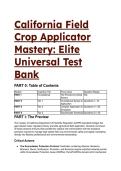
California Field
Crop Applicator
Mastery: Elite
Universal Test
Bank
PART 0: Table of Contents
Section Cognitive Tier Focus Area Question Range
PART I Foundational The Preview & Critical N/A
Axioms
PART II Tier 1 Foundational Syntax & Questions 1–10
Application
PART II Tier 2 Complex Application & Questions 11–20
Simulation
PART II Tier 3 Grandmaster Synthesis Questions 21–30
PART I: The Preview
The mastery of California Department of Pesticide Regulation (CDPR) standards bridges the
gap between basic regulatory theory and elite agricultural field application. Absolute command
of these protocols ensures that practitioners replace rote memorization with the analytical
precision required to manage high-stakes field crop environments safely and legally, translating
directly into flawless professional and environmental stewardship.
Critical Axioms
● The Groundwater Protection Protocol: Pesticides containing Atrazine, Bentazon,
Bromacil, Diuron, Norflurazon, Prometon, and Simazine require restricted material permits
within Groundwater Protection Areas (GWPAs). Runoff GWPAs demand strict mechanical
, management, such as 33% row banding or 48-hour soil incorporation.
● The Schoolsite Proximity Law: Annual notifications must be submitted to schoolsites
and County Agricultural Commissioners (CAC) by April 30. High-drift applications are
strictly prohibited within a 1/4-mile radius of a schoolsite from Monday through Friday,
6:00 a.m. to 6:00 p.m..
● Engineering Controls Hierarchy: A Tier 1 closed system is unconditionally required for
liquid pesticides bearing the label "Fatal if absorbed through skin." Protective eyewear
remains universally mandatory even when the system is completely closed.
● Biological Baselines: Employers must provide medical supervision, including baseline
blood tests established after 30 days without exposure, for employees handling
organophosphates or carbamates carrying the "DANGER" or "WARNING" signal word for
more than 6 days in any 30-day period.
● Decontamination Imperatives: A minimum of 3 gallons of clean water per handler must
be available at the start of the workday, located within 100 feet of the mixing and loading
site. Hand sanitizers are strictly prohibited as a substitute for mechanical water flushing.
Regulatory Framework Trigger / Condition Legal Mandate / Restriction
3 CCR 6624 (Records) Agricultural Field Applications 2-Year Retention of Use
Records
3 CCR 6624 (Records) Structural Pest Control 3-Year Retention of Use
Applications Records
3 CCR 6691 (Schools) Dusts, Fumigants, Aerial 1/4-Mile Buffer (Mon-Fri,
Formulations 6am-6pm)
3 CCR 6691 (Schools) Granule Formulations 25-Foot Buffer (Mon-Fri,
6am-6pm)
3 CCR 6457 (Bentazon) Statewide GWPA Prohibition Complete Ban in Del Norte,
Humboldt, & Rice
PART II: THE ELITE TEST BANK
Tier 1: Foundational Syntax & Application
Q1: According to California code regarding pesticide use records (PUR), which retention
timeline is the MOST ACCURATE for an agricultural pest control business applying restricted
materials to a field crop? A) One year for agricultural applications, three years for structural
applications. B) Two years for agricultural applications, three years for structural applications. C)
Three years for agricultural applications, two years for structural applications. D) Five years
universally, regardless of the application setting.
● The Answer: B (Two years for agricultural applications, three years for structural
applications.)
● Distractor Analysis:
○ A is incorrect: A one-year retention period represents an outdated legacy standard
that violates current 3 CCR section 6624 guidelines.
○ C is incorrect: This inverses the correct temporal requirements. Structural pest
control records under 16 CCR section 1970 demand three years, whereas
agricultural applications require two years.
○ D is incorrect: A universal five-year retention policy represents a severe analytical
error and does not align with any current CDPR mandate for standard use records.
The Mentor's Analysis: Regulatory record-keeping creates the foundation for compliance
, tracking and the continuous evaluation of state-wide pesticide usage. When facing record
audits, the immediate priority is verifying the domain of application: agricultural (2 years) versus
structural (3 years). By utilizing the 3 CCR section 6624 framework, practitioners bypass the
common trap of misapplying structural regulations to field crop operations, ensuring that all
data—including specific method codes—is available for County Agricultural Commissioner
(CAC) inspection. Professional/Academic Intuition: Record retention is strictly
domain-dependent; lock the 2-year agricultural and 3-year structural rule into permanent
memory.
Q2: When mixing liquid pesticide products, which specific label statement unequivocally dictates
the mandatory use of a Tier 1 closed mixing system under California regulations? A) "Harmful if
inhaled." B) "May be fatal if absorbed through the skin." C) "Corrosive, causes skin damage." D)
"Fatal if absorbed through skin."
● The Answer: D ("Fatal if absorbed through skin.")
● Distractor Analysis:
○ A is incorrect: Inhalation hazards dictate respiratory protection protocols (3 CCR
6739), not specifically dermal-focused closed mixing systems.
○ B is incorrect: "May be fatal" triggers the requirement for a Tier 2 closed mixing
system, not a Tier 1 system. A Tier 2 system removes the pesticide but does not
mandate the rinsing of the container while connected.
○ C is incorrect: "Corrosive" statements also trigger Tier 2 system requirements under
California worker safety regulations.
The Mentor's Analysis: The absolute hazard level of dermal toxicity dictates the engineering
controls required on the field. When facing highly toxic liquid concentrates, the immediate
priority is complete handler isolation. By utilizing a Tier 1 closed system, handlers achieve
simultaneous extraction and rinsing, bypassing the severe danger of systemic dermal poisoning
caused by Category 1 liquids. The legacy exemption allowing operators to hand-pour from
one-gallon containers has been abolished, reinforcing the absolute necessity of closed-system
engineering. Professional/Academic Intuition: "Fatal" demands Tier 1 isolation; "May be
fatal" or "Corrosive" demands Tier 2.
Q3: An agricultural operator is planning an application of Bentazon (Basagran®) within a
designated Groundwater Protection Area (GWPA). Based on 3 CCR Section 6457, which
location restriction is MOST ACCURATE? A) Bentazon may be used in Del Norte County if
applied via band treatment. B) Bentazon is strictly prohibited from use in the production of rice.
C) Bentazon requires mechanical soil disturbance incorporation within 7 days of application. D)
Bentazon applications in Humboldt County require an approved alternative management
practice.
● The Answer: B (Bentazon is strictly prohibited from use in the production of rice.)
● Distractor Analysis:
○ A is incorrect: Bentazon applications are entirely prohibited in Del Norte County,
regardless of the management practice utilized.
○ C is incorrect: Standard soil disturbance and 48-hour incorporation management
practices for runoff GWPAs explicitly exclude Bentazon.
○ D is incorrect: Similar to Del Norte, Bentazon is completely prohibited in Humboldt
County; no alternative management practice or CAC permit overrides this
geographic ban.
The Mentor's Analysis: Chemical-specific geographic and crop prohibitions supersede general
GWPA management practices due to extreme leaching properties. When applying Bentazon,
the immediate priority is verifying county lines and crop type. By recognizing the absolute bans
Crop Applicator
Mastery: Elite
Universal Test
Bank
PART 0: Table of Contents
Section Cognitive Tier Focus Area Question Range
PART I Foundational The Preview & Critical N/A
Axioms
PART II Tier 1 Foundational Syntax & Questions 1–10
Application
PART II Tier 2 Complex Application & Questions 11–20
Simulation
PART II Tier 3 Grandmaster Synthesis Questions 21–30
PART I: The Preview
The mastery of California Department of Pesticide Regulation (CDPR) standards bridges the
gap between basic regulatory theory and elite agricultural field application. Absolute command
of these protocols ensures that practitioners replace rote memorization with the analytical
precision required to manage high-stakes field crop environments safely and legally, translating
directly into flawless professional and environmental stewardship.
Critical Axioms
● The Groundwater Protection Protocol: Pesticides containing Atrazine, Bentazon,
Bromacil, Diuron, Norflurazon, Prometon, and Simazine require restricted material permits
within Groundwater Protection Areas (GWPAs). Runoff GWPAs demand strict mechanical
, management, such as 33% row banding or 48-hour soil incorporation.
● The Schoolsite Proximity Law: Annual notifications must be submitted to schoolsites
and County Agricultural Commissioners (CAC) by April 30. High-drift applications are
strictly prohibited within a 1/4-mile radius of a schoolsite from Monday through Friday,
6:00 a.m. to 6:00 p.m..
● Engineering Controls Hierarchy: A Tier 1 closed system is unconditionally required for
liquid pesticides bearing the label "Fatal if absorbed through skin." Protective eyewear
remains universally mandatory even when the system is completely closed.
● Biological Baselines: Employers must provide medical supervision, including baseline
blood tests established after 30 days without exposure, for employees handling
organophosphates or carbamates carrying the "DANGER" or "WARNING" signal word for
more than 6 days in any 30-day period.
● Decontamination Imperatives: A minimum of 3 gallons of clean water per handler must
be available at the start of the workday, located within 100 feet of the mixing and loading
site. Hand sanitizers are strictly prohibited as a substitute for mechanical water flushing.
Regulatory Framework Trigger / Condition Legal Mandate / Restriction
3 CCR 6624 (Records) Agricultural Field Applications 2-Year Retention of Use
Records
3 CCR 6624 (Records) Structural Pest Control 3-Year Retention of Use
Applications Records
3 CCR 6691 (Schools) Dusts, Fumigants, Aerial 1/4-Mile Buffer (Mon-Fri,
Formulations 6am-6pm)
3 CCR 6691 (Schools) Granule Formulations 25-Foot Buffer (Mon-Fri,
6am-6pm)
3 CCR 6457 (Bentazon) Statewide GWPA Prohibition Complete Ban in Del Norte,
Humboldt, & Rice
PART II: THE ELITE TEST BANK
Tier 1: Foundational Syntax & Application
Q1: According to California code regarding pesticide use records (PUR), which retention
timeline is the MOST ACCURATE for an agricultural pest control business applying restricted
materials to a field crop? A) One year for agricultural applications, three years for structural
applications. B) Two years for agricultural applications, three years for structural applications. C)
Three years for agricultural applications, two years for structural applications. D) Five years
universally, regardless of the application setting.
● The Answer: B (Two years for agricultural applications, three years for structural
applications.)
● Distractor Analysis:
○ A is incorrect: A one-year retention period represents an outdated legacy standard
that violates current 3 CCR section 6624 guidelines.
○ C is incorrect: This inverses the correct temporal requirements. Structural pest
control records under 16 CCR section 1970 demand three years, whereas
agricultural applications require two years.
○ D is incorrect: A universal five-year retention policy represents a severe analytical
error and does not align with any current CDPR mandate for standard use records.
The Mentor's Analysis: Regulatory record-keeping creates the foundation for compliance
, tracking and the continuous evaluation of state-wide pesticide usage. When facing record
audits, the immediate priority is verifying the domain of application: agricultural (2 years) versus
structural (3 years). By utilizing the 3 CCR section 6624 framework, practitioners bypass the
common trap of misapplying structural regulations to field crop operations, ensuring that all
data—including specific method codes—is available for County Agricultural Commissioner
(CAC) inspection. Professional/Academic Intuition: Record retention is strictly
domain-dependent; lock the 2-year agricultural and 3-year structural rule into permanent
memory.
Q2: When mixing liquid pesticide products, which specific label statement unequivocally dictates
the mandatory use of a Tier 1 closed mixing system under California regulations? A) "Harmful if
inhaled." B) "May be fatal if absorbed through the skin." C) "Corrosive, causes skin damage." D)
"Fatal if absorbed through skin."
● The Answer: D ("Fatal if absorbed through skin.")
● Distractor Analysis:
○ A is incorrect: Inhalation hazards dictate respiratory protection protocols (3 CCR
6739), not specifically dermal-focused closed mixing systems.
○ B is incorrect: "May be fatal" triggers the requirement for a Tier 2 closed mixing
system, not a Tier 1 system. A Tier 2 system removes the pesticide but does not
mandate the rinsing of the container while connected.
○ C is incorrect: "Corrosive" statements also trigger Tier 2 system requirements under
California worker safety regulations.
The Mentor's Analysis: The absolute hazard level of dermal toxicity dictates the engineering
controls required on the field. When facing highly toxic liquid concentrates, the immediate
priority is complete handler isolation. By utilizing a Tier 1 closed system, handlers achieve
simultaneous extraction and rinsing, bypassing the severe danger of systemic dermal poisoning
caused by Category 1 liquids. The legacy exemption allowing operators to hand-pour from
one-gallon containers has been abolished, reinforcing the absolute necessity of closed-system
engineering. Professional/Academic Intuition: "Fatal" demands Tier 1 isolation; "May be
fatal" or "Corrosive" demands Tier 2.
Q3: An agricultural operator is planning an application of Bentazon (Basagran®) within a
designated Groundwater Protection Area (GWPA). Based on 3 CCR Section 6457, which
location restriction is MOST ACCURATE? A) Bentazon may be used in Del Norte County if
applied via band treatment. B) Bentazon is strictly prohibited from use in the production of rice.
C) Bentazon requires mechanical soil disturbance incorporation within 7 days of application. D)
Bentazon applications in Humboldt County require an approved alternative management
practice.
● The Answer: B (Bentazon is strictly prohibited from use in the production of rice.)
● Distractor Analysis:
○ A is incorrect: Bentazon applications are entirely prohibited in Del Norte County,
regardless of the management practice utilized.
○ C is incorrect: Standard soil disturbance and 48-hour incorporation management
practices for runoff GWPAs explicitly exclude Bentazon.
○ D is incorrect: Similar to Del Norte, Bentazon is completely prohibited in Humboldt
County; no alternative management practice or CAC permit overrides this
geographic ban.
The Mentor's Analysis: Chemical-specific geographic and crop prohibitions supersede general
GWPA management practices due to extreme leaching properties. When applying Bentazon,
the immediate priority is verifying county lines and crop type. By recognizing the absolute bans


