

BUS 303 Final Exam Questions and Answers
with Verified Solutions | Latest Updated 2026
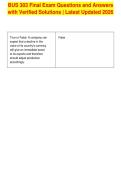
True or False: A company can False
expect that a decline in the
value of its country's currency
will give an immediate boost
to its exports and therefore
should adjust production
accordingly.
,A company can reduce its risk Invoicing, Payment Timing, Hedging
from currency fluctuations (foreign receivables insurance)
during an international •Company remedies for own currency
business transaction by: appreciation (raises price of exports;
lowers cost of inputs; lowers value of
foreign assets)
-Pricing: adjust prices in line with
company goals
•Allow prices to increase to protect profit
margins
•Lower prices to protect market share
-Marketing:
•Reposition brand to justify higher prices
(Gucci in Japan)
•Develop new markets with stronger
currencies
-Production/Operatons
•Increase productivity to maintain steady
export prices & market share
•Cut costs
•Relocate production (foreign sourcing)
to countries with weaker currencies
("natural hedge")
Is it advisable for most CENTRALIZED at headquarters.
multinational corporations to
manage their foreign currency
transactions centrally at
headquarters or to
decentralize them to
subsidiaries?
, An agreement with a bank to FORWARD MARKET CONTRACT
deliver a fixed amount of one
currency for a fixed amount of
another currency on an
agreed future date (the value
date) is called:
MNCs utilize this financial Netting: an intra-company hedge
technique to offset credits and through subsidiaries, affiliates, or partners
liabilities among subsidiaries in A foreign associate creates an offsetting
order to reduce overall transaction so the two exposures net out
requirements for foreign and remove risk.
currency transactions that
carry costly commissions and
transfer fees.
When a company shifts the Natural Hedge
location of production to a
country where the company
has sizeable sales in order to
minimize the impact of
currency changes on its costs
of production it is called:
When faced with a foreign Open Account (exporter ships goods 1st
buyer's uncertain and bills imports later) - Seller assumes
creditworthiness, a seller both credit and currency risks
should avoid this payment
method because it shifts most
risk to the seller.
with Verified Solutions | Latest Updated 2026
True or False: A company can False
expect that a decline in the
value of its country's currency
will give an immediate boost
to its exports and therefore
should adjust production
accordingly.
,A company can reduce its risk Invoicing, Payment Timing, Hedging
from currency fluctuations (foreign receivables insurance)
during an international •Company remedies for own currency
business transaction by: appreciation (raises price of exports;
lowers cost of inputs; lowers value of
foreign assets)
-Pricing: adjust prices in line with
company goals
•Allow prices to increase to protect profit
margins
•Lower prices to protect market share
-Marketing:
•Reposition brand to justify higher prices
(Gucci in Japan)
•Develop new markets with stronger
currencies
-Production/Operatons
•Increase productivity to maintain steady
export prices & market share
•Cut costs
•Relocate production (foreign sourcing)
to countries with weaker currencies
("natural hedge")
Is it advisable for most CENTRALIZED at headquarters.
multinational corporations to
manage their foreign currency
transactions centrally at
headquarters or to
decentralize them to
subsidiaries?
, An agreement with a bank to FORWARD MARKET CONTRACT
deliver a fixed amount of one
currency for a fixed amount of
another currency on an
agreed future date (the value
date) is called:
MNCs utilize this financial Netting: an intra-company hedge
technique to offset credits and through subsidiaries, affiliates, or partners
liabilities among subsidiaries in A foreign associate creates an offsetting
order to reduce overall transaction so the two exposures net out
requirements for foreign and remove risk.
currency transactions that
carry costly commissions and
transfer fees.
When a company shifts the Natural Hedge
location of production to a
country where the company
has sizeable sales in order to
minimize the impact of
currency changes on its costs
of production it is called:
When faced with a foreign Open Account (exporter ships goods 1st
buyer's uncertain and bills imports later) - Seller assumes
creditworthiness, a seller both credit and currency risks
should avoid this payment
method because it shifts most
risk to the seller.


