

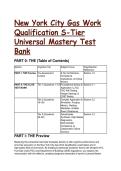
New York City Gas Work
Qualification S-Tier
Universal Mastery Test
Bank
PART 0: THE (Table of Contents)
Section Cognitive Tier Subject Focus Page/Section
Reference
PART I: THE Preview Pre-Assessment S-Tier Architecture, Section 1.0
Context Compliance
Implications, & Critical
Axioms
PART II: THE ELITE Tier 1 (Questions 1–15) Foundational Syntax & Section 2.1
TEST BANK Application: LL152,
FGC 406 Testing,
Hanger Spacing, &
CSST Basics.
Tier 2 (Questions Complex Application & Section 2.2
16–35) Simulation: Purging
Metrics, Welding
Mandates, & Meter
Room Clearances.
Tier 3 (Questions Grandmaster Section 2.3
36–60) Synthesis: High-Stakes
Diagnostics,
Multi-Variable
Compliance, &
Catastrophic Failure
Aversion.
PART I: THE Preview
Mastering this exhaustive test bank translates directly to elite cognitive performance and
error-free execution on the New York City Gas Work Qualification examination and in
high-stakes field environments. By bridging fundamental academic theory with stringent NYC
Fuel Gas Code (FGC) and Department of Buildings (DOB) regulations, you replace rote
memorization with the reflexive, analytical judgment demanded of top-tier Licensed Master
,Plumbers and qualified gas practitioners.
The "Critical Axioms" Cheat Sheet
● The LL152 Administrative Mandate: Following a Local Law 152 inspection, the
Licensed Master Plumber (LMP) must issue the GPS1 Report to the owner within 30
days. The owner holds the legal burden to submit the GPS2 Certification to the DOB
within 60 days.
● The FGC 406 Pressure Thresholds: Low-pressure systems require a minimum 3 psig
test using a 5 psig gauge. Tests exceeding 125 psig must cap hoop stress at 50% of the
pipe's specified minimum yield strength. The 2022 FGC completely prohibits the use of
fresh water as a testing medium.
● The Purging Proximity Rule: When discharging purged gases outdoors, maintain a strict
radius of 10 feet from ignition sources, 10 feet from building openings, and 25 feet from
mechanical air intakes. Cease operations precisely when 90% fuel gas by volume is
detected by the Combustible Gas Indicator (CGI).
● The High-Pressure Welding Matrix: All gas piping greater than 4 inches in diameter
must be welded. Piping 2-1/2 inches or greater must be butt welded, while piping less
than 2-1/2 inches may be socket welded. Butt welds operating above 5 psig mandate
100% Radiographic Testing (RT).
● The CSST Bonding Law: Corrugated Stainless Steel Tubing (CSST) must be directly
bonded to the electrical grounding system using a minimum 6 AWG copper wire. The
bonding clamp must attach to a rigid piping component or brass fitting, never to the
corrugated tubing itself.
PART II: THE ELITE TEST BANK
Tier 1: Foundational Syntax & Application
Q1: A Licensed Master Plumber (LMP) completes a Local Law 152 periodic inspection of a
mixed-use building's gas piping system and identifies no immediately hazardous conditions.
Based on the principles of Local Law 152 Administrative Compliance, which action sequence
is the MOST ACCURATE? A) The LMP must submit the GPS1 report directly to the NYC DOB
within 30 days. B) The LMP must provide the GPS1 report to the owner within 30 days, and the
LMP must submit the GPS2 to the DOB within 60 days. C) The LMP must provide the GPS1
report to the owner within 30 days, and the owner must submit the GPS2 certification to the
DOB within 60 days. D) The LMP must submit both the GPS1 and GPS2 to the owner within 60
days.
● The Answer: C (The LMP must provide the GPS1 report to the owner within 30 days, and
the owner must submit the GPS2 certification to the DOB within 60 days.)
● Distractor Analysis:
○ A is incorrect: The GPS1 (Gas System Periodic Inspection Report) is strictly a
diagnostic document exchanged between the LMP and the building owner, not the
DOB.
○ B is incorrect: While the LMP signs and seals the GPS2, the legal burden of
submission to the DOB via the online portal rests exclusively on the building owner.
○ D is incorrect: This conflates the timelines and incorrectly assigns the GPS2
, submission destination to the owner rather than the DOB.
The Mentor's Analysis: Regulatory compliance is a strict chain of custody. When handling
LL152 paperwork, the immediate priority is understanding who holds the legal burden of
submission. By utilizing the GPS1 for the owner and GPS2 for the DOB, you bypass the
common trap of assuming the plumber manages all municipal filings. Professional/Academic
Intuition: The LMP inspects and informs (30 days); the Owner certifies and submits (60 days).
Q2: An apprentice is preparing to perform a pressure test on a newly installed low-pressure gas
distribution system in a residential occupancy. Based on the principles of NYC FGC Section
406 (Inspection, Testing and Purging), which testing parameters are the MOST ACCURATE?
A) A 3 PSI test using a 5 PSI gauge. B) A 5 PSI test using a 10 PSI gauge. C) A 3 PSI test
using fresh water as the testing medium. D) A 1.5 PSI test utilizing a 3 PSI gauge.
● The Answer: A (A 3 PSI test using a 5 PSI gauge.)
● Distractor Analysis:
○ B is incorrect: 5 PSI exceeds the required 3 PSI standard for standard low-pressure
distribution systems in NYC.
○ C is incorrect: The 2022 FGC explicitly eliminated the use of fresh water as a
testing medium to prevent internal corrosion and system contamination.
○ D is incorrect: This utilizes the 1.5x working pressure rule but fails to meet the
absolute floor of 3 psig mandated by the code.
The Mentor's Analysis: Precision in testing parameters guarantees system integrity without
inducing catastrophic stress. When facing a standard low-pressure test, the immediate priority is
selecting the properly scaled measurement device. By utilizing a 5 PSI gauge for a 3 PSI test,
you bypass the common trap of using unscaled equipment that masks micro-leaks.
Professional/Academic Intuition: The measurement gauge must closely frame the test
pressure; never test a 3 PSI system with a 30 PSI gauge.
Q3: A technician is installing continuous 1-inch Schedule 40 steel gas piping horizontally across
a commercial basement. Based on the principles of Table 415.1/407.2 (Piping Support), what
is the maximum allowable horizontal spacing between hangers? A) 6 feet B) 8 feet C) 10 feet D)
12 feet
● The Answer: B (8 feet)
● Distractor Analysis:
○ A is incorrect: 6 feet is the maximum horizontal spacing specifically for 1/2-inch
nominal steel pipe, not 1-inch.
○ C is incorrect: 10 feet is reserved for steel piping that is 1-1/4 inches and larger.
○ D is incorrect: 12 feet exceeds all allowable horizontal support spacing parameters
for steel gas piping under the FGC.
The Mentor's Analysis: Structural support prevents stress fractures and joint fatigue. When
calculating hanger spacing, the immediate priority is matching the nominal pipe diameter to its
maximum unsupported span. By utilizing the 8-foot rule for 3/4" to 1" pipe, you bypass the
common trap of applying a one-size-fits-all spacing metric to an entire building.
Professional/Academic Intuition: Support spacing scales directly with diameter: 1/2" (6ft),
3/4"-1" (8ft), 1-1/4"+ (10ft).
Q4: During a field inspection, an LMP notices a threaded close nipple and a union installed on a
gas branch line located three feet upstream of the appliance shutoff valve. Based on the
principles of FGC 403.10.1.1 (Prohibited Joints and Fittings), which conclusion is the MOST
ACCURATE? A) The installation is compliant because the union is within 6 feet of the
appliance. B) The installation is compliant provided the union is accessible and not concealed
within a wall cavity. C) The installation is non-compliant because unions and threaded close
Qualification S-Tier
Universal Mastery Test
Bank
PART 0: THE (Table of Contents)
Section Cognitive Tier Subject Focus Page/Section
Reference
PART I: THE Preview Pre-Assessment S-Tier Architecture, Section 1.0
Context Compliance
Implications, & Critical
Axioms
PART II: THE ELITE Tier 1 (Questions 1–15) Foundational Syntax & Section 2.1
TEST BANK Application: LL152,
FGC 406 Testing,
Hanger Spacing, &
CSST Basics.
Tier 2 (Questions Complex Application & Section 2.2
16–35) Simulation: Purging
Metrics, Welding
Mandates, & Meter
Room Clearances.
Tier 3 (Questions Grandmaster Section 2.3
36–60) Synthesis: High-Stakes
Diagnostics,
Multi-Variable
Compliance, &
Catastrophic Failure
Aversion.
PART I: THE Preview
Mastering this exhaustive test bank translates directly to elite cognitive performance and
error-free execution on the New York City Gas Work Qualification examination and in
high-stakes field environments. By bridging fundamental academic theory with stringent NYC
Fuel Gas Code (FGC) and Department of Buildings (DOB) regulations, you replace rote
memorization with the reflexive, analytical judgment demanded of top-tier Licensed Master
,Plumbers and qualified gas practitioners.
The "Critical Axioms" Cheat Sheet
● The LL152 Administrative Mandate: Following a Local Law 152 inspection, the
Licensed Master Plumber (LMP) must issue the GPS1 Report to the owner within 30
days. The owner holds the legal burden to submit the GPS2 Certification to the DOB
within 60 days.
● The FGC 406 Pressure Thresholds: Low-pressure systems require a minimum 3 psig
test using a 5 psig gauge. Tests exceeding 125 psig must cap hoop stress at 50% of the
pipe's specified minimum yield strength. The 2022 FGC completely prohibits the use of
fresh water as a testing medium.
● The Purging Proximity Rule: When discharging purged gases outdoors, maintain a strict
radius of 10 feet from ignition sources, 10 feet from building openings, and 25 feet from
mechanical air intakes. Cease operations precisely when 90% fuel gas by volume is
detected by the Combustible Gas Indicator (CGI).
● The High-Pressure Welding Matrix: All gas piping greater than 4 inches in diameter
must be welded. Piping 2-1/2 inches or greater must be butt welded, while piping less
than 2-1/2 inches may be socket welded. Butt welds operating above 5 psig mandate
100% Radiographic Testing (RT).
● The CSST Bonding Law: Corrugated Stainless Steel Tubing (CSST) must be directly
bonded to the electrical grounding system using a minimum 6 AWG copper wire. The
bonding clamp must attach to a rigid piping component or brass fitting, never to the
corrugated tubing itself.
PART II: THE ELITE TEST BANK
Tier 1: Foundational Syntax & Application
Q1: A Licensed Master Plumber (LMP) completes a Local Law 152 periodic inspection of a
mixed-use building's gas piping system and identifies no immediately hazardous conditions.
Based on the principles of Local Law 152 Administrative Compliance, which action sequence
is the MOST ACCURATE? A) The LMP must submit the GPS1 report directly to the NYC DOB
within 30 days. B) The LMP must provide the GPS1 report to the owner within 30 days, and the
LMP must submit the GPS2 to the DOB within 60 days. C) The LMP must provide the GPS1
report to the owner within 30 days, and the owner must submit the GPS2 certification to the
DOB within 60 days. D) The LMP must submit both the GPS1 and GPS2 to the owner within 60
days.
● The Answer: C (The LMP must provide the GPS1 report to the owner within 30 days, and
the owner must submit the GPS2 certification to the DOB within 60 days.)
● Distractor Analysis:
○ A is incorrect: The GPS1 (Gas System Periodic Inspection Report) is strictly a
diagnostic document exchanged between the LMP and the building owner, not the
DOB.
○ B is incorrect: While the LMP signs and seals the GPS2, the legal burden of
submission to the DOB via the online portal rests exclusively on the building owner.
○ D is incorrect: This conflates the timelines and incorrectly assigns the GPS2
, submission destination to the owner rather than the DOB.
The Mentor's Analysis: Regulatory compliance is a strict chain of custody. When handling
LL152 paperwork, the immediate priority is understanding who holds the legal burden of
submission. By utilizing the GPS1 for the owner and GPS2 for the DOB, you bypass the
common trap of assuming the plumber manages all municipal filings. Professional/Academic
Intuition: The LMP inspects and informs (30 days); the Owner certifies and submits (60 days).
Q2: An apprentice is preparing to perform a pressure test on a newly installed low-pressure gas
distribution system in a residential occupancy. Based on the principles of NYC FGC Section
406 (Inspection, Testing and Purging), which testing parameters are the MOST ACCURATE?
A) A 3 PSI test using a 5 PSI gauge. B) A 5 PSI test using a 10 PSI gauge. C) A 3 PSI test
using fresh water as the testing medium. D) A 1.5 PSI test utilizing a 3 PSI gauge.
● The Answer: A (A 3 PSI test using a 5 PSI gauge.)
● Distractor Analysis:
○ B is incorrect: 5 PSI exceeds the required 3 PSI standard for standard low-pressure
distribution systems in NYC.
○ C is incorrect: The 2022 FGC explicitly eliminated the use of fresh water as a
testing medium to prevent internal corrosion and system contamination.
○ D is incorrect: This utilizes the 1.5x working pressure rule but fails to meet the
absolute floor of 3 psig mandated by the code.
The Mentor's Analysis: Precision in testing parameters guarantees system integrity without
inducing catastrophic stress. When facing a standard low-pressure test, the immediate priority is
selecting the properly scaled measurement device. By utilizing a 5 PSI gauge for a 3 PSI test,
you bypass the common trap of using unscaled equipment that masks micro-leaks.
Professional/Academic Intuition: The measurement gauge must closely frame the test
pressure; never test a 3 PSI system with a 30 PSI gauge.
Q3: A technician is installing continuous 1-inch Schedule 40 steel gas piping horizontally across
a commercial basement. Based on the principles of Table 415.1/407.2 (Piping Support), what
is the maximum allowable horizontal spacing between hangers? A) 6 feet B) 8 feet C) 10 feet D)
12 feet
● The Answer: B (8 feet)
● Distractor Analysis:
○ A is incorrect: 6 feet is the maximum horizontal spacing specifically for 1/2-inch
nominal steel pipe, not 1-inch.
○ C is incorrect: 10 feet is reserved for steel piping that is 1-1/4 inches and larger.
○ D is incorrect: 12 feet exceeds all allowable horizontal support spacing parameters
for steel gas piping under the FGC.
The Mentor's Analysis: Structural support prevents stress fractures and joint fatigue. When
calculating hanger spacing, the immediate priority is matching the nominal pipe diameter to its
maximum unsupported span. By utilizing the 8-foot rule for 3/4" to 1" pipe, you bypass the
common trap of applying a one-size-fits-all spacing metric to an entire building.
Professional/Academic Intuition: Support spacing scales directly with diameter: 1/2" (6ft),
3/4"-1" (8ft), 1-1/4"+ (10ft).
Q4: During a field inspection, an LMP notices a threaded close nipple and a union installed on a
gas branch line located three feet upstream of the appliance shutoff valve. Based on the
principles of FGC 403.10.1.1 (Prohibited Joints and Fittings), which conclusion is the MOST
ACCURATE? A) The installation is compliant because the union is within 6 feet of the
appliance. B) The installation is compliant provided the union is accessible and not concealed
within a wall cavity. C) The installation is non-compliant because unions and threaded close


