

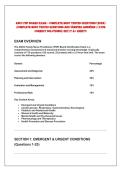
ANCC FNP Board Exam – Complete Most Tested Questions (2026)
|COMPLETE MOST TESTED QUESTIONS AND VERIFIED ANSWERS |(100%
CORRECT SOLUTIONS)|GET IT A+ RIGHT!!
EXAM OVERVIEW
The ANCC Family Nurse Practitioner (FNP) Board Certification Exam is a
comprehensive assessment of advanced practice nursing knowledge. It typically
consists of 175 questions (150 scored, 25 pretest) with a 3.5-hour time limit. The exam
covers the following domains:
Domain Percentage
Assessment and Diagnosis 40%
Planning and Intervention 35%
Evaluation and Management 15%
Professional Role 10%
Key Content Areas:
• Emergent and Urgent Conditions
• Cardiovascular, Respiratory, Gastrointestinal, Neurological
• Pediatric and Adolescent Health
• Women's Health and Maternity
• Mental Health and Psychosocial Issues
• Pharmacology and Therapeutics
• Health Promotion and Disease Prevention
SECTION 1: EMERGENT & URGENT CONDITIONS
(Questions 1-25)
,Question 1
A 68-year-old male presents with sudden onset of severe, tearing chest pain that
radiates to his back. His blood pressure is 160/90 in the right arm and 110/70 in the left
arm. What is the most likely diagnosis?
A) Acute myocardial infarction
B) Pulmonary embolism
C) Aortic dissection
D) Musculoskeletal pain
Correct Answer: C
Rationale: Aortic dissection presents with sudden, severe "tearing" chest pain and
pulse/blood pressure differential between arms. This is a vascular emergency requiring
immediate imaging (CT angiography). The pain is typically described as tearing or
ripping, and blood pressure differential is a classic sign.
Question 2
A 5-year-old child presents with fever, drooling, stridor, and tripod positioning. What is
the most likely diagnosis?
A) Croup
B) Epiglottitis
C) Peritonsillar abscess
D) Retropharyngeal abscess
Correct Answer: B
Rationale: Epiglottitis presents with acute onset of fever, drooling, stridor, and tripod
positioning. It is a medical emergency due to risk of airway obstruction. Drooling and
stridor with fever suggest airway-threatening epiglottitis. Unlike croup (which has a
barking cough), epiglottitis is more severe and requires immediate airway
management.
Question 3
A 55-year-old female with hypertension presents with headache, blurred vision, and BP
210/120. Fundoscopy reveals papilledema. What is the diagnosis?
,A) Hypertensive urgency
B) Hypertensive emergency
C) Migraine
D) Glaucoma
Correct Answer: B
Rationale: Hypertensive emergency is defined as severe hypertension (SBP > 180 or
DBP > 120) with evidence of target organ damage (papilledema, retinal hemorrhages,
acute kidney injury, encephalopathy). This requires immediate IV antihypertensive
therapy. Hypertensive urgency would lack end-organ damage.
Question 4
A 32-year-old female presents with acute onset of right lower quadrant abdominal pain,
nausea, and fever (101.5°F). Rebound tenderness is present at McBurney's point. What
is the most likely diagnosis?
A) Gastroenteritis
B) Ectopic pregnancy
C) Appendicitis
D) Ovarian cyst
Correct Answer: C
Rationale: Acute appendicitis presents with periumbilical pain migrating to the right
lower quadrant, associated with nausea, vomiting, fever, and rebound tenderness at
McBurney's point. Early recognition is crucial to prevent perforation. In women of
childbearing age, a pregnancy test and pelvic ultrasound should be considered to rule
out ectopic pregnancy (B).
Question 5
An 8-year-old child presents with sudden onset of wheezing, dyspnea, and urticaria
after eating peanuts. What is the priority intervention?
A) Albuterol nebulizer
B) Oral antihistamine
C) Epinephrine 1:1000 IM
D) IV corticosteroids
Correct Answer: C
, Rationale: Anaphylaxis is a life-threatening allergic reaction. The priority intervention
is epinephrine 1:1000 IM, which is the first-line treatment for anaphylaxis.
Antihistamines and corticosteroids are adjunctive therapies. Albuterol may help with
bronchospasm but does not address the systemic symptoms.
Question 6
A 45-year-old male presents with sudden severe headache, nausea, vomiting, and
photophobia. Kernig's sign and Brudzinski's sign are positive. What is the most likely
diagnosis?
A) Migraine
B) Tension headache
C) Meningitis
D) Cluster headache
Correct Answer: C
Rationale: Meningitis presents with sudden onset of severe headache, fever, nuchal
rigidity, and photophobia. Kernig's sign (pain with knee extension) and Brudzinski's sign
(neck flexion causing hip flexion) are classic signs. Bacterial meningitis is a medical
emergency requiring immediate antibiotics.
Question 7
A 70-year-old male with a history of smoking presents with sudden onset of severe,
tearing chest pain radiating to the back. BP is 180/90 in the right arm and 100/70 in the
left arm. Which imaging study is most appropriate for diagnosis?
A) Chest X-ray
B) CT angiography of the chest
C) ECG
D) Cardiac enzymes
Correct Answer: B
Rationale: The symptoms suggest aortic dissection. CT angiography of the chest is the
gold standard for diagnosis, providing rapid assessment of the aorta. Chest X-ray may
show a widened mediastinum but is not diagnostic. ECG and cardiac enzymes help rule
out MI but are not specific for aortic dissection.
|COMPLETE MOST TESTED QUESTIONS AND VERIFIED ANSWERS |(100%
CORRECT SOLUTIONS)|GET IT A+ RIGHT!!
EXAM OVERVIEW
The ANCC Family Nurse Practitioner (FNP) Board Certification Exam is a
comprehensive assessment of advanced practice nursing knowledge. It typically
consists of 175 questions (150 scored, 25 pretest) with a 3.5-hour time limit. The exam
covers the following domains:
Domain Percentage
Assessment and Diagnosis 40%
Planning and Intervention 35%
Evaluation and Management 15%
Professional Role 10%
Key Content Areas:
• Emergent and Urgent Conditions
• Cardiovascular, Respiratory, Gastrointestinal, Neurological
• Pediatric and Adolescent Health
• Women's Health and Maternity
• Mental Health and Psychosocial Issues
• Pharmacology and Therapeutics
• Health Promotion and Disease Prevention
SECTION 1: EMERGENT & URGENT CONDITIONS
(Questions 1-25)
,Question 1
A 68-year-old male presents with sudden onset of severe, tearing chest pain that
radiates to his back. His blood pressure is 160/90 in the right arm and 110/70 in the left
arm. What is the most likely diagnosis?
A) Acute myocardial infarction
B) Pulmonary embolism
C) Aortic dissection
D) Musculoskeletal pain
Correct Answer: C
Rationale: Aortic dissection presents with sudden, severe "tearing" chest pain and
pulse/blood pressure differential between arms. This is a vascular emergency requiring
immediate imaging (CT angiography). The pain is typically described as tearing or
ripping, and blood pressure differential is a classic sign.
Question 2
A 5-year-old child presents with fever, drooling, stridor, and tripod positioning. What is
the most likely diagnosis?
A) Croup
B) Epiglottitis
C) Peritonsillar abscess
D) Retropharyngeal abscess
Correct Answer: B
Rationale: Epiglottitis presents with acute onset of fever, drooling, stridor, and tripod
positioning. It is a medical emergency due to risk of airway obstruction. Drooling and
stridor with fever suggest airway-threatening epiglottitis. Unlike croup (which has a
barking cough), epiglottitis is more severe and requires immediate airway
management.
Question 3
A 55-year-old female with hypertension presents with headache, blurred vision, and BP
210/120. Fundoscopy reveals papilledema. What is the diagnosis?
,A) Hypertensive urgency
B) Hypertensive emergency
C) Migraine
D) Glaucoma
Correct Answer: B
Rationale: Hypertensive emergency is defined as severe hypertension (SBP > 180 or
DBP > 120) with evidence of target organ damage (papilledema, retinal hemorrhages,
acute kidney injury, encephalopathy). This requires immediate IV antihypertensive
therapy. Hypertensive urgency would lack end-organ damage.
Question 4
A 32-year-old female presents with acute onset of right lower quadrant abdominal pain,
nausea, and fever (101.5°F). Rebound tenderness is present at McBurney's point. What
is the most likely diagnosis?
A) Gastroenteritis
B) Ectopic pregnancy
C) Appendicitis
D) Ovarian cyst
Correct Answer: C
Rationale: Acute appendicitis presents with periumbilical pain migrating to the right
lower quadrant, associated with nausea, vomiting, fever, and rebound tenderness at
McBurney's point. Early recognition is crucial to prevent perforation. In women of
childbearing age, a pregnancy test and pelvic ultrasound should be considered to rule
out ectopic pregnancy (B).
Question 5
An 8-year-old child presents with sudden onset of wheezing, dyspnea, and urticaria
after eating peanuts. What is the priority intervention?
A) Albuterol nebulizer
B) Oral antihistamine
C) Epinephrine 1:1000 IM
D) IV corticosteroids
Correct Answer: C
, Rationale: Anaphylaxis is a life-threatening allergic reaction. The priority intervention
is epinephrine 1:1000 IM, which is the first-line treatment for anaphylaxis.
Antihistamines and corticosteroids are adjunctive therapies. Albuterol may help with
bronchospasm but does not address the systemic symptoms.
Question 6
A 45-year-old male presents with sudden severe headache, nausea, vomiting, and
photophobia. Kernig's sign and Brudzinski's sign are positive. What is the most likely
diagnosis?
A) Migraine
B) Tension headache
C) Meningitis
D) Cluster headache
Correct Answer: C
Rationale: Meningitis presents with sudden onset of severe headache, fever, nuchal
rigidity, and photophobia. Kernig's sign (pain with knee extension) and Brudzinski's sign
(neck flexion causing hip flexion) are classic signs. Bacterial meningitis is a medical
emergency requiring immediate antibiotics.
Question 7
A 70-year-old male with a history of smoking presents with sudden onset of severe,
tearing chest pain radiating to the back. BP is 180/90 in the right arm and 100/70 in the
left arm. Which imaging study is most appropriate for diagnosis?
A) Chest X-ray
B) CT angiography of the chest
C) ECG
D) Cardiac enzymes
Correct Answer: B
Rationale: The symptoms suggest aortic dissection. CT angiography of the chest is the
gold standard for diagnosis, providing rapid assessment of the aorta. Chest X-ray may
show a widened mediastinum but is not diagnostic. ECG and cardiac enzymes help rule
out MI but are not specific for aortic dissection.


