

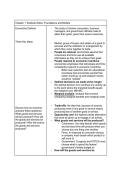
Chapter 1 Textbook Notes: Foundations and Models
Economics Defined - The study of choices consumers, business
managers, and government officials make to
attain their goals, given their scarce resources.
Three Key Ideas
- Market: group of buyers and sellers of a good or
services and the institution or arrangement by
which they come together to trade.
- People are rational: economists assume that
consumers and firms use all available
information as they act to achieve their goals
- People respond to economic incentives:
economists emphasize that individuals and firms
consistently respond to economic incentives
- Biden loan reduction plan for educational
incentives had economists worried that
tuition would go up and taxpayer money
would be “wasted”
- Optimal decisions are made at the margin:
the optimal decision is to continue any activity up
to the point where the marginal benefit equals
the marginal cost, MB=MC
- Marginal analysis: analysis that involves
comparing marginal benefits and marginal costs
- Trade-offs: the idea that, because of scarcity,
Discuss how an economy producing more of one good or service means
answers these questions: producing less of another good or service.
What goods and services - Opportunity cost: the highest-values alternative
will be produced? How will that must be given up to engage in an activity
the goods and services be - What goods and services will be produced?
produced? Who will receive - Consumers: You help decide which goods
the goods and services and services firms will produce when you
produced? choose buy one thing over another
- Firms: In response to consumer choices,
a company must decide which product to
sell more of
- Government: Congress and POTUS must
choose what to spend the federal
government’s limited budget on
- How will the goods and services be
, produced?
- Firms choose how to produce the goods
and services, with a trade-off between
more workers or more machines
- Who will receive the goods and services
produced?
- This is dependent largely on how income
is distributed (in the US)
- Should the government intervene to make
the distribution of income more equal?
Centrally Planned - Centrally Planned: an economy in which the
Economics vs. Market government decides how economic resources
Economics will be allocated
- Market: an economy in which the decisions of
households and firms as they interact in markets
determine the allocation of economic resources
- North Korea is only centrally controlled market rn
The Modern Mixed - Mixed economies: an economy in which most
Economy economic decisions result from the interaction of
buyers and sellers in markets but in which the
government plays a significant role in the
allocation of resources
Efficiency and Equity - Mixed economics tend to be more efficient that
centrally planned economies
- Two types of efficiency:
- Productive efficiency: occurs when a
good or service is produced at the lowest
possible cost; usually a result of
competition
- Allocative efficiency: occurs when
production is in accordance with
consumer preferences; results from
competition + voluntary exchange
- Efficient because competition and voluntary
exchange
- Voluntary exchange: A situation that
occurs in markets when both the buyer
and the seller of a product are made
better off by the transaction
- Inefficiency can occur from multiple sources
- US limits on imports
Economics Defined - The study of choices consumers, business
managers, and government officials make to
attain their goals, given their scarce resources.
Three Key Ideas
- Market: group of buyers and sellers of a good or
services and the institution or arrangement by
which they come together to trade.
- People are rational: economists assume that
consumers and firms use all available
information as they act to achieve their goals
- People respond to economic incentives:
economists emphasize that individuals and firms
consistently respond to economic incentives
- Biden loan reduction plan for educational
incentives had economists worried that
tuition would go up and taxpayer money
would be “wasted”
- Optimal decisions are made at the margin:
the optimal decision is to continue any activity up
to the point where the marginal benefit equals
the marginal cost, MB=MC
- Marginal analysis: analysis that involves
comparing marginal benefits and marginal costs
- Trade-offs: the idea that, because of scarcity,
Discuss how an economy producing more of one good or service means
answers these questions: producing less of another good or service.
What goods and services - Opportunity cost: the highest-values alternative
will be produced? How will that must be given up to engage in an activity
the goods and services be - What goods and services will be produced?
produced? Who will receive - Consumers: You help decide which goods
the goods and services and services firms will produce when you
produced? choose buy one thing over another
- Firms: In response to consumer choices,
a company must decide which product to
sell more of
- Government: Congress and POTUS must
choose what to spend the federal
government’s limited budget on
- How will the goods and services be
, produced?
- Firms choose how to produce the goods
and services, with a trade-off between
more workers or more machines
- Who will receive the goods and services
produced?
- This is dependent largely on how income
is distributed (in the US)
- Should the government intervene to make
the distribution of income more equal?
Centrally Planned - Centrally Planned: an economy in which the
Economics vs. Market government decides how economic resources
Economics will be allocated
- Market: an economy in which the decisions of
households and firms as they interact in markets
determine the allocation of economic resources
- North Korea is only centrally controlled market rn
The Modern Mixed - Mixed economies: an economy in which most
Economy economic decisions result from the interaction of
buyers and sellers in markets but in which the
government plays a significant role in the
allocation of resources
Efficiency and Equity - Mixed economics tend to be more efficient that
centrally planned economies
- Two types of efficiency:
- Productive efficiency: occurs when a
good or service is produced at the lowest
possible cost; usually a result of
competition
- Allocative efficiency: occurs when
production is in accordance with
consumer preferences; results from
competition + voluntary exchange
- Efficient because competition and voluntary
exchange
- Voluntary exchange: A situation that
occurs in markets when both the buyer
and the seller of a product are made
better off by the transaction
- Inefficiency can occur from multiple sources
- US limits on imports


