Diagnostic Reasoning Test 3 Questions and Answers Graded A+
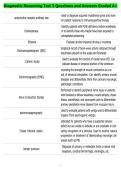
Used to diagnose acquired myasthenia gravis and moni-
acetycholine receptor antibody test
tor patient response to immunosuportive therapy
Identify patients with PChE deficiency before anesthesia
Cholinesterase or to identify those who maybe have been exposed to
phosphate poisoning
Ethanol Evaluate alcohol-impaired driving or overdose
Graphical record of brain-wave activity obtained through
Electroencephalogram (EEG)
electrodes placed on the scalp and forehead
Used to evaluate the function of cranial nerve VIII. Can
Caloric study
indicate disease in temporal portion of the cerebrum
recording the strength of muscle contraction as a re-
sult of electrical stimulation. Can identify primary muscle
Electromyography (EMG)
diseases and ditterentiate them from primary neurologic
pathologic conditions
Performed to identify peripheral nerve injury in patients
with localized or dittuse weakness, muscle atrophy, dyses-
Nerve Conduction Studies
thesia, paresthesia, and neurogenic pain to ditterentiate
primary peripheral nerve disease from muscular injury.
Used to evaluate patients with vertigo and to ditterentiate
electronystagmography
organic from psychogenic vertigo
Indicated for patients who have a suspected sensory
deficit but are unable to indicate or are unreliable in indi-
Evoked Potential studies cating recognition of a stimulus. Used to monitor natural
progression or treatment of deteriorating neurologic dis-
eases such as MS
Diagnosis of primary or metastatic brain or spinal cord
lumbar puncture
neoplasm, cerebral hemorrhage, meninigtis, etc.
1/4
Used to diagnose acquired myasthenia gravis and moni-
acetycholine receptor antibody test
tor patient response to immunosuportive therapy
Identify patients with PChE deficiency before anesthesia
Cholinesterase or to identify those who maybe have been exposed to
phosphate poisoning
Ethanol Evaluate alcohol-impaired driving or overdose
Graphical record of brain-wave activity obtained through
Electroencephalogram (EEG)
electrodes placed on the scalp and forehead
Used to evaluate the function of cranial nerve VIII. Can
Caloric study
indicate disease in temporal portion of the cerebrum
recording the strength of muscle contraction as a re-
sult of electrical stimulation. Can identify primary muscle
Electromyography (EMG)
diseases and ditterentiate them from primary neurologic
pathologic conditions
Performed to identify peripheral nerve injury in patients
with localized or dittuse weakness, muscle atrophy, dyses-
Nerve Conduction Studies
thesia, paresthesia, and neurogenic pain to ditterentiate
primary peripheral nerve disease from muscular injury.
Used to evaluate patients with vertigo and to ditterentiate
electronystagmography
organic from psychogenic vertigo
Indicated for patients who have a suspected sensory
deficit but are unable to indicate or are unreliable in indi-
Evoked Potential studies cating recognition of a stimulus. Used to monitor natural
progression or treatment of deteriorating neurologic dis-
eases such as MS
Diagnosis of primary or metastatic brain or spinal cord
lumbar puncture
neoplasm, cerebral hemorrhage, meninigtis, etc.
1/4