
GRADE 10 MATHEMATICS TERM 2
LINEAR FUNCTION
𝑦 = 𝑚𝑥 + 𝑞
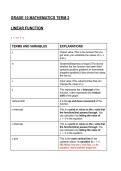
TERMS AND VARIABLES EXPLANATIONS
𝑦 Output value (This is the answer that you
get when you substitute the values of 𝑚, 𝑥
and 𝑞 .
𝑚 Gradient/Steepness of slope (This shows
whether the line function has been tilted
upwards (positive gradient) or downwards
(negative gradient),it also shows how steep
the line is).
𝑥 Input value (This value/number that can
change the value of 𝑦).
𝑞 This represents the 𝑦-intercept of the
function, it also represents the vertical
shift of the graph.
Vertical shift It is the up and down movement of the
function.
𝑦-intercept This is a point or value on the 𝑦-axis that
the function(line) passes through. You
can calculate it by letting the value of
𝑥 = 0 in the equation.
𝑥-intercept This is a point or value on the 𝑥-axis that
the function(line) passes through. You
can calculate it by letting the value of
𝑦 = 0 in the equation.
𝑦-axis This is the main vertical line in the
cartesian plane. Its equation is 𝑥 = 0.
NB:Notice how the 𝑦-axis has 𝑥 in its
equation, many learners forget this.
, 𝑥-axis This is the main horizontal line in the
cartesian plane. Its equation is 𝑦 = 0.
NB:Notice how the 𝑥-axis has 𝑦 in its
equation, many learners forget this.
Domain This is the complete set of all possible
input values (𝑥-values).
Range This is the complete set of all possible
output values (𝑦-values) that result from
substituting the domain values into the
function.
NB: You will find that in the equation 𝑦 = 𝑚𝑥 + 𝑞, instead of y you’ll see 𝑓(𝑥),𝑔(𝑥),
ℎ(𝑥) etc. All of those alternatives are just another name for writing 𝑦. These other
ways of writing 𝑦 help with naming functions to avoid confusion when many
functions are used. For example if you are given 𝑓(𝑥) = 2𝑥 + 1,it will be called
graph 𝑓 (or just 𝑓).if you are given 𝑔(𝑥) =− 2𝑥 + 1,it will be called graph 𝑔 (or just 𝑔
).
GRADIENT (𝑚)
The gradient of a line function can either increase (positive gradient) or decrease (negative
gradient). Now let's look at the linear function for 𝑓(𝑥) = 2𝑥 + 1.
LINEAR FUNCTION
𝑦 = 𝑚𝑥 + 𝑞
TERMS AND VARIABLES EXPLANATIONS
𝑦 Output value (This is the answer that you
get when you substitute the values of 𝑚, 𝑥
and 𝑞 .
𝑚 Gradient/Steepness of slope (This shows
whether the line function has been tilted
upwards (positive gradient) or downwards
(negative gradient),it also shows how steep
the line is).
𝑥 Input value (This value/number that can
change the value of 𝑦).
𝑞 This represents the 𝑦-intercept of the
function, it also represents the vertical
shift of the graph.
Vertical shift It is the up and down movement of the
function.
𝑦-intercept This is a point or value on the 𝑦-axis that
the function(line) passes through. You
can calculate it by letting the value of
𝑥 = 0 in the equation.
𝑥-intercept This is a point or value on the 𝑥-axis that
the function(line) passes through. You
can calculate it by letting the value of
𝑦 = 0 in the equation.
𝑦-axis This is the main vertical line in the
cartesian plane. Its equation is 𝑥 = 0.
NB:Notice how the 𝑦-axis has 𝑥 in its
equation, many learners forget this.
, 𝑥-axis This is the main horizontal line in the
cartesian plane. Its equation is 𝑦 = 0.
NB:Notice how the 𝑥-axis has 𝑦 in its
equation, many learners forget this.
Domain This is the complete set of all possible
input values (𝑥-values).
Range This is the complete set of all possible
output values (𝑦-values) that result from
substituting the domain values into the
function.
NB: You will find that in the equation 𝑦 = 𝑚𝑥 + 𝑞, instead of y you’ll see 𝑓(𝑥),𝑔(𝑥),
ℎ(𝑥) etc. All of those alternatives are just another name for writing 𝑦. These other
ways of writing 𝑦 help with naming functions to avoid confusion when many
functions are used. For example if you are given 𝑓(𝑥) = 2𝑥 + 1,it will be called
graph 𝑓 (or just 𝑓).if you are given 𝑔(𝑥) =− 2𝑥 + 1,it will be called graph 𝑔 (or just 𝑔
).
GRADIENT (𝑚)
The gradient of a line function can either increase (positive gradient) or decrease (negative
gradient). Now let's look at the linear function for 𝑓(𝑥) = 2𝑥 + 1.


