

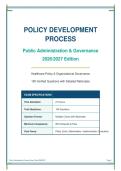
POLICY DEVELOPMENT
PROCESS
Public Administration & Governance
2026/2027 Edition
Healthcare Policy & Organizational Governance
100 Verified Questions with Detailed Rationales
EXAM SPECIFICATIONS
Time Allocation: 2.5 Hours
Total Questions: 100 Questions
Question Format: Multiple Choice with Rationales
Minimum Competency: 80% Required to Pass
Core Focus: Policy Cycle, Stakeholders, Implementation, Evaluation
Policy Development Process Exam Prep 2026/2027 Page 1
, Exam Overview & Content Outline
EXAM PURPOSE
This Policy Development Process Exam Prep evaluates knowledge of public administration,
healthcare policy formulation, implementation, and evaluation. Content covers policy cycle,
stakeholder analysis, regulatory frameworks, and organizational governance in healthcare settings.
CONTENT DISTRIBUTION
• Policy Formulation (25%) — Problem identification, agenda setting, policy design, evidence-based
policymaking
• Stakeholder Analysis & Engagement (20%) — Interest groups, public participation, advocacy,
lobbying, power dynamics
• Policy Implementation (25%) — Administrative rulemaking, budgeting, organizational change,
street-level bureaucracy
• Policy Evaluation (15%) — Outcome measures, cost-benefit analysis, impact assessment,
feedback loops
• Healthcare Governance (15%) — Regulatory compliance, accreditation, quality improvement,
institutional policy
QUESTION FORMAT & SCORING
Each item presents four options. Correct answers are highlighted in green with checkmark (✓).
Every question includes a detailed rationale. Achieve 80% competency to demonstrate mastery.
STUDY STRATEGY
Understand the full policy cycle from problem to evaluation. Apply frameworks to healthcare
scenarios. Use rationales to distinguish similar concepts like policy vs. procedure.
CURRICULUM ALIGNMENT
Questions reflect 2026/2027 standards: Kingdon's Multiple Streams, Advocacy Coalition Framework,
WHO policy guidelines, Joint Commission standards, and MPA core competencies.
Policy Development Process Exam Prep 2026/2027 Page 2
, SECTION I: Policy Formulation & Agenda Setting
1. The first stage of the policy process is typically:
A. Policy evaluation
✓ B. Problem identification and agenda setting
C. Implementation
D. Policy termination
Rationale: The policy cycle begins with identifying a problem and getting it onto the agenda. Evaluation
occurs after implementation. Termination is the final stage if policy is discontinued.
2. Kingdon's Multiple Streams Framework identifies which three streams that must converge
for policy change?
A. Legislative, Executive, Judicial
✓ B. Problem, Policy, Politics
C. Federal, State, Local
D. Economic, Social, Environmental
Rationale: Kingdon's model states that policy windows open when problem stream (issues recognized),
policy stream (solutions available), and politics stream (political will) converge.
3. A policy that is symbolic and lacks enforcement mechanisms is called:
A. Substantive policy
B. Procedural policy
✓ C. Symbolic policy
D. Regulatory policy
Rationale: Symbolic policies express values or intent but lack implementation resources or enforcement.
Substantive policies create tangible benefits/burdens. Procedural policies govern processes.
4. Evidence-based policymaking prioritizes:
A. Political ideology over data
✓ B. Research findings and data analysis in decision-making
C. Public opinion polls only
D. Lowest cost option regardless of outcomes
Rationale: EBP uses rigorous research, data, and evaluation to inform policy choices. While politics and cost
matter, evidence is the primary driver. Public opinion informs but doesn't replace evidence.
5. In healthcare, a clinical practice guideline issued by a professional association is an
example of:
A. Public policy
✓ B. Organizational policy
C. Federal law
D. Constitutional amendment
Policy Development Process Exam Prep 2026/2027 Page 3
PROCESS
Public Administration & Governance
2026/2027 Edition
Healthcare Policy & Organizational Governance
100 Verified Questions with Detailed Rationales
EXAM SPECIFICATIONS
Time Allocation: 2.5 Hours
Total Questions: 100 Questions
Question Format: Multiple Choice with Rationales
Minimum Competency: 80% Required to Pass
Core Focus: Policy Cycle, Stakeholders, Implementation, Evaluation
Policy Development Process Exam Prep 2026/2027 Page 1
, Exam Overview & Content Outline
EXAM PURPOSE
This Policy Development Process Exam Prep evaluates knowledge of public administration,
healthcare policy formulation, implementation, and evaluation. Content covers policy cycle,
stakeholder analysis, regulatory frameworks, and organizational governance in healthcare settings.
CONTENT DISTRIBUTION
• Policy Formulation (25%) — Problem identification, agenda setting, policy design, evidence-based
policymaking
• Stakeholder Analysis & Engagement (20%) — Interest groups, public participation, advocacy,
lobbying, power dynamics
• Policy Implementation (25%) — Administrative rulemaking, budgeting, organizational change,
street-level bureaucracy
• Policy Evaluation (15%) — Outcome measures, cost-benefit analysis, impact assessment,
feedback loops
• Healthcare Governance (15%) — Regulatory compliance, accreditation, quality improvement,
institutional policy
QUESTION FORMAT & SCORING
Each item presents four options. Correct answers are highlighted in green with checkmark (✓).
Every question includes a detailed rationale. Achieve 80% competency to demonstrate mastery.
STUDY STRATEGY
Understand the full policy cycle from problem to evaluation. Apply frameworks to healthcare
scenarios. Use rationales to distinguish similar concepts like policy vs. procedure.
CURRICULUM ALIGNMENT
Questions reflect 2026/2027 standards: Kingdon's Multiple Streams, Advocacy Coalition Framework,
WHO policy guidelines, Joint Commission standards, and MPA core competencies.
Policy Development Process Exam Prep 2026/2027 Page 2
, SECTION I: Policy Formulation & Agenda Setting
1. The first stage of the policy process is typically:
A. Policy evaluation
✓ B. Problem identification and agenda setting
C. Implementation
D. Policy termination
Rationale: The policy cycle begins with identifying a problem and getting it onto the agenda. Evaluation
occurs after implementation. Termination is the final stage if policy is discontinued.
2. Kingdon's Multiple Streams Framework identifies which three streams that must converge
for policy change?
A. Legislative, Executive, Judicial
✓ B. Problem, Policy, Politics
C. Federal, State, Local
D. Economic, Social, Environmental
Rationale: Kingdon's model states that policy windows open when problem stream (issues recognized),
policy stream (solutions available), and politics stream (political will) converge.
3. A policy that is symbolic and lacks enforcement mechanisms is called:
A. Substantive policy
B. Procedural policy
✓ C. Symbolic policy
D. Regulatory policy
Rationale: Symbolic policies express values or intent but lack implementation resources or enforcement.
Substantive policies create tangible benefits/burdens. Procedural policies govern processes.
4. Evidence-based policymaking prioritizes:
A. Political ideology over data
✓ B. Research findings and data analysis in decision-making
C. Public opinion polls only
D. Lowest cost option regardless of outcomes
Rationale: EBP uses rigorous research, data, and evaluation to inform policy choices. While politics and cost
matter, evidence is the primary driver. Public opinion informs but doesn't replace evidence.
5. In healthcare, a clinical practice guideline issued by a professional association is an
example of:
A. Public policy
✓ B. Organizational policy
C. Federal law
D. Constitutional amendment
Policy Development Process Exam Prep 2026/2027 Page 3


