

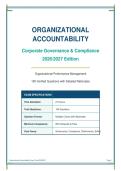
ORGANIZATIONAL
ACCOUNTABILITY
Corporate Governance & Compliance
2026/2027 Edition
Organizational Performance Management
100 Verified Questions with Detailed Rationales
EXAM SPECIFICATIONS
Time Allocation: 2.5 Hours
Total Questions: 100 Questions
Question Format: Multiple Choice with Rationales
Minimum Competency: 80% Required to Pass
Core Focus: Governance, Compliance, Performance, Ethics
Organizational Accountability Exam Prep 2026/2027 Page 1
, Exam Overview & Content Outline
EXAM PURPOSE
This Organizational Accountability Exam Prep evaluates knowledge of corporate governance,
regulatory compliance, performance management, and ethical leadership. Content aligns with COSO
framework, SOX requirements, and modern ESG standards.
CONTENT DISTRIBUTION
• Corporate Governance (25%) — Board responsibilities, fiduciary duty, stakeholder theory, agency
problems
• Compliance & Risk Management (25%) — Regulatory frameworks, internal controls, audit
functions, whistleblower protections
• Performance Management (20%) — KPIs, balanced scorecard, accountability metrics,
transparency reporting
• Ethical Leadership (15%) — Code of conduct, conflict of interest, ethical decision models, culture
of integrity
• Stakeholder Accountability (15%) — CSR, ESG reporting, social responsibility, public trust
QUESTION FORMAT & SCORING
Each item presents four options. Correct answers are highlighted in green with checkmark (✓).
Every question includes a detailed rationale. Achieve 80% competency to demonstrate mastery.
STUDY STRATEGY
Focus on applying frameworks to scenarios. Understand 'why' behind compliance requirements. Use
rationales to connect theory to practice.
CURRICULUM ALIGNMENT
Questions reflect 2026/2027 standards: COSO 2013, SOX 404, ISO 37001, GRI Standards, and
AICPA guidelines.
Organizational Accountability Exam Prep 2026/2027 Page 2
, SECTION I: Corporate Governance & Fiduciary Responsibility
1. The primary responsibility of a board of directors is to:
A. Manage daily operations
✓ B. Protect shareholder interests and provide oversight
C. Report directly to the CEO
D. Approve all employee hiring decisions
Rationale: Boards have fiduciary duty to shareholders, providing strategic oversight and accountability. They
don't manage daily operations (management's role) or report to the CEO. The board hires/fires the CEO, not
all employees.
2. Which component is NOT part of the COSO Internal Control Framework?
A. Control Environment
B. Risk Assessment
✓ C. Profit Maximization
D. Monitoring Activities
Rationale: COSO's five components are Control Environment, Risk Assessment, Control Activities,
Information & Communication, and Monitoring. Profit maximization is a business objective, not an internal
control component.
3. Sarbanes-Oxley Section 404 requires management to:
A. Certify financial statements personally
✓ B. Assess and report on internal control over financial reporting
C. Eliminate the audit committee
D. Outsource all accounting functions
Rationale: SOX 404 mandates management's assessment of ICFR effectiveness and auditor attestation.
Section 302 covers CEO/CFO certification. SOX strengthens audit committees and doesn't require
outsourcing.
4. Agency theory addresses the conflict between:
A. Employees and customers
✓ B. Principals (owners) and agents (managers)
C. Government and corporations
D. Suppliers and buyers
Rationale: Agency theory examines conflicts when principals delegate authority to agents whose interests
may not align. The board monitors management to reduce agency costs.
5. A 'tone at the top' refers to:
A. The CEO's speaking volume
✓ B. Ethical culture set by senior leadership
C. The organization's mission statement
Organizational Accountability Exam Prep 2026/2027 Page 3
ACCOUNTABILITY
Corporate Governance & Compliance
2026/2027 Edition
Organizational Performance Management
100 Verified Questions with Detailed Rationales
EXAM SPECIFICATIONS
Time Allocation: 2.5 Hours
Total Questions: 100 Questions
Question Format: Multiple Choice with Rationales
Minimum Competency: 80% Required to Pass
Core Focus: Governance, Compliance, Performance, Ethics
Organizational Accountability Exam Prep 2026/2027 Page 1
, Exam Overview & Content Outline
EXAM PURPOSE
This Organizational Accountability Exam Prep evaluates knowledge of corporate governance,
regulatory compliance, performance management, and ethical leadership. Content aligns with COSO
framework, SOX requirements, and modern ESG standards.
CONTENT DISTRIBUTION
• Corporate Governance (25%) — Board responsibilities, fiduciary duty, stakeholder theory, agency
problems
• Compliance & Risk Management (25%) — Regulatory frameworks, internal controls, audit
functions, whistleblower protections
• Performance Management (20%) — KPIs, balanced scorecard, accountability metrics,
transparency reporting
• Ethical Leadership (15%) — Code of conduct, conflict of interest, ethical decision models, culture
of integrity
• Stakeholder Accountability (15%) — CSR, ESG reporting, social responsibility, public trust
QUESTION FORMAT & SCORING
Each item presents four options. Correct answers are highlighted in green with checkmark (✓).
Every question includes a detailed rationale. Achieve 80% competency to demonstrate mastery.
STUDY STRATEGY
Focus on applying frameworks to scenarios. Understand 'why' behind compliance requirements. Use
rationales to connect theory to practice.
CURRICULUM ALIGNMENT
Questions reflect 2026/2027 standards: COSO 2013, SOX 404, ISO 37001, GRI Standards, and
AICPA guidelines.
Organizational Accountability Exam Prep 2026/2027 Page 2
, SECTION I: Corporate Governance & Fiduciary Responsibility
1. The primary responsibility of a board of directors is to:
A. Manage daily operations
✓ B. Protect shareholder interests and provide oversight
C. Report directly to the CEO
D. Approve all employee hiring decisions
Rationale: Boards have fiduciary duty to shareholders, providing strategic oversight and accountability. They
don't manage daily operations (management's role) or report to the CEO. The board hires/fires the CEO, not
all employees.
2. Which component is NOT part of the COSO Internal Control Framework?
A. Control Environment
B. Risk Assessment
✓ C. Profit Maximization
D. Monitoring Activities
Rationale: COSO's five components are Control Environment, Risk Assessment, Control Activities,
Information & Communication, and Monitoring. Profit maximization is a business objective, not an internal
control component.
3. Sarbanes-Oxley Section 404 requires management to:
A. Certify financial statements personally
✓ B. Assess and report on internal control over financial reporting
C. Eliminate the audit committee
D. Outsource all accounting functions
Rationale: SOX 404 mandates management's assessment of ICFR effectiveness and auditor attestation.
Section 302 covers CEO/CFO certification. SOX strengthens audit committees and doesn't require
outsourcing.
4. Agency theory addresses the conflict between:
A. Employees and customers
✓ B. Principals (owners) and agents (managers)
C. Government and corporations
D. Suppliers and buyers
Rationale: Agency theory examines conflicts when principals delegate authority to agents whose interests
may not align. The board monitors management to reduce agency costs.
5. A 'tone at the top' refers to:
A. The CEO's speaking volume
✓ B. Ethical culture set by senior leadership
C. The organization's mission statement
Organizational Accountability Exam Prep 2026/2027 Page 3


