

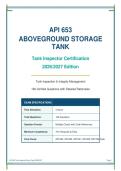
API 653
ABOVEGROUND STORAGE
TANK
Tank Inspector Certification
2026/2027 Edition
Tank Inspection & Integrity Management
100 Verified Questions with Detailed Rationales
EXAM SPECIFICATIONS
Time Allocation: 4 Hours
Total Questions: 100 Questions
Question Format: Multiple Choice with Code References
Minimum Competency: 70% Required to Pass
Core Focus: API 653, API 650, API 651, API 652, NDT Methods
API 653 Tank Inspector Exam Prep 2026/2027 Page 1
, Exam Overview & Content Outline
EXAM PURPOSE
This API 653 Aboveground Storage Tank Inspector Certification Exam Prep validates knowledge
required for inspection, repair, alteration, and reconstruction of aboveground storage tanks per API
Standard 653. Content covers tank integrity, NDT methods, calculations, and industry codes.
CONTENT DISTRIBUTION
• Inspection & Evaluation (30%) — API 653 inspection intervals, external/internal inspection,
degradation mechanisms, settlement evaluation
• Materials & Welding (20%) — API 650 materials, welding procedures, WPS/PQR, welder
qualification, NDT methods
• Tank Bottom & Foundation (15%) — Corrosion, API 651 cathodic protection, API 652 lining,
bottom repair, annular plate
• Shell & Roof Integrity (15%) — Shell thickness calculations, roof design, frangible roof,
wind/seismic loads
• Repairs, Alterations & Reconstruction (10%) — Hot taps, shell replacement, reconstruction
requirements, hydrotest
• Calculations & Code Compliance (10%) — Thickness, remaining life, MAWP, settlement,
inspector responsibilities
QUESTION FORMAT & SCORING
Each item presents four options. Correct answers are highlighted in green with checkmark (✓).
Every question includes detailed rationale with API 653/650/651/652 section references. Achieve
70% competency to pass.
STUDY STRATEGY
Master API 653 Section 4-6 inspection requirements. Practice thickness calculations and remaining
life formulas. Know NDT methods and acceptance criteria. Use rationales to understand code intent.
CURRICULUM ALIGNMENT
Questions reflect 2026/2027 API 653 5th Edition, API 650 13th Edition, API 651 4th Edition, API 652
5th Edition, and ASME Section V/VIII/IX standards.
API 653 Tank Inspector Exam Prep 2026/2027 Page 2
, SECTION I: Inspection Intervals & Degradation Mechanisms
1. Per API 653, the maximum interval between external inspections shall not exceed:
A. 1 year
✓ B. 5 years
C. 10 years
D. 20 years
Rationale: API 653 Section 6.3.2.1 requires external inspection at least every 5 years or at 1/4 corrosion rate
life, whichever is less. Internal inspection max is 10 years per 6.4.2.
2. The primary degradation mechanism for tank bottoms is:
A. Atmospheric corrosion
✓ B. Soil-side corrosion
C. Stress corrosion cracking
D. Erosion
Rationale: API 653 identifies soil-side corrosion as the primary bottom failure mechanism. Atmospheric
corrosion affects shell/roof. SCC and erosion are less common for bottoms.
3. API 653 requires internal inspection when:
A. Every 5 years regardless
✓ B. Corrosion rate indicates 10-year interval or less
C. Only after leak detection
D. At owner discretion only
Rationale: API 653 6.4.2 mandates internal inspection when remaining life ≤10 years based on corrosion
rate. 5 years is external interval. Leak detection triggers inspection but isn't the interval basis.
4. A tank with settlement greater than allowable limits per API 653 requires:
A. Immediate decommissioning
✓ B. Engineering evaluation for continued service
C. No action if no leaks
D. Hydrotest only
Rationale: API 653 Section 12 requires engineering assessment when settlement exceeds B.3 limits.
Decommissioning isn't automatic. Evaluation determines repair/re-rating needs.
5. Which NDT method is most effective for detecting tank bottom corrosion without entry?
A. Visual testing
✓ B. Magnetic flux leakage (MFL)
C. Dye penetrant
D. Radiographic testing
Rationale: MFL scans tank floors from topside detecting corrosion pitting. VT requires entry. PT and RT
aren't practical for full bottom scanning. MFL per API 653 6.4.3.
API 653 Tank Inspector Exam Prep 2026/2027 Page 3
ABOVEGROUND STORAGE
TANK
Tank Inspector Certification
2026/2027 Edition
Tank Inspection & Integrity Management
100 Verified Questions with Detailed Rationales
EXAM SPECIFICATIONS
Time Allocation: 4 Hours
Total Questions: 100 Questions
Question Format: Multiple Choice with Code References
Minimum Competency: 70% Required to Pass
Core Focus: API 653, API 650, API 651, API 652, NDT Methods
API 653 Tank Inspector Exam Prep 2026/2027 Page 1
, Exam Overview & Content Outline
EXAM PURPOSE
This API 653 Aboveground Storage Tank Inspector Certification Exam Prep validates knowledge
required for inspection, repair, alteration, and reconstruction of aboveground storage tanks per API
Standard 653. Content covers tank integrity, NDT methods, calculations, and industry codes.
CONTENT DISTRIBUTION
• Inspection & Evaluation (30%) — API 653 inspection intervals, external/internal inspection,
degradation mechanisms, settlement evaluation
• Materials & Welding (20%) — API 650 materials, welding procedures, WPS/PQR, welder
qualification, NDT methods
• Tank Bottom & Foundation (15%) — Corrosion, API 651 cathodic protection, API 652 lining,
bottom repair, annular plate
• Shell & Roof Integrity (15%) — Shell thickness calculations, roof design, frangible roof,
wind/seismic loads
• Repairs, Alterations & Reconstruction (10%) — Hot taps, shell replacement, reconstruction
requirements, hydrotest
• Calculations & Code Compliance (10%) — Thickness, remaining life, MAWP, settlement,
inspector responsibilities
QUESTION FORMAT & SCORING
Each item presents four options. Correct answers are highlighted in green with checkmark (✓).
Every question includes detailed rationale with API 653/650/651/652 section references. Achieve
70% competency to pass.
STUDY STRATEGY
Master API 653 Section 4-6 inspection requirements. Practice thickness calculations and remaining
life formulas. Know NDT methods and acceptance criteria. Use rationales to understand code intent.
CURRICULUM ALIGNMENT
Questions reflect 2026/2027 API 653 5th Edition, API 650 13th Edition, API 651 4th Edition, API 652
5th Edition, and ASME Section V/VIII/IX standards.
API 653 Tank Inspector Exam Prep 2026/2027 Page 2
, SECTION I: Inspection Intervals & Degradation Mechanisms
1. Per API 653, the maximum interval between external inspections shall not exceed:
A. 1 year
✓ B. 5 years
C. 10 years
D. 20 years
Rationale: API 653 Section 6.3.2.1 requires external inspection at least every 5 years or at 1/4 corrosion rate
life, whichever is less. Internal inspection max is 10 years per 6.4.2.
2. The primary degradation mechanism for tank bottoms is:
A. Atmospheric corrosion
✓ B. Soil-side corrosion
C. Stress corrosion cracking
D. Erosion
Rationale: API 653 identifies soil-side corrosion as the primary bottom failure mechanism. Atmospheric
corrosion affects shell/roof. SCC and erosion are less common for bottoms.
3. API 653 requires internal inspection when:
A. Every 5 years regardless
✓ B. Corrosion rate indicates 10-year interval or less
C. Only after leak detection
D. At owner discretion only
Rationale: API 653 6.4.2 mandates internal inspection when remaining life ≤10 years based on corrosion
rate. 5 years is external interval. Leak detection triggers inspection but isn't the interval basis.
4. A tank with settlement greater than allowable limits per API 653 requires:
A. Immediate decommissioning
✓ B. Engineering evaluation for continued service
C. No action if no leaks
D. Hydrotest only
Rationale: API 653 Section 12 requires engineering assessment when settlement exceeds B.3 limits.
Decommissioning isn't automatic. Evaluation determines repair/re-rating needs.
5. Which NDT method is most effective for detecting tank bottom corrosion without entry?
A. Visual testing
✓ B. Magnetic flux leakage (MFL)
C. Dye penetrant
D. Radiographic testing
Rationale: MFL scans tank floors from topside detecting corrosion pitting. VT requires entry. PT and RT
aren't practical for full bottom scanning. MFL per API 653 6.4.3.
API 653 Tank Inspector Exam Prep 2026/2027 Page 3


