

Elite Massachusetts Early Education and
Care (EEC) Director Certification Protocol
PART 0: THE NAVIGATOR
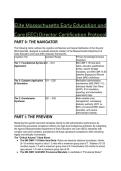
The following matrix outlines the cognitive architecture and topical distribution of the 30-point
MCQ Gauntlet, designed to evaluate absolute mastery of the Massachusetts Department of
Early Education and Care (EEC) statutory frameworks.
Cognitive Tier Question Range Primary Knowledge Domains
Assessed
Tier 1: Foundational Syntax & Q1 – Q10 606 CMR 7.10 hard-deck
Application ratios, educator qualifications
syntax, square footage
mandates, and 606 CMR 14.00
baseline Background Record
Check (BRC) definitions.
Tier 2: Complex Application Q11 – Q20 Medication administration
& Simulation mechanisms (606 CMR 7.11),
Individual Health Care Plans
(IHCP), 51A mandatory
reporting, and intermediate
supervision logic.
Tier 3: Grandmaster Q21 – Q30 Multi-variable crisis
Synthesis management, overlapping
statutory authority (DCF vs.
EEC), provisional BRC failure
cascades, and severe
administrative liability.
PART I: THE PREVIEW
Mastering this specific test bank translates directly to elite administrative performance by
transforming procedural compliance officers into high-level institutional architects. By integrating
the rigorous Massachusetts Department of Early Education and Care (EEC) standards with
complex real-world variables, practitioners will forge operational competence while remaining
legally and ethically invulnerable.
The "Critical Axioms" Cheat Sheet:
● The 606 CMR 7.10 Ratio Hard-Deck: Ratios are absolute statutory boundaries. Infants
(0–15 months) require a strict 1:3 ratio with a maximum group size of 7. Toddlers (15–33
months) require 1:4 with a maximum group size of 9. Preschoolers (33 months to school
age) require 1:10 with a maximum group size of 20.
● The 606 CMR 14.00 BRC Provisional Mandate: A candidate in "Provisional Status"
, must remain under the direct visual supervision of an EEC-approved employee who holds
a final suitability determination at all times.
● The 51A & EEC Dual-Reporting Axis: Mandated reporters must file an oral 51A report
immediately upon suspicion of abuse or neglect, followed by a written report to DCF
within 48 hours. Concurrently, EEC must be notified immediately by telephone of any
serious injury or death, followed by a written notice within 48 hours.
● The 606 CMR 7.11 Medication First-Dose Rule: An educator is strictly prohibited from
administering the first dose of any medication to a child, barring extraordinary
circumstances with explicit parental consent.
● The Spatial Axiom (606 CMR 7.07): Facilities must guarantee a minimum of 35 square
feet of approved indoor activity space per child and 75 square feet of outdoor play space
per child who is outside at any one time.
PART II: THE ELITE TEST BANK
Tier 1: Foundational Syntax & Application
Q1: A Massachusetts EEC-licensed center plans to open a new Infant room. The Director
intends to enroll the maximum allowable number of infants under standard fixed-age group
regulations. Based on the principles of 606 CMR 7.10, what is the MAXIMUM group size and
the corresponding educator-to-child ratio required for this specific room? A) Maximum group
size of 9, with a 1:4 ratio. B) Maximum group size of 7, with a 1:3 ratio, requiring one additional
educator if 4 to 7 infants are present. C) Maximum group size of 10, with a 1:5 ratio. D)
Maximum group size of 6, with a 1:3 ratio.
● The Answer: B (Maximum group size of 7, with a 1:3 ratio, requiring one additional
educator if 4 to 7 infants are present.)
● Distractor Analysis:
○ A is incorrect: This framework describes the Toddler (15 to 33 months) ratio and
maximum group size, not the Infant parameters, representing a dangerous
cross-application of developmental limits.
○ C is incorrect: This represents a severe hallucination of ratios; Massachusetts
maintains one of the strictest infant ratios in the United States to ensure rapid
evacuation capability and secure attachment dynamics.
○ D is incorrect: While 1:3 is the correct baseline ratio, the maximum group size for
infants (up to 15 months) in a full or half-day program is explicitly and statutorily
capped at 7, not 6.
The Mentor's Analysis: The architectural integrity of a center's financial and spatial planning
begins with the 606 CMR 7.10 Hard-Deck. The origin of this strict ratio is rooted in evacuation
physics and neurological attachment theory, ensuring that in the event of a catastrophic fire, two
educators can physically carry up to seven non-ambulatory infants out of the building. When
facing infant enrollment, the immediate priority is understanding the absolute biological cap of 7
infants per group. By utilizing the 1:3 / Max 7 metric, you bypass the common trap of
over-enrolling and triggering an immediate, uncorrectable licensing violation.
Professional/Academic Intuition: Infant environments are mathematically locked: a 1:3
baseline dictating that the exact moment a 4th infant crosses the threshold, a second
educator must be physically present.
, Age Cohort Regulatory Age Bracket Required Ratio Maximum Group Size
Infant Birth to 15 months 1:3 7
Toddler 15 months to 33 1:4 9
months
Preschool 33 months to School 1:10 20
Age
Q2: Under 606 CMR 7.07, an early childhood program must maintain specific square footage to
ensure physiological safety, infectious disease control, and developmental mobility. Which
calculation represents the ACCURATE statutory minimums for indoor activity space and outdoor
play space per child? A) 40 square feet indoor; 65 square feet outdoor. B) 35 square feet indoor;
75 square feet outdoor. C) 50 square feet indoor; 100 square feet outdoor. D) 35 square feet
indoor; outdoor space is heavily recommended but not statutorily required.
● The Answer: B (35 square feet indoor; 75 square feet outdoor.)
● Distractor Analysis:
○ A is incorrect: This calculation relies on outdated or out-of-state metrics;
Massachusetts law is highly specific to the 35/75 paradigm to mitigate respiratory
droplet transmission and allow gross motor development.
○ C is incorrect: While exceeding minimums is an operational best practice for
high-quality spatial design and premium tuition modeling, 50/100 is not the statutory
baseline required for legal licensure.
○ D is incorrect: Outdoor play space of at least 75 square feet per child is a strict,
non-negotiable regulatory requirement, not a mere pedagogical recommendation.
The Mentor's Analysis: Facility blueprinting relies on absolute spatial constraints dictated by
the state to control population density. The mechanism behind these numbers ensures that viral
load transmission is minimized indoors while gross motor velocity is safely accommodated
outdoors. When facing capacity planning, the immediate priority is calculating the usable,
unencumbered footprint. By utilizing the 35/75 Spatial Axiom, you bypass the common trap of
illegally including hallways, kitchens, or storage areas in your indoor capacity limits.
Professional/Academic Intuition: Square footage minimums are calculated strictly on
"approved activity space," meaning functional, accessible zones exclusively dedicated to
the child's active learning, devoid of structural encumbrances.
Q3: A candidate applies for a Lead Teacher position. EEC completes the preliminary screening
of their Background Record Check (BRC), and the candidate is officially placed in "Provisional
Status." According to 606 CMR 14.13, which operational parameter MUST be aggressively
enforced? A) The candidate may manage a classroom independently for up to 30 days while the
final BRC clears the state backlog. B) The candidate must remain under the direct visual
supervision of an EEC-approved employee with a "suitable" final determination at all times. C)
The candidate can work unsupervised during nap times or low-ratio periods, provided they do
not administer medication. D) The candidate must be paired with another Provisional Status
employee to mathematically maintain classroom ratios.
● The Answer: B (The candidate must remain under the direct visual supervision of an
EEC-approved employee with a "suitable" final determination at all times.)
● Distractor Analysis:
○ A is incorrect: Provisional hires are statutorily barred from unsupervised access to
children regardless of administrative delays or bureaucratic timeframes.
○ C is incorrect: This is a lethal novice compromise. Supervision is required for all
access, as predators or unqualified personnel pose a risk during vulnerable periods
Care (EEC) Director Certification Protocol
PART 0: THE NAVIGATOR
The following matrix outlines the cognitive architecture and topical distribution of the 30-point
MCQ Gauntlet, designed to evaluate absolute mastery of the Massachusetts Department of
Early Education and Care (EEC) statutory frameworks.
Cognitive Tier Question Range Primary Knowledge Domains
Assessed
Tier 1: Foundational Syntax & Q1 – Q10 606 CMR 7.10 hard-deck
Application ratios, educator qualifications
syntax, square footage
mandates, and 606 CMR 14.00
baseline Background Record
Check (BRC) definitions.
Tier 2: Complex Application Q11 – Q20 Medication administration
& Simulation mechanisms (606 CMR 7.11),
Individual Health Care Plans
(IHCP), 51A mandatory
reporting, and intermediate
supervision logic.
Tier 3: Grandmaster Q21 – Q30 Multi-variable crisis
Synthesis management, overlapping
statutory authority (DCF vs.
EEC), provisional BRC failure
cascades, and severe
administrative liability.
PART I: THE PREVIEW
Mastering this specific test bank translates directly to elite administrative performance by
transforming procedural compliance officers into high-level institutional architects. By integrating
the rigorous Massachusetts Department of Early Education and Care (EEC) standards with
complex real-world variables, practitioners will forge operational competence while remaining
legally and ethically invulnerable.
The "Critical Axioms" Cheat Sheet:
● The 606 CMR 7.10 Ratio Hard-Deck: Ratios are absolute statutory boundaries. Infants
(0–15 months) require a strict 1:3 ratio with a maximum group size of 7. Toddlers (15–33
months) require 1:4 with a maximum group size of 9. Preschoolers (33 months to school
age) require 1:10 with a maximum group size of 20.
● The 606 CMR 14.00 BRC Provisional Mandate: A candidate in "Provisional Status"
, must remain under the direct visual supervision of an EEC-approved employee who holds
a final suitability determination at all times.
● The 51A & EEC Dual-Reporting Axis: Mandated reporters must file an oral 51A report
immediately upon suspicion of abuse or neglect, followed by a written report to DCF
within 48 hours. Concurrently, EEC must be notified immediately by telephone of any
serious injury or death, followed by a written notice within 48 hours.
● The 606 CMR 7.11 Medication First-Dose Rule: An educator is strictly prohibited from
administering the first dose of any medication to a child, barring extraordinary
circumstances with explicit parental consent.
● The Spatial Axiom (606 CMR 7.07): Facilities must guarantee a minimum of 35 square
feet of approved indoor activity space per child and 75 square feet of outdoor play space
per child who is outside at any one time.
PART II: THE ELITE TEST BANK
Tier 1: Foundational Syntax & Application
Q1: A Massachusetts EEC-licensed center plans to open a new Infant room. The Director
intends to enroll the maximum allowable number of infants under standard fixed-age group
regulations. Based on the principles of 606 CMR 7.10, what is the MAXIMUM group size and
the corresponding educator-to-child ratio required for this specific room? A) Maximum group
size of 9, with a 1:4 ratio. B) Maximum group size of 7, with a 1:3 ratio, requiring one additional
educator if 4 to 7 infants are present. C) Maximum group size of 10, with a 1:5 ratio. D)
Maximum group size of 6, with a 1:3 ratio.
● The Answer: B (Maximum group size of 7, with a 1:3 ratio, requiring one additional
educator if 4 to 7 infants are present.)
● Distractor Analysis:
○ A is incorrect: This framework describes the Toddler (15 to 33 months) ratio and
maximum group size, not the Infant parameters, representing a dangerous
cross-application of developmental limits.
○ C is incorrect: This represents a severe hallucination of ratios; Massachusetts
maintains one of the strictest infant ratios in the United States to ensure rapid
evacuation capability and secure attachment dynamics.
○ D is incorrect: While 1:3 is the correct baseline ratio, the maximum group size for
infants (up to 15 months) in a full or half-day program is explicitly and statutorily
capped at 7, not 6.
The Mentor's Analysis: The architectural integrity of a center's financial and spatial planning
begins with the 606 CMR 7.10 Hard-Deck. The origin of this strict ratio is rooted in evacuation
physics and neurological attachment theory, ensuring that in the event of a catastrophic fire, two
educators can physically carry up to seven non-ambulatory infants out of the building. When
facing infant enrollment, the immediate priority is understanding the absolute biological cap of 7
infants per group. By utilizing the 1:3 / Max 7 metric, you bypass the common trap of
over-enrolling and triggering an immediate, uncorrectable licensing violation.
Professional/Academic Intuition: Infant environments are mathematically locked: a 1:3
baseline dictating that the exact moment a 4th infant crosses the threshold, a second
educator must be physically present.
, Age Cohort Regulatory Age Bracket Required Ratio Maximum Group Size
Infant Birth to 15 months 1:3 7
Toddler 15 months to 33 1:4 9
months
Preschool 33 months to School 1:10 20
Age
Q2: Under 606 CMR 7.07, an early childhood program must maintain specific square footage to
ensure physiological safety, infectious disease control, and developmental mobility. Which
calculation represents the ACCURATE statutory minimums for indoor activity space and outdoor
play space per child? A) 40 square feet indoor; 65 square feet outdoor. B) 35 square feet indoor;
75 square feet outdoor. C) 50 square feet indoor; 100 square feet outdoor. D) 35 square feet
indoor; outdoor space is heavily recommended but not statutorily required.
● The Answer: B (35 square feet indoor; 75 square feet outdoor.)
● Distractor Analysis:
○ A is incorrect: This calculation relies on outdated or out-of-state metrics;
Massachusetts law is highly specific to the 35/75 paradigm to mitigate respiratory
droplet transmission and allow gross motor development.
○ C is incorrect: While exceeding minimums is an operational best practice for
high-quality spatial design and premium tuition modeling, 50/100 is not the statutory
baseline required for legal licensure.
○ D is incorrect: Outdoor play space of at least 75 square feet per child is a strict,
non-negotiable regulatory requirement, not a mere pedagogical recommendation.
The Mentor's Analysis: Facility blueprinting relies on absolute spatial constraints dictated by
the state to control population density. The mechanism behind these numbers ensures that viral
load transmission is minimized indoors while gross motor velocity is safely accommodated
outdoors. When facing capacity planning, the immediate priority is calculating the usable,
unencumbered footprint. By utilizing the 35/75 Spatial Axiom, you bypass the common trap of
illegally including hallways, kitchens, or storage areas in your indoor capacity limits.
Professional/Academic Intuition: Square footage minimums are calculated strictly on
"approved activity space," meaning functional, accessible zones exclusively dedicated to
the child's active learning, devoid of structural encumbrances.
Q3: A candidate applies for a Lead Teacher position. EEC completes the preliminary screening
of their Background Record Check (BRC), and the candidate is officially placed in "Provisional
Status." According to 606 CMR 14.13, which operational parameter MUST be aggressively
enforced? A) The candidate may manage a classroom independently for up to 30 days while the
final BRC clears the state backlog. B) The candidate must remain under the direct visual
supervision of an EEC-approved employee with a "suitable" final determination at all times. C)
The candidate can work unsupervised during nap times or low-ratio periods, provided they do
not administer medication. D) The candidate must be paired with another Provisional Status
employee to mathematically maintain classroom ratios.
● The Answer: B (The candidate must remain under the direct visual supervision of an
EEC-approved employee with a "suitable" final determination at all times.)
● Distractor Analysis:
○ A is incorrect: Provisional hires are statutorily barred from unsupervised access to
children regardless of administrative delays or bureaucratic timeframes.
○ C is incorrect: This is a lethal novice compromise. Supervision is required for all
access, as predators or unqualified personnel pose a risk during vulnerable periods


