
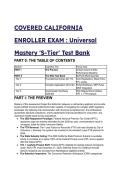
COVERED CALIFORNIA
ENROLLER EXAM : Universal
Mastery 'S-Tier' Test Bank
PART 0: THE TABLE OF CONTENTS
Section Cognitive Tier Focus Area
PART I The Preview Critical Axioms & Elite
Performance Baseline
PART II The Elite Test Bank 60-Point MCQ Gauntlet
- Tier 1 Foundational Syntax (Q1-15) Core Regulations, Metal Tiers,
FPL syntax
- Tier 2 Complex Application (Q16-35) Portal Workflows, SEP Rules,
CRW Integration
- Tier 3 Grandmaster Synthesis High-Stakes Reconciliation,
(Q36-60) H.R. 1, FTR Analysis
PART I: THE PREVIEW
Mastery of this assessment forged the distinction between a rudimentary applicant and an elite,
board-certified Covered California Enroller capable of navigating the complex 2026 regulatory
landscape. By replacing rote memorization with structural comprehension, the professional
guarantees absolute compliance, averts catastrophic financial penalties for consumers, and
maximizes health equity across populations.
● The 2026 Repayment Paradigm: Federal Advance Premium Tax Credit (APTC)
repayment caps are entirely eliminated for the 2026 tax year; overestimations result in
uncapped, dollar-for-dollar consumer liability.
● The FTR Reversal: The 1-year Failure to Reconcile (FTR) rule was blocked by City of
Columbus v. Kennedy; the system has reverted to the standard 2-year FTR protocol for
2026.
● The State Subsidy Ceiling: The 2026 California State Premium Subsidy is available
strictly to enrollees at or below 165% of the Federal Poverty Level (FPL) and is applied
after the federal APTC.
● H.R. 1 Lawfully Present Shift: Federal APTC eligibility for lawfully present immigrants
under 100% FPL ends December 31, 2025; Deferred Action for Childhood Arrivals
(DACA) recipients are excluded from Marketplace eligibility entirely.
● The Retention Imperative: The Consumer Retention Workspace (CRW) categorizes
, renewal risks; high-risk consumers require proactive down-tiering strategies to survive
2026 premium shocks.
PART II: THE ELITE TEST BANK
Tier 1 - Foundational Syntax & Application
Q1: An applicant completes the Certified Enrollment Counselor (CEC) training modules within
the Learning Management System (LMS). Based on Covered California certification rules, which
action is the FIRST strict requirement regarding the final examination? A) The applicant must
complete the exam with a passing score of 70% and submit an endorsement fee. B) The
applicant must pass the open-book exam with a score of 80% or greater within three attempts.
C) The applicant must complete the examination strictly without the use of study guides or
reference materials. D) The applicant must complete the exam within 90 days of LMS
enrollment to avoid forced re-registration.
● The Answer: B (The applicant must pass the open-book exam with a score of 80% or
greater within three attempts.)
● Distractor Analysis:
○ A is incorrect: The required passing score is 80%, not 70%, and CECs do not pay
an endorsement fee.
○ C is incorrect: The exam is explicitly designated as an open-book assessment.
○ D is incorrect: CECs have exactly 30 days, not 90 days, to complete their training
courses.
The Mentor's Analysis: Certification exams balance rigor with accessibility. The 80% threshold
establishes a baseline of competence, while the open-book format mimics real-world scenarios
where professionals consult official resources. By utilizing Official Study Guides, the scholar
bypasses the artificial constraint of rote memorization. Professional/Academic Intuition:
Certification validates resourcefulness as much as retention; mastery is located in the ability to
source accurate data efficiently.
Q2: A consumer applies for health coverage in November 2025 for the 2026 plan year. Based
on the 2026 Open Enrollment guidelines, what is the MOST ACCURATE timeline for standard
enrollment? A) November 1, 2025, through December 15, 2025. B) November 1, 2025, through
January 31, 2026. C) November 1, 2025, through December 31, 2026. D) October 15, 2025,
through January 15, 2026.
● The Answer: B (November 1, 2025, through January 31, 2026.)
● Distractor Analysis:
○ A is incorrect: This is the historical federal Marketplace deadline, not the standard
extended Covered California deadline for 2026.
○ C is incorrect: While future years (2027 onward) will shorten the deadline to
December 31, the 2026 plan year retains the January 31 deadline.
○ D is incorrect: This timeline reflects Medicare open enrollment parameters.
The Mentor's Analysis: California leverages extended enrollment windows to maximize
coverage equity. Despite federal pressures to shorten enrollment periods, the 2026 cycle
mandates a January 31 termination. By utilizing the State-Specific Timeline, the professional
prevents catastrophic coverage gaps for late applicants. Professional/Academic Intuition:
Jurisdictional timelines supersede federal defaults; always anchor deadlines to the specific state
exchange operational mandate.
,Q3: A consumer successfully enrolls in an Enhanced Silver 94 plan. Based on the 2026
Patient-Centered Benefit Design, what is the MOST ACCURATE required medical deductible
for this tier? A) $5,200 B) $1,400 C) $0 D) $50
● The Answer: C ($0)
● Distractor Analysis:
○ A is incorrect: $5,200 is the medical deductible for the standard Silver 70 and Silver
73 tiers.
○ B is incorrect: $1,400 is the medical deductible for the Enhanced Silver 87 tier.
○ D is incorrect: $50 represents the pharmacy deductible for Silver 73 and 87, not a
medical deductible.
The Mentor's Analysis: Enhanced Silver 94 plans are engineered to eliminate financial barriers
for the lowest-income cohorts (under 150% FPL). The complete removal of the medical
deductible ensures immediate access to care. By utilizing Enhanced Cost-Sharing Reductions
(CSR), the system bypasses the deterrence of upfront medical costs. Professional/Academic
Intuition: In Enhanced Silver 94, the barrier to entry is eliminated; the medical and pharmacy
deductibles are unequivocally zero.
Q4: A Certified Enrollment Counselor (CEC) is asked to assist a consumer who possesses an
active insurance agent license from the California Department of Insurance. Based on Covered
California eligibility rules, which conclusion is the MOST ACCURATE? A) The individual is
eligible to become a CEC provided they pass a Live Scan background check. B) The individual
is strictly prohibited from becoming a CEC while possessing an active insurance license. C) The
individual may serve as a CEC but cannot collect commissions on Covered California products.
D) The individual must pay an endorsement fee to function as a CEC.
● The Answer: B (The individual is strictly prohibited from becoming a CEC while
possessing an active insurance license.)
● Distractor Analysis:
○ A is incorrect: Background checks do not override the absolute prohibition against
dual licensing roles.
○ C is incorrect: Licensed agents must register as Certified Insurance Agents (CIA),
not CECs, regardless of commission structures.
○ D is incorrect: Endorsement fees are exclusively for CIAs.
The Mentor's Analysis: The architectural separation between Counselors and Agents prevents
conflicts of interest and regulatory overlap. Certified Counselors operate outside the commission
structure and cannot hold Department of Insurance licensing. By utilizing Strict Role Delineation,
the exchange ensures objective, unbiased consumer guidance. Professional/Academic
Intuition: Counselors educate; Agents solicit. A professional cannot simultaneously hold a state
insurance license and a Counselor certification.
Q5: An enroller is guiding a household with an income calculated at 145% of the Federal
Poverty Level (FPL). Based on 2026 regulations, which Enhanced Silver plan is the MOST
APPROPRIATE recommendation? A) Silver 73 B) Silver 87 C) Silver 94 D) Standard Silver 70
● The Answer: C (Silver 94)
● Distractor Analysis:
○ A is incorrect: Silver 73 is reserved for incomes between 200% and 250% FPL.
○ B is incorrect: Silver 87 is designated for incomes between 150% and 200% FPL.
○ D is incorrect: The standard Silver 70 lacks the enhanced cost-sharing reductions
legally afforded to a consumer at 145% FPL.
The Mentor's Analysis: Cost-Sharing Reductions (CSR) scale inversely with income. For
households beneath the 150% FPL threshold, the Silver 94 plan acts as the ultimate safety net,
, providing 94% actuarial value. By utilizing Precise FPL Mapping, the enroller ensures the
consumer accesses maximum statutory subsidies. Professional/Academic Intuition: Income
dictates the enhancement: <150% unlocks the 94 tier; 150-200% unlocks the 87 tier.
Q6: A consumer receives an IRS Form 1095-A for the 2025 tax year. The form displays data for
every month the consumer was enrolled. Variable: The consumer paid full price for their
premiums and never requested Advance Premium Tax Credits (APTC). Based on federal tax
reporting rules, which statement is MOST ACCURATE? A) The 1095-A form was generated in
error and should be discarded by the consumer. B) The 1095-A form is generated for all
enrolled months regardless of whether APTC was applied. C) The consumer must request a
Form 1095-B instead. D) The form proves the consumer committed tax fraud by receiving
unrequested subsidies.
● The Answer: B (The 1095-A form is generated for all enrolled months regardless of
whether APTC was applied.)
● Distractor Analysis:
○ A is incorrect: 1095-A generation is automatic and mandatory for Marketplace
coverage, not an error.
○ C is incorrect: Form 1095-B is issued by government agencies (e.g., Medi-Cal) or
off-exchange insurers, not the Marketplace.
○ D is incorrect: Receiving the form simply proves Minimum Essential Coverage
(MEC) existed; it does not indicate fraudulent subsidy receipt.
The Mentor's Analysis: Form 1095-A serves a dual purpose: it reconciles subsidies and
validates the existence of coverage. Even in the absence of APTC, the form is the definitive
legal proof of enrollment in a Qualified Health Plan. By utilizing the Universal Generation Rule,
the professional prevents consumer panic during tax season. Professional/Academic
Intuition: The 1095-A is tied to the existence of the policy, not the existence of the subsidy.
Q7: An individual applies to become a Plan-Based Enroller (PBE) but does not possess an
active CA Department of Insurance license. What is the FIRST mandatory action required to
achieve background clearance? A) Obtain a Captive Agent license immediately from the
Department of Insurance. B) Submit a Criminal Record Disclosure and complete a Live Scan
fingerprinting process. C) Pay an administrative waiver fee to Covered California. D) Provide
three professional letters of reference.
● The Answer: B (Submit a Criminal Record Disclosure and complete a Live Scan
fingerprinting process.)
● Distractor Analysis:
○ A is incorrect: While a PBE can choose to become a Captive Agent, it is not the
mandatory immediate step for background clearance.
○ C is incorrect: There is no waiver fee capable of overriding a statutory background
check.
○ D is incorrect: Reference letters are irrelevant to Department of Justice criminal
background protocols.
The Mentor's Analysis: Consumer Personally Identifiable Information (PII) is fiercely protected.
Unlicensed personnel lack the pre-existing regulatory oversight of the Department of Insurance,
necessitating an immediate, rigorous biometric and criminal review. By utilizing Live Scan
Biometrics, the exchange secures the data perimeter. Professional/Academic Intuition: No
license equals mandatory biometrics. Security vetting cannot be bypassed.
Q8: A consumer's household income drops, qualifying them for the California Premium Subsidy
Program in 2026. What is the MAXIMUM income limit, expressed as a percentage of the
Federal Poverty Level (FPL), to receive this specific state-funded subsidy? A) 138% FPL B)
ENROLLER EXAM : Universal
Mastery 'S-Tier' Test Bank
PART 0: THE TABLE OF CONTENTS
Section Cognitive Tier Focus Area
PART I The Preview Critical Axioms & Elite
Performance Baseline
PART II The Elite Test Bank 60-Point MCQ Gauntlet
- Tier 1 Foundational Syntax (Q1-15) Core Regulations, Metal Tiers,
FPL syntax
- Tier 2 Complex Application (Q16-35) Portal Workflows, SEP Rules,
CRW Integration
- Tier 3 Grandmaster Synthesis High-Stakes Reconciliation,
(Q36-60) H.R. 1, FTR Analysis
PART I: THE PREVIEW
Mastery of this assessment forged the distinction between a rudimentary applicant and an elite,
board-certified Covered California Enroller capable of navigating the complex 2026 regulatory
landscape. By replacing rote memorization with structural comprehension, the professional
guarantees absolute compliance, averts catastrophic financial penalties for consumers, and
maximizes health equity across populations.
● The 2026 Repayment Paradigm: Federal Advance Premium Tax Credit (APTC)
repayment caps are entirely eliminated for the 2026 tax year; overestimations result in
uncapped, dollar-for-dollar consumer liability.
● The FTR Reversal: The 1-year Failure to Reconcile (FTR) rule was blocked by City of
Columbus v. Kennedy; the system has reverted to the standard 2-year FTR protocol for
2026.
● The State Subsidy Ceiling: The 2026 California State Premium Subsidy is available
strictly to enrollees at or below 165% of the Federal Poverty Level (FPL) and is applied
after the federal APTC.
● H.R. 1 Lawfully Present Shift: Federal APTC eligibility for lawfully present immigrants
under 100% FPL ends December 31, 2025; Deferred Action for Childhood Arrivals
(DACA) recipients are excluded from Marketplace eligibility entirely.
● The Retention Imperative: The Consumer Retention Workspace (CRW) categorizes
, renewal risks; high-risk consumers require proactive down-tiering strategies to survive
2026 premium shocks.
PART II: THE ELITE TEST BANK
Tier 1 - Foundational Syntax & Application
Q1: An applicant completes the Certified Enrollment Counselor (CEC) training modules within
the Learning Management System (LMS). Based on Covered California certification rules, which
action is the FIRST strict requirement regarding the final examination? A) The applicant must
complete the exam with a passing score of 70% and submit an endorsement fee. B) The
applicant must pass the open-book exam with a score of 80% or greater within three attempts.
C) The applicant must complete the examination strictly without the use of study guides or
reference materials. D) The applicant must complete the exam within 90 days of LMS
enrollment to avoid forced re-registration.
● The Answer: B (The applicant must pass the open-book exam with a score of 80% or
greater within three attempts.)
● Distractor Analysis:
○ A is incorrect: The required passing score is 80%, not 70%, and CECs do not pay
an endorsement fee.
○ C is incorrect: The exam is explicitly designated as an open-book assessment.
○ D is incorrect: CECs have exactly 30 days, not 90 days, to complete their training
courses.
The Mentor's Analysis: Certification exams balance rigor with accessibility. The 80% threshold
establishes a baseline of competence, while the open-book format mimics real-world scenarios
where professionals consult official resources. By utilizing Official Study Guides, the scholar
bypasses the artificial constraint of rote memorization. Professional/Academic Intuition:
Certification validates resourcefulness as much as retention; mastery is located in the ability to
source accurate data efficiently.
Q2: A consumer applies for health coverage in November 2025 for the 2026 plan year. Based
on the 2026 Open Enrollment guidelines, what is the MOST ACCURATE timeline for standard
enrollment? A) November 1, 2025, through December 15, 2025. B) November 1, 2025, through
January 31, 2026. C) November 1, 2025, through December 31, 2026. D) October 15, 2025,
through January 15, 2026.
● The Answer: B (November 1, 2025, through January 31, 2026.)
● Distractor Analysis:
○ A is incorrect: This is the historical federal Marketplace deadline, not the standard
extended Covered California deadline for 2026.
○ C is incorrect: While future years (2027 onward) will shorten the deadline to
December 31, the 2026 plan year retains the January 31 deadline.
○ D is incorrect: This timeline reflects Medicare open enrollment parameters.
The Mentor's Analysis: California leverages extended enrollment windows to maximize
coverage equity. Despite federal pressures to shorten enrollment periods, the 2026 cycle
mandates a January 31 termination. By utilizing the State-Specific Timeline, the professional
prevents catastrophic coverage gaps for late applicants. Professional/Academic Intuition:
Jurisdictional timelines supersede federal defaults; always anchor deadlines to the specific state
exchange operational mandate.
,Q3: A consumer successfully enrolls in an Enhanced Silver 94 plan. Based on the 2026
Patient-Centered Benefit Design, what is the MOST ACCURATE required medical deductible
for this tier? A) $5,200 B) $1,400 C) $0 D) $50
● The Answer: C ($0)
● Distractor Analysis:
○ A is incorrect: $5,200 is the medical deductible for the standard Silver 70 and Silver
73 tiers.
○ B is incorrect: $1,400 is the medical deductible for the Enhanced Silver 87 tier.
○ D is incorrect: $50 represents the pharmacy deductible for Silver 73 and 87, not a
medical deductible.
The Mentor's Analysis: Enhanced Silver 94 plans are engineered to eliminate financial barriers
for the lowest-income cohorts (under 150% FPL). The complete removal of the medical
deductible ensures immediate access to care. By utilizing Enhanced Cost-Sharing Reductions
(CSR), the system bypasses the deterrence of upfront medical costs. Professional/Academic
Intuition: In Enhanced Silver 94, the barrier to entry is eliminated; the medical and pharmacy
deductibles are unequivocally zero.
Q4: A Certified Enrollment Counselor (CEC) is asked to assist a consumer who possesses an
active insurance agent license from the California Department of Insurance. Based on Covered
California eligibility rules, which conclusion is the MOST ACCURATE? A) The individual is
eligible to become a CEC provided they pass a Live Scan background check. B) The individual
is strictly prohibited from becoming a CEC while possessing an active insurance license. C) The
individual may serve as a CEC but cannot collect commissions on Covered California products.
D) The individual must pay an endorsement fee to function as a CEC.
● The Answer: B (The individual is strictly prohibited from becoming a CEC while
possessing an active insurance license.)
● Distractor Analysis:
○ A is incorrect: Background checks do not override the absolute prohibition against
dual licensing roles.
○ C is incorrect: Licensed agents must register as Certified Insurance Agents (CIA),
not CECs, regardless of commission structures.
○ D is incorrect: Endorsement fees are exclusively for CIAs.
The Mentor's Analysis: The architectural separation between Counselors and Agents prevents
conflicts of interest and regulatory overlap. Certified Counselors operate outside the commission
structure and cannot hold Department of Insurance licensing. By utilizing Strict Role Delineation,
the exchange ensures objective, unbiased consumer guidance. Professional/Academic
Intuition: Counselors educate; Agents solicit. A professional cannot simultaneously hold a state
insurance license and a Counselor certification.
Q5: An enroller is guiding a household with an income calculated at 145% of the Federal
Poverty Level (FPL). Based on 2026 regulations, which Enhanced Silver plan is the MOST
APPROPRIATE recommendation? A) Silver 73 B) Silver 87 C) Silver 94 D) Standard Silver 70
● The Answer: C (Silver 94)
● Distractor Analysis:
○ A is incorrect: Silver 73 is reserved for incomes between 200% and 250% FPL.
○ B is incorrect: Silver 87 is designated for incomes between 150% and 200% FPL.
○ D is incorrect: The standard Silver 70 lacks the enhanced cost-sharing reductions
legally afforded to a consumer at 145% FPL.
The Mentor's Analysis: Cost-Sharing Reductions (CSR) scale inversely with income. For
households beneath the 150% FPL threshold, the Silver 94 plan acts as the ultimate safety net,
, providing 94% actuarial value. By utilizing Precise FPL Mapping, the enroller ensures the
consumer accesses maximum statutory subsidies. Professional/Academic Intuition: Income
dictates the enhancement: <150% unlocks the 94 tier; 150-200% unlocks the 87 tier.
Q6: A consumer receives an IRS Form 1095-A for the 2025 tax year. The form displays data for
every month the consumer was enrolled. Variable: The consumer paid full price for their
premiums and never requested Advance Premium Tax Credits (APTC). Based on federal tax
reporting rules, which statement is MOST ACCURATE? A) The 1095-A form was generated in
error and should be discarded by the consumer. B) The 1095-A form is generated for all
enrolled months regardless of whether APTC was applied. C) The consumer must request a
Form 1095-B instead. D) The form proves the consumer committed tax fraud by receiving
unrequested subsidies.
● The Answer: B (The 1095-A form is generated for all enrolled months regardless of
whether APTC was applied.)
● Distractor Analysis:
○ A is incorrect: 1095-A generation is automatic and mandatory for Marketplace
coverage, not an error.
○ C is incorrect: Form 1095-B is issued by government agencies (e.g., Medi-Cal) or
off-exchange insurers, not the Marketplace.
○ D is incorrect: Receiving the form simply proves Minimum Essential Coverage
(MEC) existed; it does not indicate fraudulent subsidy receipt.
The Mentor's Analysis: Form 1095-A serves a dual purpose: it reconciles subsidies and
validates the existence of coverage. Even in the absence of APTC, the form is the definitive
legal proof of enrollment in a Qualified Health Plan. By utilizing the Universal Generation Rule,
the professional prevents consumer panic during tax season. Professional/Academic
Intuition: The 1095-A is tied to the existence of the policy, not the existence of the subsidy.
Q7: An individual applies to become a Plan-Based Enroller (PBE) but does not possess an
active CA Department of Insurance license. What is the FIRST mandatory action required to
achieve background clearance? A) Obtain a Captive Agent license immediately from the
Department of Insurance. B) Submit a Criminal Record Disclosure and complete a Live Scan
fingerprinting process. C) Pay an administrative waiver fee to Covered California. D) Provide
three professional letters of reference.
● The Answer: B (Submit a Criminal Record Disclosure and complete a Live Scan
fingerprinting process.)
● Distractor Analysis:
○ A is incorrect: While a PBE can choose to become a Captive Agent, it is not the
mandatory immediate step for background clearance.
○ C is incorrect: There is no waiver fee capable of overriding a statutory background
check.
○ D is incorrect: Reference letters are irrelevant to Department of Justice criminal
background protocols.
The Mentor's Analysis: Consumer Personally Identifiable Information (PII) is fiercely protected.
Unlicensed personnel lack the pre-existing regulatory oversight of the Department of Insurance,
necessitating an immediate, rigorous biometric and criminal review. By utilizing Live Scan
Biometrics, the exchange secures the data perimeter. Professional/Academic Intuition: No
license equals mandatory biometrics. Security vetting cannot be bypassed.
Q8: A consumer's household income drops, qualifying them for the California Premium Subsidy
Program in 2026. What is the MAXIMUM income limit, expressed as a percentage of the
Federal Poverty Level (FPL), to receive this specific state-funded subsidy? A) 138% FPL B)


