

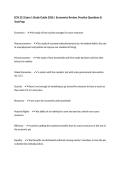
ECN 211 Exam 1 Study Guide 2026 | Economics Review, Practice Questions &
Test Prep
Economics - ✔✔the study of how society manages its scarce resources
Macroeconomics - ✔✔the study of economy-wide phenomena (ex. the federal deficit, the rate
of unemployment and policies to improve our standard of living)
Microeconomics - ✔✔the study of how households and firms make decisions and how they
interact in markets
Mixed Economies - ✔✔a system with free markets, but with some government intervention
(ex. U.S.)
Scarcity - ✔✔there is not enough of something to go around for everyone to have as much as
they want of it at a zero price
Resources - ✔✔are scarce for economies and households
Property Rights - ✔✔the ability of an individual to own and exercise control over scarce
resources
Efficiency - ✔✔society is getting the maximum benefits from its scarce resources or the size of
the economic pie
Equality - ✔✔that benefits are distributed uniformly among society's members or how the pie
is divided into individual slices
, Productivity - ✔✔the amount of goods and services produced from each unit of labor input
Incentives - ✔✔something that induces a person to act or change a behavior
Cost - ✔✔money, time, activities, etc. you give up
Opportunity Cost - ✔✔whatever you give up to get something else
Marginal Benefit - ✔✔the benefit/revenue of producing an item or of a choice
Marginal Thinking - ✔✔if the benefits of your choice outway the cost of it
Marginal Cost - ✔✔the cost of producing an item or of a choice
Trade-offs - ✔✔-"There ain't no such thing as a free lunch."
-To get more of one thing we have to give up something else
-Guns and butter (defense or social programs)
Trade-off between equality and efficiency - ✔✔taxes and welfare make us more equal but
reduce incentives for hard work, lowering total output
Trade-off between inflation and unemployment - ✔✔an increase in the quantity of money
stimulates spending, which raises both prices and production
The increase in production requires more hiring, which reduces unemployment.
an increase in inflation tends to reduce unemployment, causing a trade-off between inflation
and unemployment.
Test Prep
Economics - ✔✔the study of how society manages its scarce resources
Macroeconomics - ✔✔the study of economy-wide phenomena (ex. the federal deficit, the rate
of unemployment and policies to improve our standard of living)
Microeconomics - ✔✔the study of how households and firms make decisions and how they
interact in markets
Mixed Economies - ✔✔a system with free markets, but with some government intervention
(ex. U.S.)
Scarcity - ✔✔there is not enough of something to go around for everyone to have as much as
they want of it at a zero price
Resources - ✔✔are scarce for economies and households
Property Rights - ✔✔the ability of an individual to own and exercise control over scarce
resources
Efficiency - ✔✔society is getting the maximum benefits from its scarce resources or the size of
the economic pie
Equality - ✔✔that benefits are distributed uniformly among society's members or how the pie
is divided into individual slices
, Productivity - ✔✔the amount of goods and services produced from each unit of labor input
Incentives - ✔✔something that induces a person to act or change a behavior
Cost - ✔✔money, time, activities, etc. you give up
Opportunity Cost - ✔✔whatever you give up to get something else
Marginal Benefit - ✔✔the benefit/revenue of producing an item or of a choice
Marginal Thinking - ✔✔if the benefits of your choice outway the cost of it
Marginal Cost - ✔✔the cost of producing an item or of a choice
Trade-offs - ✔✔-"There ain't no such thing as a free lunch."
-To get more of one thing we have to give up something else
-Guns and butter (defense or social programs)
Trade-off between equality and efficiency - ✔✔taxes and welfare make us more equal but
reduce incentives for hard work, lowering total output
Trade-off between inflation and unemployment - ✔✔an increase in the quantity of money
stimulates spending, which raises both prices and production
The increase in production requires more hiring, which reduces unemployment.
an increase in inflation tends to reduce unemployment, causing a trade-off between inflation
and unemployment.


